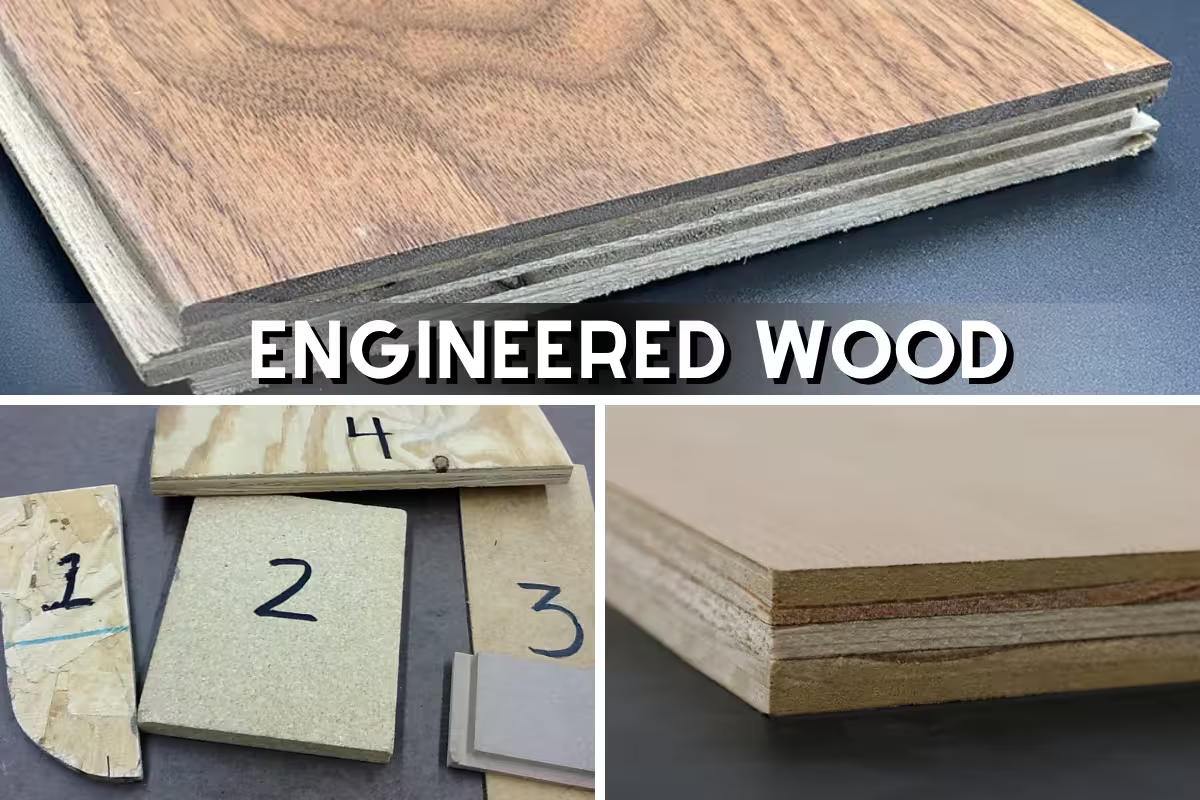


A 4×8 sheet of 3/4-inch plywood generally weighs 55–90 pounds: softwood panels commonly weigh 56–70 pounds, hardwood panels 68–86 pounds, and dense Baltic birch 80–90 pounds. Exact plywood weight changes with sheet size, actual thickness, core species, glue, coatings, and moisture.
Table of Contents
Plywood Weight at a Glance
For quick planning, use a range rather than one average. Two sheets carrying the same grade stamp can feel quite different: one may lift cleanly, while a damp sheet feels heavy at the lower edge and makes your fingers work harder to keep it upright.
3/4-Inch 4×8: 55–90 lb
A full 4×8 sheet has 32 square feet of area. The common plywood 3/4 weight range is 55–90 pounds, equal to roughly 1.7–2.8 pounds per square foot.
| 3/4-inch plywood type | Estimated 4×8 weight | Weight per square foot |
|---|---|---|
| Softwood | 56–70 lb | 1.75–2.19 lb/ft² |
| Hardwood veneer core | 68–86 lb | 2.13–2.69 lb/ft² |
| Baltic birch equivalent | 80–90 lb | 2.50–2.81 lb/ft² |
These figures assume an uncoated panel near its listed dimensions. Review the manufacturer’s data whenever exact load planning affects a vehicle, cabinet, boat, shipping quote, or lifting method.
1/2-Inch 4×8: 37–60 lb
How much does a sheet of half-inch plywood weigh? A 4×8 sheet normally weighs 37–60 pounds: about 37–47 pounds for softwood, 45–57 pounds for hardwood, and 53–60 pounds for dense birch.
The 1/2 plywood weight per square foot is about 1.16–1.88 pounds across those categories. Panels labeled 1/2 inch may measure 15/32 inch, which cuts calculated weight by about 6.3% compared with a true 0.500-inch sheet.
1/4-Inch 4×8: 19–30 lb
A 1/4-inch 4×8 sheet commonly weighs 19–30 pounds. Softwood panels fall near 19–23 pounds, hardwood near 23–29 pounds, and dense Baltic birch near 27–30 pounds.
Thin sheets feel lighter in the hands but can be awkward because they flex, flutter, and catch wind. A 7/32-inch panel contains 12.5% less volume than a true 1/4-inch panel of equal length and width.
Planning Ranges and Exact Weights
Use the low end for dry lightweight veneer cores and the high end for dense, coated, or moisture-exposed panels. The APA Resource Library explains panel standards and grade information, but a grade mark doesn’t assign one fixed sheet weight.
- Use the midpoint for an early material estimate.
- Use the high end for vehicle payload and manual-handling plans.
- Add pallet, wrapping, corner protection, and straps to shipping totals.
- Check the technical data sheet for the exact SKU.
- Weigh one representative sheet before calculating a large stack.
A bathroom scale can work for small panels, but full sheets need a platform scale or two-scale setup. Shipping weight may include cardboard and packaging, so don’t treat it as the bare panel mass.
3/4-Inch Plywood Weight by Type
How much does a sheet of 3/4 plywood weigh? A 4×8 panel weighs about 56–90 pounds, with the core construction producing much of the difference.
Softwood: 56–70 lb
A true 3/4-inch 4×8 panel occupies exactly 2 cubic feet: 4 × 8 × 0.75 ÷ 12. At a planning density of 28–35 pounds per cubic foot, the calculated softwood plywood weight is 56–70 pounds.
Construction sheathing often contains pine, fir, or mixed softwood veneers. Voids, repairs, species changes, and sanding cause sheet-to-sheet variation, so 64 pounds can be a useful midpoint but isn’t a universal answer.
Hardwood: 68–86 lb
A true 3/4-inch 4×8 hardwood veneer-core sheet usually weighs 68–86 pounds when estimated at 34–43 pounds per cubic foot. The upper end becomes noticeable while rotating a panel onto a table saw because the sheet resists the turn and loads the wrists.
“Hardwood plywood” may describe the face rather than every inner veneer. A decorative maple face over poplar can weigh less than a birch- or eucalyptus-core panel; see the guide to cabinet-grade plywood before assigning a density.
Baltic Birch: 80–90 lb
A true 3/4-inch 4×8-equivalent Baltic birch panel weighs roughly 80–90 pounds. Its numerous birch veneers, limited core voids, and 40–45-pound-per-cubic-foot planning density make it heavier than common softwood plywood.
Baltic birch plywood weight per square foot is about 2.50–2.81 pounds at a true 3/4 inch. Many sellers stock 5×5 metric sheets instead, so compare the actual dimensions in this Baltic birch guide before scaling a published weight.
Marine and Treated Plywood
Marine plywood can weigh more than basic sheathing because it may use denser veneers, more consistent cores, and water-resistant adhesive systems. “Marine” refers to manufacturing and veneer requirements, not one density; the marine plywood details explain those distinctions.
Recently pressure-treated plywood can be much heavier while wet. Don’t calculate a roof-rack load from a dry untreated sheet, and don’t seal a visibly wet panel into a cabinet where trapped moisture can cause movement or mold.
Nominal 3/4 vs 23/32
A nominal 3/4-inch construction panel may measure 23/32 inch, or 0.71875 inch. Its 4×8 volume is about 1.917 cubic feet, which is 4.17% below the 2-cubic-foot volume of a true 3/4-inch sheet.
At 32 pounds per cubic foot, that difference changes the estimate from 64 pounds to about 61.3 pounds. Measure the edge away from damaged corners with calipers, since sanding and allowed tolerances can move the reading.
18mm Baltic Birch
An 18mm panel is about 0.709 inch, not 0.750 inch. Across equal length and width, it contains about 5.5% less material than a true 3/4-inch panel.
A 4×8-equivalent 18mm birch sheet at 40–45 pounds per cubic foot calculates to about 75.6–85.0 pounds. Metric thickness, metric sheet size, and product construction must all match before comparing its weight with US nominal plywood.
Plywood Weight Chart by Thickness
The following plywood weight chart estimates full 4×8 sheets at true nominal thickness. It covers common softwood, hardwood veneer-core, and dense Baltic birch panels, but an exact SKU can fall outside these ranges.
Estimated 4×8 Weights
| Nominal thickness | True-thickness volume | Softwood | Hardwood | Baltic birch |
|---|---|---|---|---|
| 1/8 in | 0.333 ft³ | 9–12 lb | 11–14 lb | 13–15 lb |
| 1/4 in | 0.667 ft³ | 19–23 lb | 23–29 lb | 27–30 lb |
| 3/8 in | 1.000 ft³ | 28–35 lb | 34–43 lb | 40–45 lb |
| 1/2 in | 1.333 ft³ | 37–47 lb | 45–57 lb | 53–60 lb |
| 5/8 in | 1.667 ft³ | 47–58 lb | 57–72 lb | 67–75 lb |
| 3/4 in | 2.000 ft³ | 56–70 lb | 68–86 lb | 80–90 lb |
| 1 in | 2.667 ft³ | 75–93 lb | 91–115 lb | 107–120 lb |
These are calculated planning values, rounded to useful whole-pound ranges. Veneer-core, lumber-core, combination-core, MDF-core, and particleboard-core products shouldn’t share one density assumption.
1/8- to 3/8-Inch Panels
A 4×8 sheet ranges from about 9–15 pounds at 1/8 inch, 19–30 pounds at 1/4 inch, and 28–45 pounds at 3/8 inch. Thin panels often need two-point support during carrying because they bow and can split around a tight grip.
Small thickness errors have a large percentage effect here. A panel sold as 1/4 inch but measuring 0.205 inch contains 18% less material than a true 0.250-inch sheet, before accounting for density differences.
1/2-Inch Plywood Weight
A full 1/2-inch 4×8 sheet weighs approximately 37–60 pounds. Its square-foot weight is about 1.16–1.47 pounds for softwood, 1.41–1.78 pounds for hardwood, and 1.66–1.88 pounds for Baltic birch.
This thickness is deceptively awkward. The sheet is light enough to lift alone in many cases, yet flexible enough for the far edge to bounce, scrape a doorway, or pull the carrier off balance.
5/8- to 1-Inch Panels
Estimated 4×8 weights rise to 47–75 pounds at 5/8 inch, 56–90 pounds at 3/4 inch, and 75–120 pounds at 1 inch. At this point, panel type matters as much as nominal thickness.
One-inch plywood may be a special-order product or a nominal size with a different measured thickness. Dense core stock can exceed comfortable solo handling long before the sheet reaches the saw or workbench.
Weight Per Square Foot
Calculate plywood weight per square foot by multiplying thickness in feet by density in pounds per cubic foot. True 3/4-inch plywood at 32 lb/ft³ weighs 2.00 lb/ft²; at 42 lb/ft³, it weighs 2.625 lb/ft².
| Thickness and type | Estimated weight per square foot |
|---|---|
| 1/4-inch softwood | 0.58–0.73 lb/ft² |
| 1/2-inch softwood | 1.16–1.47 lb/ft² |
| 1/2-inch Baltic birch | 1.66–1.88 lb/ft² |
| 3/4-inch softwood | 1.75–2.19 lb/ft² |
| 3/4-inch hardwood | 2.13–2.69 lb/ft² |
| 3/4-inch Baltic birch | 2.50–2.81 lb/ft² |
Square-foot values make cabinet and wall calculations faster. Add the weights of hardware, edge banding, finish, fasteners, and solid-wood frames separately rather than hiding them inside the plywood estimate.
Nominal vs Actual Thickness
Common construction labels may correspond to 7/32, 15/32, 19/32, and 23/32 inch rather than exactly 1/4, 1/2, 5/8, and 3/4 inch. Product category and sanding affect actual panel thickness.
| Nominal label | Possible actual thickness | Volume reduction |
|---|---|---|
| 1/4 in | 7/32 in | 12.5% |
| 1/2 in | 15/32 in | 6.25% |
| 5/8 in | 19/32 in | 5.0% |
| 3/4 in | 23/32 in | 4.17% |
Use the panel’s measured edge or specification rather than assuming the label is exact. The broader plywood dimensions guide covers standard sheet sizes and nominal measurements.
Pounds and Kilograms
Convert plywood weight in pounds to kilograms by multiplying by 0.4536. Convert ply board weight in kg to pounds by multiplying by 2.2046.
| Weight in pounds | Weight in kilograms |
|---|---|
| 30 lb | 13.6 kg |
| 50 lb | 22.7 kg |
| 56 lb | 25.4 kg |
| 70 lb | 31.8 kg |
| 80 lb | 36.3 kg |
| 90 lb | 40.8 kg |
A 55–90-pound sheet is about 24.9–40.8 kilograms. Keep full precision during a multi-sheet calculation, then round the final result upward for transport planning.
Plywood Weight by Sheet Size
Plywood weight changes in direct proportion to area when thickness and construction stay the same. A 4×4 sheet weighs half as much as a matching 4×8 sheet, while a 2×4 sheet weighs one-quarter as much.
4×8 Sheet Weight
A 4×8 sheet covers 32 square feet. At a true 3/4 inch, its volume is 2 cubic feet; at a true 1/2 inch, the volume is 1.333 cubic feet.
Most US plywood weight searches assume this full-sheet format. Verify both dimensions because imported, craft, cabinet, and specialty stock may use 5×5, 4×10, or metric sizes.
4×4 and 2×4 Sheets
At 3/4 inch, a 4×4 sheet weighs about 28–35 pounds in softwood, 34–43 pounds in hardwood, or 40–45 pounds in dense birch. A matching 2×4 sheet weighs about 14–17.5, 17–21.5, or 20–22.5 pounds.
Precut panels cost more per square foot, but they can reduce delivery fees, waste, and handling risk. Check whether the seller’s stated dimensions are exact, since craft panels may be slightly undersized for packaging.
5×5 Baltic Birch Sheets
A 5×5 sheet covers 25 square feet, or 78.125% of a 4×8 sheet’s area. A true 3/4-inch birch panel at 40–45 lb/ft³ calculates to 62.5–70.3 pounds.
An 18mm 5×5 panel has about 1.477 cubic feet of volume and weighs roughly 59.1–66.5 pounds at the same density range. Scaling only by area would overstate that weight because 18mm is thinner than 3/4 inch.
Small Craft Panels
A 24×24 panel covers 4 square feet, one-eighth of a 4×8 sheet. A 12×12 panel covers one square foot, making its estimated weight equal to the material’s pounds-per-square-foot figure.
Small online panels may carry rounded thickness descriptions. Weighing a stack and dividing by the panel count often gives a cleaner reading than trying to measure one light sheet on a coarse household scale.
24×24 Baltic Birch Example
A 24×24-inch panel at 18mm thickness contains about 0.236 cubic feet. At 40–45 lb/ft³, its theoretical birch plywood weight is 9.4–10.6 pounds, excluding packaging.

Three Quarter Inch Baltic Birch Panel
- Three-quarter inch thick Baltic birch
- Large twenty-four inch square panel
- Eighteen millimeter material for weight planning
- B BB grade faces
- Ideal for sturdy shelves CNC and laser projects
 Buy on Amazon
Use the product’s listed bare-panel weight if supplied. A shipping figure can include a box, corner guards, film, and labels, which are a larger share of total weight for a small panel.
24×36 Baltic Birch Example
A 24×36-inch panel covers 6 square feet. At 12mm thickness, its volume is also about 0.236 cubic feet, producing an estimated weight of 9.4–10.6 pounds at 40–45 lb/ft³.

Half Inch Baltic Birch Sheet
- Half inch thick Baltic birch plywood
- Large twenty-four by thirty-six inch sheet
- Twelve millimeter material for weight estimates
- B BB grade wood faces
- Suitable for shelves CNC and laser cutting
Buy on Amazon
This panel and the 18mm 24×24 example have similar theoretical volume because the larger area offsets the thinner material. That comparison shows why dimensions and thickness must be calculated together.
How to Calculate Plywood Weight
Calculate plywood weight by multiplying panel volume by material density. Use a density range rather than a hidden single value, then report a minimum and maximum result.
Imperial Weight Formula
Weight in pounds = length in feet × width in feet × thickness in feet × density in lb/ft³.
Imperial plywood weight formula
When dimensions are in inches, use: weight = length × width × thickness × density ÷ 1,728. For a 48 × 96 × 0.75-inch sheet at 32 lb/ft³, the result is 64 pounds.
Keep all units consistent. A frequent beginner error is entering 0.75 as feet rather than inches, producing a result twelve times too high; convert 0.75 inch to 0.0625 foot first.
Metric Weight Formula
Weight in kilograms = length in meters × width in meters × thickness in meters × density in kg/m³.
Metric plywood weight formula
An 18mm panel measuring 1.525 × 1.525 meters at 680 kg/m³ weighs about 28.5 kilograms, or 62.8 pounds. Enter 18mm as 0.018 meter, not 18.
For quick density conversion, 30 lb/ft³ is about 481 kg/m³, 40 lb/ft³ about 641 kg/m³, and 45 lb/ft³ about 721 kg/m³.
Weight Per Square Foot
The formula is thickness in feet × density in lb/ft³. A true 1/2-inch sheet at 32 lb/ft³ weighs 1.333 lb/ft²; multiply that by the finished project area to estimate its plywood portion.
Cutouts reduce final weight, but saw kerfs, offcuts, and waste still matter during transport. Plan delivery from purchased sheet count, then calculate the finished assembly from its retained panel area.
Scaling Known Panel Weights
If material and thickness match, use: new weight = known weight × new area ÷ known area. A 4×4 panel weighs half the known weight of a matching 4×8 sheet.
If thickness changes too, multiply by both the area ratio and thickness ratio. Scaling a 3/4-inch 4×8 panel to an 18mm 5×5 panel requires 25 ÷ 32 for area and 18 ÷ 19.05 for thickness adjustment.
Calculator Inputs and Outputs
A useful plywood weight calculator should expose its assumptions. A result such as 64.0 pounds looks precise, but that precision is false if density, moisture, and thickness are only estimates.
- Enter length, width, and actual thickness.
- Select inches and pounds or metric units.
- Choose a plywood type or enter density.
- Add the number of sheets.
- Apply an optional moisture or planning allowance.
- Display pounds, kilograms, total volume, and weight per square foot.
- Show both the low and high density results.
For purchasing, compare the calculator with the SKU data sheet. For transport, round upward and include all cargo, including pallets, tools, tie-downs, passengers, and the trailer’s own weight where applicable.
Why Plywood Weight Varies
Plywood weight varies because wood density, core construction, adhesive, moisture, thickness tolerance, and surface treatments all change panel mass. The label alone doesn’t reveal every weight-producing component.
Wood Species and Density
Lightweight cores may fall near 22–28 lb/ft³, common softwood plywood near 28–35, hardwood veneer-core products near 34–43, and dense birch near 40–45. These are planning bands, not grade requirements.
Wood density varies within one species and with moisture. The USDA Wood Handbook documents wood properties and moisture relationships, while this site’s wood density guide gives further comparison context.
Core Construction
Veneer core uses cross-laminated wood veneers. Lumber core uses strips of solid wood, combination core mixes veneer with composite layers, and MDF- or particleboard-core panels use dense fiber material beneath decorative faces.
A dark hardwood face doesn’t prove that the whole sheet has a dense hardwood core. Ask for the core specification or inspect a clean edge; veneer layers appear distinct, while MDF looks fine and uniform with a dusty texture.
Plies and Adhesives
More plies don’t automatically mean more weight. Species, veneer thickness, void content, and adhesive quantity can outweigh the effect of ply count alone.
Dense multi-ply birch often feels solid when tapped, giving a short, hard sound rather than the hollower note of a voided core. Resin lines also add mass, though wood remains the larger component in most veneer-core sheets.
Faces and Coatings
Hardwood faces, high-pressure laminates, medium-density overlays, phenolic films, paint, and factory coatings add weight. A film-faced concrete-form panel shouldn’t inherit the estimate for unfinished sheathing.
Coatings may add little per square foot yet become meaningful across dozens of sheets. Include both faces, edge sealing, and any bonded laminate when estimating a finished cabinet or vehicle interior.
Moisture Content
Wet plywood weighs more because absorbed water adds mass. If the wood portion moves from 8% to 15% moisture content, its mass rises by about 6.5%, since 1.15 ÷ 1.08 equals 1.065.
Actual sheet change also depends on glue, coatings, and moisture distribution. A rain-soaked edge can feel cool and swollen while the center remains drier, so one moisture-meter reading doesn’t represent the entire panel.
Manufacturing Tolerances
Sanding, pressing, veneer variation, repairs, and allowed dimensional tolerances alter final mass. Round calculated results to useful ranges rather than presenting decimal-heavy certainty.
For a large order, weigh three to five sheets from different stack positions and average them. This catches variation from moisture exposure at the top or edges without requiring every panel to be weighed.
Density Reference Table
The following values are representative densities for weight estimates. Manufacturer technical data should replace them when available.
| Material | Planning density | Approximate metric density |
|---|---|---|
| Lightweight plywood | 22–28 lb/ft³ | 352–449 kg/m³ |
| Softwood plywood | 28–35 lb/ft³ | 449–561 kg/m³ |
| Hardwood veneer-core plywood | 34–43 lb/ft³ | 545–689 kg/m³ |
| Baltic birch plywood | 40–45 lb/ft³ | 641–721 kg/m³ |
| OSB | 38–42 lb/ft³ | 609–673 kg/m³ |
| MDF | 45–50 lb/ft³ | 721–801 kg/m³ |
| Particleboard | 40–50 lb/ft³ | 641–801 kg/m³ |
Lightweight species such as poplar and falcata can reduce mass, but “lightweight” isn’t a structural grade or strength promise. Consult the guide to the lightest wood species for related material choices.
Plywood vs Other Sheet Materials
At equal dimensions, common softwood plywood is often lighter than OSB, MDF, or particleboard. Dense birch and composite-core plywood can narrow or reverse that comparison.
Plywood vs OSB
A true 3/4-inch 4×8 OSB panel at 38–42 lb/ft³ theoretically weighs 76–84 pounds. That makes it heavier than many 56–70-pound softwood plywood sheets.
Actual OSB sheathing may measure 23/32 inch, so compare measured thickness and manufacturer data. Don’t substitute one product for another from weight alone; grade, span rating, fastening, and exposure classification still control its use.
Plywood vs MDF
A true 3/4-inch 4×8 MDF panel at 45–50 lb/ft³ weighs about 90–100 pounds. MDF’s fine, uniform interior gives it a steady heavy feel without the lighter voids found in some veneer cores.
MDF machines smoothly but produces very fine dust and can lose edge fastener grip under repeated stress. Its extra weight doesn’t prove greater bending strength or moisture resistance.
Plywood vs Particleboard
A true 3/4-inch 4×8 particleboard sheet at 40–50 lb/ft³ weighs about 80–100 pounds. Hardwood plywood with a particleboard core can be substantially heavier than a similar-looking veneer-core panel.
Particleboard offers a flat substrate for laminate, but damaged edges can crumble and wet areas may swell. Support it fully during transport rather than lifting a large sheet from one corner.
Weight vs Load Capacity
Panel weight isn’t capacity. Shelf strength depends on plywood grade, face-grain direction, span, width, support spacing, edge reinforcement, load shape, moisture, and acceptable deflection.
A lighter veneer-core panel may resist bending better than a heavier particleboard panel. For structural work, use span ratings, engineering data, and applicable building requirements rather than estimating strength from how heavy the sheet feels.
12mm Plywood Capacity Limits
There’s no single answer to how much weight 12mm plywood can hold. A short, fully supported panel may carry a substantial distributed load, while the same sheet spanning a wide gap can sag under a much smaller load.
- Confirm whether the load is concentrated or evenly distributed.
- Measure the unsupported span and panel width.
- Place the face-grain direction across the supports where the design permits.
- Check grade, defects, moisture exposure, and fastening.
- Add solid edging or a front rail to reduce shelf sag.
- Use engineering data for safety-related or structural loads.
Beginners often test a shelf by pressing on it and assume it will hold that load permanently. Wood panels creep under sustained weight, so a shelf that feels stiff today may develop a visible dip over months.
Multiple Sheets, Transport, and Handling
Multiply the per-sheet range by sheet count, then add packaging and other cargo. Transport plans should use the high estimate until an exact SKU weight has been confirmed.
Softwood Load Estimates
Using 56–70 pounds for each 3/4-inch softwood sheet, five sheets weigh 280–350 pounds and ten sheets weigh 560–700 pounds.
| Sheet count | Estimated softwood load |
|---|---|
| 5 | 280–350 lb |
| 10 | 560–700 lb |
| 20 | 1,120–1,400 lb |
| 50 | 2,800–3,500 lb |
A stack’s lower end can load one axle more than expected if it sits too far forward or rearward. Center the cargo according to the vehicle or trailer maker’s instructions rather than guessing from the bed’s open space.
Hardwood Load Estimates
Using 68–86 pounds per 3/4-inch hardwood sheet, five sheets weigh 340–430 pounds and ten weigh 680–860 pounds. Twenty sheets can reach 1,720 pounds before a pallet or wrapping is added.
| Sheet count | Estimated hardwood load |
|---|---|
| 5 | 340–430 lb |
| 10 | 680–860 lb |
| 20 | 1,360–1,720 lb |
| 50 | 3,400–4,300 lb |
Stack calculations become less forgiving as sheet count rises. A ten-pound per-sheet error becomes 500 pounds across 50 panels, which can alter freight class, equipment choice, or legal payload.
Vehicle and Trailer Payload
Payload isn’t the same as towing capacity. Subtract passengers, tools, racks, hitch load, and other cargo from the vehicle’s rated payload before assigning the remainder to plywood.
- Check the door-jamb payload label and owner’s manual.
- Stay within gross vehicle and axle ratings.
- Subtract the empty trailer weight from its gross trailer rating.
- Check the roof rack’s dynamic load limit, not its parked limit.
- Secure the front, rear, and sides against sliding and lift.
- Keep sheet edges from projecting into unsafe traffic space.
A roof rack may reach its limit with only two or three dense sheets. Large panels also create aerodynamic lift, so a lightweight panel can still become a serious road hazard if tied only through open windows.
Freight and Shipping Weight
Freight weight can include plywood, pallet, blocking, protective sheets, straps, and wrapping. Carriers may also apply oversize, lift-gate, residential-delivery, or minimum-shipment charges.
Small craft sheets often cost more per square foot yet cost less to ship and require no full-sheet cutting setup. “Free shipping” doesn’t mean panel weight has no effect; the seller may build handling and freight into the delivered price.
Safe Panel Handling
A full sheet is difficult because it combines weight with a large wind-catching surface. The OSHA ergonomics guidance doesn’t impose a universal 50-pound lifting maximum; task frequency, posture, grip, reach, and conditions all affect risk.
- Use a second person for sheets that exceed comfortable control.
- Move stacks with a sheet-goods cart or rated panel trolley.
- Use a panel carrier to keep one hand from bearing the whole edge.
- Wear gloves that improve grip without reducing finger control.
- Cut sheets into manageable sections when the project allows it.
- Delay outdoor carrying during strong or gusting wind.
Keep fingers away from the bottom edge when setting a sheet down. Plywood can pinch sharply, and a rough veneer edge can leave a long splinter before the carrier has time to release the panel.

Verifying Exact SKU Weight
For an exact plywood sheet weight, start with the manufacturer’s technical data, then confirm whether the figure describes a bare panel or packaged shipment. Match the SKU, dimensions, thickness, grade, core, and treatment.
If no weight is published, measure one dry representative panel on a platform scale. For a large stack, sample sheets from the top, middle, and edge, since storage moisture can create a meaningful spread.
Practical Notes From Real-World Use
Sheet handling often exposes a bad estimate before the scale does. A dense core feels planted and slow to rotate, while damp stock feels cool at the edge and may leave a faint moisture mark on gloves or a shop floor.
Never plan a solo lift from pounds alone. Door width, ceiling height, stairs, wind, slippery coatings, and the distance from the vehicle to the work area can make a 45-pound panel harder to control than a compact 80-pound object.
For shop work, place full sheets on a low rolling cart and bring the tool or cutting guide to the panel where possible. This avoids the common mistake of lifting 3/4-inch stock onto a high table, twisting under load, and letting the far corner crash onto the surface.
Use 55–90 pounds as the broad 4×8 3/4-inch plywood weight range, then narrow it by material and actual thickness. A scale or exact product sheet remains the best answer whenever payload, freight, structural dead load, or safe handling depends on a few pounds.
FAQs
How Much Does A 4×8 Sheet Of 3/4-Inch Plywood Weigh?
A standard 4×8 sheet of 3/4-inch plywood typically weighs 60 to 75 pounds. The exact weight depends on the wood species, glue type, veneer count, and moisture content. Hardwood plywood is often heavier than softwood construction plywood, so check the manufacturer’s product specifications when accurate lifting or shipping estimates matter.
How Much Does A Sheet Of 1/2-Inch Plywood Weigh?
A standard 4×8 sheet of 1/2-inch plywood usually weighs about 40 to 50 pounds. Softwood panels tend to fall near the lower end, while hardwood, marine, and specialty panels can weigh more. Always verify the listed panel weight if you need to transport several sheets or calculate structural loads.
How Much Does 3/4-Inch Plywood Weigh Per Square Foot?
3/4-inch plywood generally weighs about 1.9 to 2.3 pounds per square foot. A typical 32-square-foot, 4×8 panel therefore weighs roughly 60 to 75 pounds. Weight varies by plywood grade and core material, so use the manufacturer’s data sheet for precise project, trailer, or floor-load calculations.
Is Baltic Birch Plywood Heavier Than Regular Plywood?
Yes, Baltic birch plywood is usually heavier than regular softwood plywood of the same thickness. Its dense birch veneers and many solid core layers add strength and weight. This makes it popular for cabinets, jigs, and furniture, but it may require more support and effort to move than standard construction-grade panels.
Does Wet Plywood Weigh More?
Yes, wet plywood weighs more because the wood fibers absorb water. Even moderate moisture can add several pounds to a sheet, while heavily soaked plywood can become significantly heavier. Let wet plywood dry thoroughly and inspect it for swelling, delamination, or warping before using it in a project.
Affiliate Disclosure: Some links in this post are affiliate links. If you make a purchase through these links, we may earn a small commission at no extra cost to you. We only recommend products we genuinely believe in.