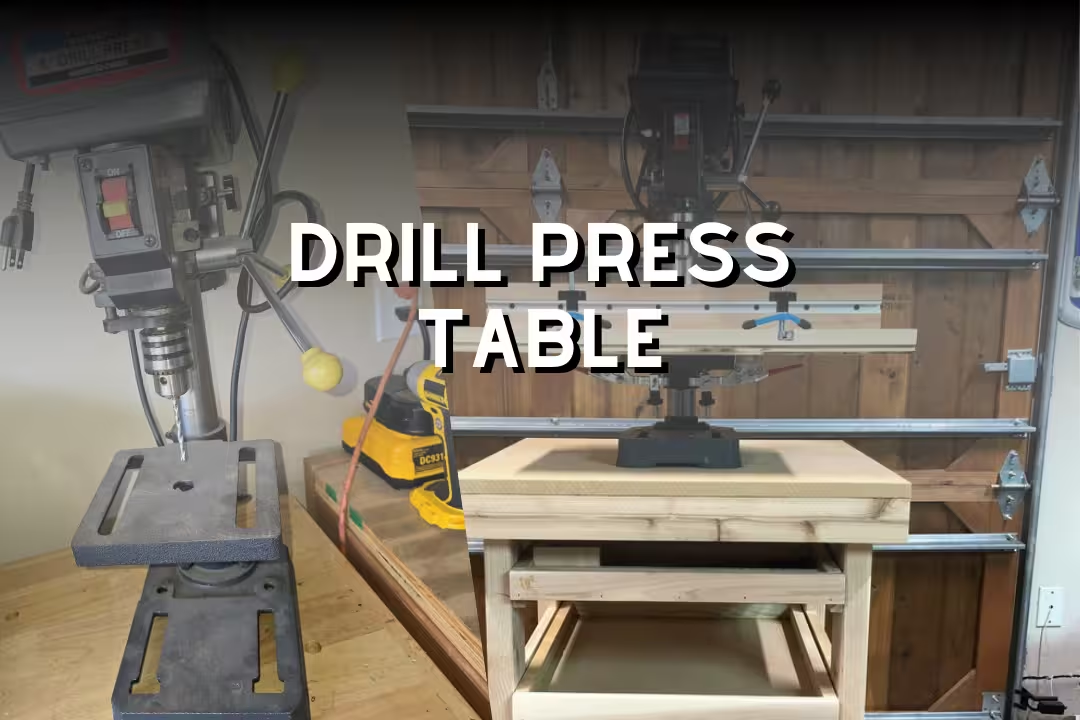

Floor Drill Press Buying Guide: Choose the Right Floor Standing Model

Table of Contents
A floor drill press is a stationary drilling machine with a tall column and a floor-mounted base for accurate, repeatable vertical holes. It gives more capacity, stability, and clearance than most benchtop models, so it suits woodworking, metalworking, repair work, and serious home shops.
If you’re comparing a floor standing drill press, focus on swing, motor power, low-speed range, quill travel, chuck quality, table support, and weight before you compare brand names. Those specs decide whether the machine feels smooth and controlled or chatters, stalls, and leaves oversized holes.
What Is a Floor Drill Press?
Quick definition
A floor drill press is a vertical drilling machine with a motor-driven spindle, adjustable table, tall support column, and wide base that stands directly on the shop floor. The bit moves straight down through the quill, which makes holes cleaner and more repeatable than hand drilling, especially when you need matching holes across several parts.
Typical capabilities
Most floor models fall between 13 and 20 inches of swing, use motors from about 1/2 HP to 1.5 HP, and offer speed ranges that may run from roughly 150 RPM to 4,000+ RPM. The larger machines also carry heavier cast iron tables, longer quill travel, wider chucks, and stronger columns that reduce the buzzing feel you get from lighter presses under load.
Best-fit users
A floor model drill press fits woodworkers, fabricators, farm repair shops, maintenance crews, schools, and garage builders who drill often enough to need repeatable depth and stable clamping. It’s also the right move when workpieces are too tall, too wide, or too awkward for a compact benchtop machine.
Common shop uses
Common jobs include drilling hinge cups, dowel holes, shelf-pin rows, steel brackets, aluminum plates, jig holes, countersinks, plugs, and clean Forstner-bit pockets. In wood, the sound is a steady shaving hiss; in steel, the right setup makes tight curled chips and a faint hot-oil smell from cutting fluid instead of blue smoke and squealing.
Floor Drill Press vs Benchtop
A floor drill press is better for large parts, deep holes, repetitive drilling, and heavier bits. A benchtop drill press is better for small shops, light repairs, and users who need a machine they can move without help; see our benchtop drill press guide if space is tight.
Floor press advantages
The main floor press advantage is working room: more throat depth, more vertical clearance, and a larger table area for fences, vises, and stops. The extra mass also matters; a 220 lb press feels calmer than a 75 lb benchtop model when a 2-inch Forstner bit starts cutting hard maple.
Floor press drawbacks
The trade-offs are space and handling. Floor presses can weigh 100 to 350+ lb, often need two people for assembly, and may require freight delivery, a liftgate, or a mobile base if the shop layout changes often.
Benchtop press advantages
A benchtop press wins on low cost, compact storage, and simple setup. It can work well for small wooden parts, electronics brackets, pen blanks, and occasional repairs if the bench is heavy enough to stop vibration.
Benchtop press limits
The limits show up as short clearance, smaller tables, lighter columns, and less torque with bigger bits. Beginners often blame the bit when holes wander, but the real cause is usually a springy bench, loose clamp setup, or quill play on a light machine.
Which should you buy
Buy a drill press floor standing model if you drill thick stock, use jigs, cut metal, or want a machine that stays set up. Buy a benchtop model if you drill small pieces a few times a month and can bolt the machine to a solid bench.
Choose the Right Size
Most home shops do best with a 15-inch to 17-inch floor drill press and a 3/4 HP motor. Professional users, production shops, and frequent metalworkers should look at 18-inch to 20-inch models with 1 HP to 1.5 HP motors.
13-inch floor drill press
A 13-inch floor drill press is the compact choice for small garages, light woodworking, craft fixtures, and occasional metal holes. It saves floor space, but the smaller throat and table can feel cramped when you add a vise, fence, or wide board.
15-inch floor drill press
A 15-inch floor drill press is the sweet spot for many home shops because it balances reach, price, and weight. Look for 3/4 HP, at least 3 inches of quill travel, and a table that locks firmly without dipping when you press the feed handle.
17-inch floor drill press
A 17-inch floor drill press gives more reach for cabinet parts, larger jigs, chair components, metal plates, and hole patterns away from an edge. This size often feels steadier because manufacturers pair the larger swing with a heavier base and column.
18- to 20-inch models
An 18- to 20-inch press makes sense for large workpieces, production drilling, and heavier steel or hardwood jobs. The downside is footprint: measure ceiling height, table swing, workpiece overhang, and the path needed to move the head assembly safely into place.
Home vs professional shops
A home shop should favor usable capacity, smooth speed changes, and clean depth stops over raw size. A professional shop should pay more for mass, low-speed torque, repeatability, and parts support because downtime costs more than the price gap between light and heavy machines.
Key Specs to Compare
The best floor drill press for your shop is the one whose specs match your material, bit size, and accuracy needs. Swing tells you reach, horsepower tells you load capacity, RPM tells you material fit, and weight often predicts how smooth the machine feels.
| Spec | What it means | Practical buying target |
|---|---|---|
| Swing | Twice the throat distance from spindle center to column | 15 to 17 inches for most shops |
| Motor power | How much load the press can handle without stalling | 3/4 HP general use; 1 HP+ for heavy work |
| Speed range | RPM options for wood, metal, plastics, and bit diameter | Below 300 RPM helps with larger steel bits |
| Quill travel | How far the spindle moves downward | 3 inches minimum; 4 to 6 inches for deep holes |
| Chuck capacity | Largest bit shank the chuck accepts | 5/8 inch for serious mixed work |
| Weight | Mass that reduces vibration and movement | 150 lb+ for steady shop use |
Swing and throat

Drill press swing is roughly twice the throat distance. A 15-inch machine usually has about 7.5 inches from spindle center to column, so it can drill to the center of a 15-inch round workpiece.
Motor power
Motor power matters most with large bits, hole saws, thick hardwood, and metal. A 3/4 HP press handles normal woodworking, while 1 HP to 1.5 HP gives better margin when feed pressure rises and chips get heavy.
Speed range
A wide speed range prevents burnt wood, ruined bits, and work-hardened steel. Belt-drive models are simple and reliable, but variable speed saves time when you move from a tiny pilot hole to a large Forstner bit or steel twist bit.
Quill travel
Quill travel is the downward spindle stroke. Short travel forces you to raise the table, reset the work, or drill from both sides; longer travel keeps deep holes straighter and makes repeated depth work less fussy.
Chuck capacity
Chuck capacity is only part of the accuracy story. A cheap chuck can add runout, which makes holes oversized and leaves a rough, oval feel at the exit side even when the bit itself is sharp.
Spindle taper
The spindle taper, often MT2 or MT3, affects chuck upgrades and tooling compatibility. MT3 appears more often on heavier machines, while MT2 is common on many general shop presses and still works well for woodworking and light metal.
Table and tilt
A good drill press table locks square, raises smoothly, and supports clamps without flexing; our guide to a better drill press table covers fences and work supports in more depth. Tilt is useful for angled holes, but always return the table to square with a machinist square instead of trusting the cast scale.
Weight and stability
Weight and stability affect surface finish, bit life, and operator control. If a press rocks slightly on an uneven concrete floor, shim or anchor it before blaming the spindle, because tiny movement at the base becomes visible runout at the bit tip.
Match Drill Press to Materials
A floor drill press for wood needs speed, table support, and clean depth control. A metalworking press needs low RPM, torque, rigidity, clamping, and cutting fluid; mixing those jobs calls for a machine with quick speed changes and enough mass to stay calm.
Woodworking drill press needs
A woodworking drill press should have a large table, easy height adjustment, a repeatable depth stop, and enough speed for small bits. Brad point bits leave crisp entry holes, while Forstner bits need firm feed pressure and slower speeds as diameter increases.
Metalworking drill press needs
A metalworking drill press needs low speed, high torque, a secure vise, sharp bits, and cutting fluid. Never hold steel by hand; if a bit catches, the work can spin like a dull propeller and bruise fingers before you can release the feed handle.
Mixed-use shop needs

A mixed-use shop should look for variable speed, 15- to 17-inch swing, 3/4 HP to 1 HP, and a table that accepts both woodworking fences and metal vises. Keep separate bit sets for wood and metal because a twist bit dulled on steel burns hardwood fibers instead of slicing them cleanly.
Drill press RPM basics
RPM selection follows two simple rules: larger bits run slower, and harder materials run slower. Safety programs such as the Princeton EHS drill press guidance also stress correct speed, clamping, and removing the chuck key before operation.
- Softwood with small twist bits: often 2,000 to 3,000+ RPM.
- Hardwood with medium bits: often 1,000 to 2,000 RPM.
- Forstner bits: often 500 to 1,500 RPM, depending on diameter.
- Mild steel with small bits: often 800 to 1,500 RPM.
- Mild steel with larger bits: often 300 to 700 RPM.
- Stainless steel: use lower speed, steady feed, and cutting fluid.
Bit speed safety
Bit speed safety comes down to heat control and chip shape. In steel, blue chips and squealing mean too much heat; in wood, dark rings and smoke mean the bit is rubbing, dull, or spinning too fast for its diameter.
Recommended Floor Drill Press Models
The best floor drill press depends on your bit size, material, floor space, and tolerance for manual belt changes. For metalworking, prioritize low-speed torque and rigidity over maximum RPM; for woodworking, table support, quill travel, and depth repeatability often matter more than horsepower alone.
Product comparison table
| Model | Capacity | Motor | Speed setup | Best use | Main limitation |
|---|---|---|---|---|---|
| JET 20 inch Smart Drill Press | 20 inch | 1.5 HP | Variable speed | Heavy-duty mixed shop work | Large footprint and premium cost |
| JET 20 inch Floor Drill Press | 20 inch | 1-1/2 HP | 12 speeds | Production-style drilling | Belt changes take time |
| Powermatic 18 inch Drill Press | 18 inch | 1 HP | Variable speed | Professional woodworking | Less capacity than 20-inch picks |
| JET 17 inch Floor Drill Press | 17 inch | 3/4 HP | 16 speeds | Balanced shop use | Not the first pick for repeated heavy steel |
| JET 15 inch Drill Press | 15 inch | 3/4 HP | 16 speeds | Home shop precision | Less throat depth than 17-inch models |
| Klutch 13 inch Drill Press | 13 inch | 3/4 HP | 16 speeds | Compact floor standing use | Smaller table and reach |
Heavy-duty 20-inch picks
A 20 inch floor drill press suits large workpieces, thick hardwood, bigger fixtures, and repeated shop drilling. The JET Smart model adds variable speed convenience, while the 12-speed JET 20-inch press gives strong power with a simpler pulley-based setup.
Professional 18-inch pick
The Powermatic floor drill press is the premium woodworking-style pick in this group, especially for shops that care about smooth feed, clean depth control, and fast speed adjustment. Its 18-inch capacity is large enough for furniture parts without taking as much room as a 20-inch industrial floor drill press.
Balanced 17-inch picks
A 17 inch floor drill press is often the best fit for a serious garage or woodworking shop. It gives more reach than a 15-inch press without the delivery, ceiling, and layout issues that come with the largest machines.
General-purpose 15-inch pick
The 15 inch floor drill press category works well for cabinetry, furniture jigs, basic metal brackets, and accurate everyday holes. If you want one press for a small shop, this size usually gives enough capacity without swallowing the corner where your planer, sander, or assembly cart needs to live.
Compact 13-inch pick
A compact floor standing drill press gives the stance of a floor machine with less reach and a smaller footprint. It’s a smart choice when a benchtop press feels too short but a 17-inch model is more machine than the room can handle.
Compare these floor drill press options by capacity, power, speed control, and the kind of work you drill most often.

JET 20 inch Smart Drill Press
- Smart controls for easier precision drilling
- Powerful 1.5 HP motor handles tough workloads
- Variable speed adjusts to different materials
- Large 20 inch capacity suits bigger projects
- Built for smooth, accurate shop performance
 Buy on Amazon

JET 20 inch Floor Drill Press
- 12 speed options for more drilling flexibility
- 1-1/2 HP motor delivers strong performance
- Large floor-standing design supports big jobs
- Built for accurate, consistent results
- Ideal for serious shop and production use
Buy on Amazon

Powermatic 18 inch Drill Press
- Variable speed setup handles varied materials
- 1 HP motor delivers confident cutting power
- Floor-standing frame supports larger workpieces
- Built for smooth, accurate drilling results
- Trusted choice for professional woodworking shops
Buy on Amazon

JET 17 inch Floor Drill Press
- 16 speed settings adapt to different materials
- 3/4 HP motor offers reliable drilling power
- Floor model provides stable operation
- Compact 17 inch size suits many shops
- Designed for accuracy and everyday use
Buy on Amazon
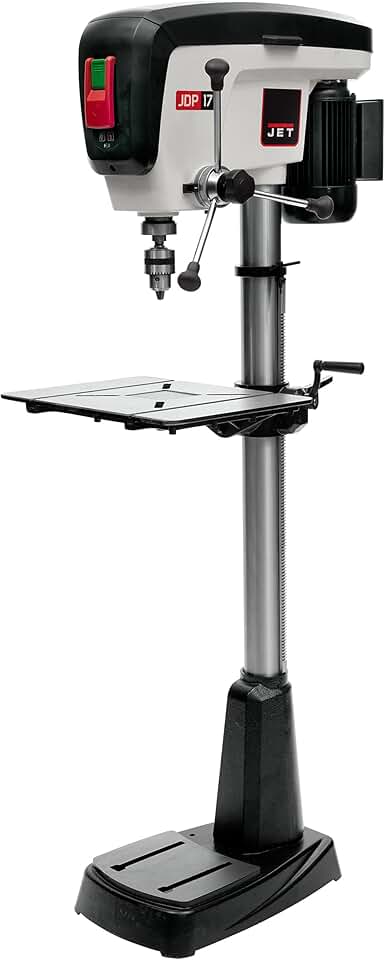
JET 17 inch Drill Press
- 16 speed range gives precise drilling control
- 3/4 HP motor suits workshop applications
- Floor design adds stability during use
- 17 inch capacity handles versatile projects
- Built for dependable performance and accuracy
Buy on Amazon

JET 15 inch Drill Press
- 16 speed settings for flexible drilling tasks
- 3/4 HP motor provides steady power
- Floor-standing design helps reduce vibration
- 15 inch capacity fits many shop needs
- Reliable choice for everyday precision work
Buy on Amazon

Klutch 13 inch Drill Press
- 16 speed settings for flexible drilling control
- 3/4 HP motor handles common shop tasks
- Floor-standing design offers solid support
- 13 inch capacity fits a range of projects
- Easy-to-use setup for home and workshop use
Buy on Amazon
Floor Drill Press Prices
A realistic floor drill press price runs from about $300 for light-duty models to $3,500+ for professional machines. Industrial geared-head presses can exceed $4,000, and freight, tooling, clamping, and setup gear can change the true cost more than beginners expect.
Entry-level models
Entry-level models usually cost $300 to $700 and offer 13- to 15-inch swing, 1/2 HP to 3/4 HP motors, and belt-driven speed changes. They work for occasional drilling, but expect more vibration, lighter tables, and less precise depth stops.
Mid-range models
Mid-range models often cost $700 to $1,500 and cover 15- to 17-inch swing with better tables, stronger motors, and 12 to 16 speeds or variable speed. This tier is where many garage woodworkers and mixed-material shops get the best value.
Professional models
Professional models commonly cost $1,500 to $3,500+ and may include 18- to 20-inch swing, 1 HP to 1.5 HP motors, heavier castings, smoother feed systems, and better speed control. They cost more, but they also stay accurate longer under repeated load.
Industrial models
Industrial models use heavier heads, gear drives, large columns, and controls meant for production or maintenance departments. They’re excellent for daily metal drilling, but they can be too slow, heavy, and expensive for a small woodworking shop.
Hidden ownership costs
Hidden costs include freight delivery, liftgate service, assembly help, a mobile base, hold-down clamps, drill press vise, better bits, cutting fluid, replacement belts, rust protection, and a chuck upgrade. A cheap press with poor clamping gear often performs worse than a smaller quality machine with a square table and solid vise.
Practical Notes From Real-World Use
Real shop use exposes problems that spec sheets hide. A press can list the right horsepower and swing, yet still feel poor if the table lock creeps, the belt slips under a hole saw, or the chuck has enough wobble to make a 1/4-inch hole feel loose around a bolt.
The fastest workaround is to test the basics before blaming the machine: square the table, set belt tension, check chuck seating on the taper, clamp the work, and drill a test hole at the correct speed. For small wood parts, a sacrificial backer board also removes the ragged exit tear-out that many new users mistake for bit runout.
One common beginner mistake is using the drill press like a milling machine. A floor model drill press handles vertical force, not side loading, so sideways cutting can loosen the chuck, damage bearings, and turn a safe setup into a grabby mess.
Setup, Safety, and Troubleshooting
Set up a floor drill press on a level surface, confirm the chuck is seated, square the table, set speed before cutting, and clamp every workpiece. The setup process affects safety and accuracy as much as the brand badge on the head casting.
This video gives a useful visual reference for drill press handling, setup thinking, and shop workflow.
Setup checklist
- Assemble the base, column, table, head, and motor using the manual.
- Use two people to lift the head assembly onto the column.
- Level the base and tighten the column bolts evenly.
- Install belts and set proper belt tension.
- Clean shipping grease from the table and column.
- Seat the chuck fully on the taper before drilling.
- Square the table to the spindle with a machinist square.
- Run the machine at low speed first and listen for belt slap or bearing noise.
Core safety rules
Core safety starts with eye protection, tied-back hair, no gloves near rotating bits, and removing the chuck key before startup. The OSHA machine guarding resource explains why guarding, safe workholding, and operator control matter around rotating machinery.
Workpiece safety
Workpiece safety means clamping wood, holding metal in a drill press vise, and supporting long panels so they don’t lever the table down. Round stock belongs in a V-block or vise, and thin sheet metal needs backing because it can catch, lift, and slice like a sharp lid.
Accuracy problems
Accuracy problems usually come from a dull bit, unsquared table, loose workpiece, excessive feed pressure, chuck runout, or quill play. For wood, use brad point bits and a backer board; for metal, center punch first, drill a pilot hole, clamp firmly, and step up in size.
Vibration and stalling
Vibration and stalling often trace back to wrong RPM, dull bits, loose belts, an uneven floor, or forcing the feed handle. If the motor slows and the belt chirps, reduce speed, sharpen or replace the bit, tighten the belts, and use pilot holes for large diameters.
Maintenance basics
Maintenance basics are simple: clean chips after each use, wax or protect cast iron, keep the column lightly lubricated, inspect belts, clean pulleys, check chuck jaws, and verify the return spring. For woodworking shops that also use machines like a spindle sander or planer, keep abrasive dust away from the drill press column because it turns smooth height adjustment into gritty scraping.
FAQs
What Size Floor Drill Press Do I Need For A Home Shop?
A 12- to 15-inch floor drill press is usually the best fit for a home shop. This size gives you enough capacity for most woodworking, DIY, and light metalworking tasks without taking up too much space. If you plan to work with larger stock or bigger drill bits, choose a model with more swing and table adjustment.
Is A Floor Drill Press Better Than A Benchtop Drill Press?
A floor drill press is better if you want more power, stability, and working height. It also handles larger projects more comfortably and usually offers greater depth capacity. A benchtop model is better for small shops, lighter tasks, or when you need a more compact and portable tool.
How Much Horsepower Does A Floor Drill Press Need?
Most home users do well with a floor drill press in the 1/2 to 3/4 horsepower range. That is enough for wood, plastics, and many metal drilling jobs. If you expect to drill larger holes, thicker metal, or use the press often, stepping up to 1 horsepower can give you smoother performance.
Can A Floor Drill Press Drill Through Metal?
Yes, a floor drill press can drill through metal when it is equipped with the right bit and speed setting. Use sharp metal-cutting bits, a secure clamp, and slower speeds for better results. For thicker steel, cutting fluid and steady pressure help extend bit life and improve accuracy.
Is Variable Speed Worth It On A Floor Drill Press?
Yes, variable speed is worth it for most users because it makes the drill press more versatile. Different materials and bit sizes need different speeds, and being able to adjust them improves safety and cut quality. It is especially helpful if you work with both wood and metal or use larger hole saws and bits.
Affiliate Disclosure: Some links in this post are affiliate links. If you make a purchase through these links, we may earn a small commission at no extra cost to you. We only recommend products we genuinely believe in.