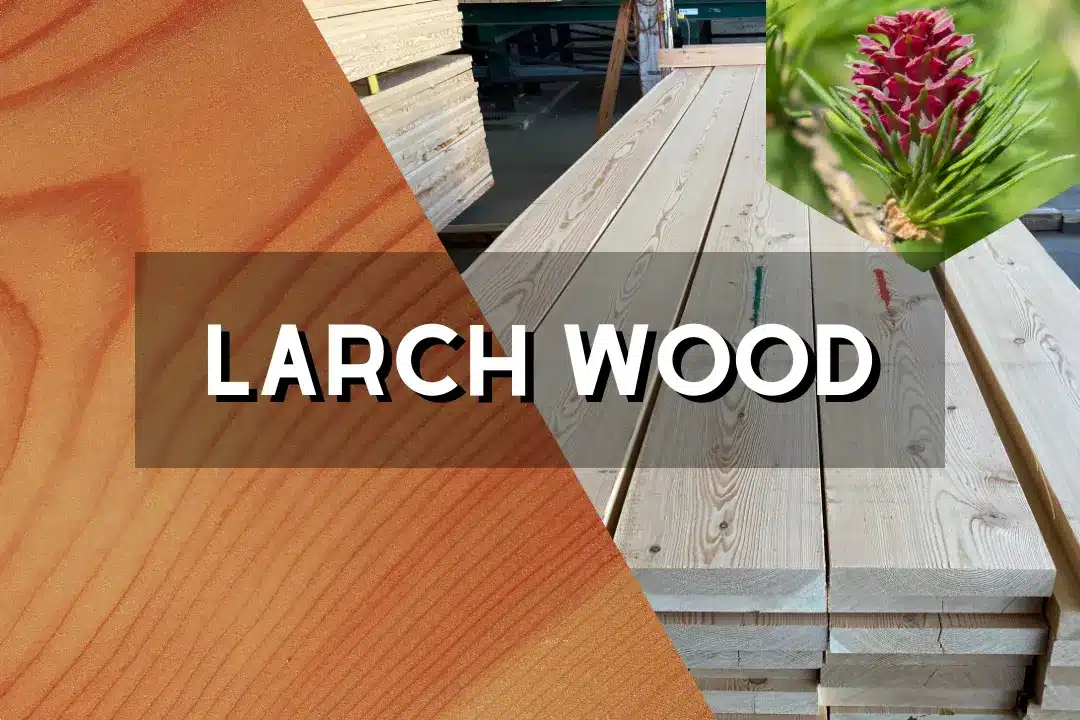

Larch wood is timber from deciduous conifers in the Larix genus. It is botanically a softwood, yet its useful strength, moderate natural durability, and warm reddish grain suit cladding, decking, flooring, joinery, and kitchenware.
Table of Contents
What Is Larch Wood?

Larch comes from roughly 10–14 recognized Larix species, with the count varying by botanical treatment and hybrid classification. Unlike most conifers, larches turn golden in autumn and shed their soft needles before winter.
Botanical Classification
The genus Larix belongs to the pine family, Pinaceae. Accepted names and natural distributions can be checked through Kew Plants of the World Online, which helps buyers separate true species from older trade names and forestry hybrids.
Deciduous conifer describes the tree’s biology rather than the timber’s performance. Larch still produces resinous softwood with distinct earlywood and latewood bands, but it drops its needles instead of retaining them through winter.
Hardwood or Softwood?
Larch is a botanical softwood because it comes from a conifer. Hardwood and softwood are plant classifications, not hardness ratings; larch can resist dents better than several lighter conifers described in our guide to soft wood.
Distribution and growth. Native and planted stands occur across central Europe, Russia, Siberia, Canada, the northern United States, western North American mountains, Japan, and northern Asia. Cold sites may produce narrow rings, but ring width alone doesn’t prove superior strength or durability; grade, density, defects, and heartwood content matter too.
Larch Species and Trade Names
Larch species differ in knot pattern, availability, growth rate, grading, and typical commercial use. A quotation that says only “larch” doesn’t identify enough information for exterior or structural specification.
European and Siberian Larch
European larch, Larix decidua, commonly has lively grain, reddish-brown heartwood, and visible knots. It appears in cladding, fencing, flooring, joinery, boat components, and utility construction, with plantation origin and grade strongly affecting appearance.
Siberian larch, Larix sibirica, is often sold as dense, narrow-ringed exterior stock. Buyers should verify legal origin, chain-of-custody documents, and import status because sanctions, trade restrictions, freight routes, and sourcing policies can affect supply.
Western, Japanese, Tamarack, and Hybrid Larch
Western larch, Larix occidentalis, is a large North American species used for structural lumber, plywood, flooring, poles, and joinery. Our detailed western larch guide covers its regional characteristics.
Japanese larch, Larix kaempferi, is widely planted for construction and fencing. Tamarack, Larix laricina, comes from northern North America, while hybrid larch, usually Larix × marschlinsii, combines European and Japanese parentage; the older name Larix × eurolepis still appears in specifications.
| Trade name | Botanical name | Typical character | Common uses |
|---|---|---|---|
| European larch | Larix decidua | Warm color, visible knots, variable grain | Cladding, flooring, fencing, joinery |
| Siberian larch | Larix sibirica | Often narrow-ringed and heartwood rich | Cladding, decking, façades |
| Western larch | Larix occidentalis | Strong regional structural timber | Lumber, veneer, poles, flooring |
| Japanese larch | Larix kaempferi | Plantation-grown, moderately knotty | Construction, fencing, cladding |
| Tamarack | Larix laricina | North American utility timber | Posts, poles, boats, outdoor work |
| Hybrid larch | Larix × marschlinsii | Fast-growing forestry hybrid | General timber and construction |
Species comparison rule: don’t transfer a density, durability class, or strength figure from one species to every board sold as larch. Ask for the botanical name, grading standard, moisture condition, origin, and declared end use.
Appearance and Technical Properties

Larch has pale sapwood, yellow-brown to reddish-brown heartwood, visible growth rings, and a medium texture. Its representative dry density is about 575 kg/m³, making it heavier and harder than many common construction softwoods.
Color, Grain, Texture, Knots, and Resin
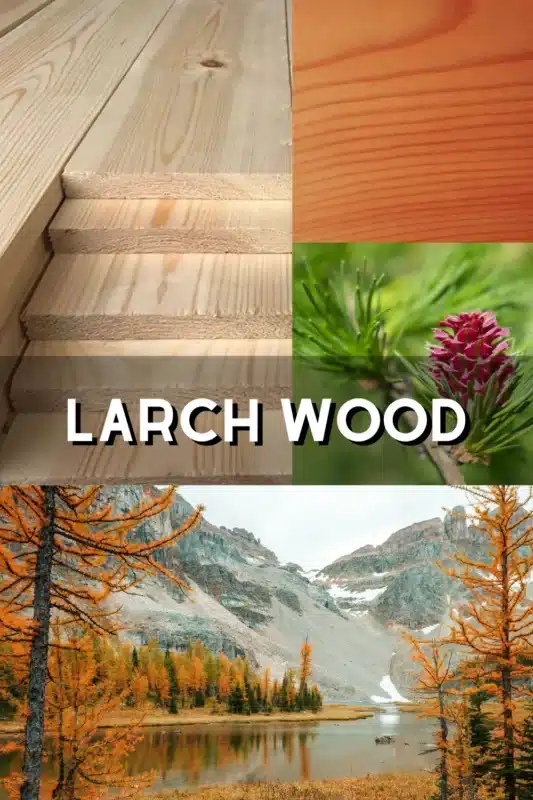
Heartwood color ranges from honey-orange to reddish brown, while the narrow sapwood is cream or pale yellow. Flatsawn faces display bold cathedral patterns; quartersawn faces show straighter stripes and usually behave more predictably across their width.
Freshly planed larch can smell sharp and resinous, and resin pockets may feel tacky under a fingertip. Knots create attractive contrast but can tear during routing, loosen after drying, or release sticky resin beneath dark finishes heated by direct sun.
Density, Hardness, Strength, Stiffness, and Movement
Representative European larch values include 575 kg/m³ dried density and 830 lbf Janka hardness. The European Larch reference data also reports about 90.3 MPa bending strength and 12.2 GPa modulus of elasticity.
Moderate hardness works for flooring and furniture, but grit, chair legs, dropped pans, and pet claws can still leave dents. Use protective pads and a wear-resistant floor finish rather than treating larch as a dent-proof hardwood substitute.
Shrinkage differs by grain direction: representative European larch values are 4.2% radial, 8.2% tangential, and 12.2% volumetric from green to oven dry. That near 2:1 tangential-to-radial relationship explains why wide flatsawn boards can cup during uneven wetting.
| Property | Representative European larch value | Practical meaning |
|---|---|---|
| Dry density | 575 kg/m³ / 36 lb/ft³ | Moderate weight with good wear resistance |
| Janka hardness | 830 lbf / 3,690 N | Hard for a softwood, but still dentable |
| Modulus of rupture | 90.3 MPa / 13,100 psi | Useful bending strength; grade still controls design |
| Modulus of elasticity | 12.2 GPa / 1.77 million psi | Relatively stiff for many joinery applications |
| Crushing strength | 50.9 MPa / 7,380 psi | Good compression performance along the grain |
| Radial shrinkage | 4.2% | Lower movement across quartersawn faces |
| Tangential shrinkage | 8.2% | Higher cupping risk in wide flatsawn stock |
Reference values vary with species, moisture content, growth location, individual tree, and test procedure. Structural work must use grade-specific engineering values for the supplied product rather than averages from a material guide.
Durability and Outdoor Performance

Larch wood is suitable for many above-ground outdoor uses, but it isn’t waterproof or rot-proof. Heartwood performs better than sapwood, while drainage, ventilation, end-grain protection, exposure, and fastener choice often decide the result.
Heartwood, Sapwood, and EN 350 Durability
Heartwood contains extractives that provide greater fungal resistance than pale sapwood. Boards carrying broad sapwood bands shouldn’t be treated as equal to heartwood-rich exterior stock, particularly near splash zones or other slow-drying details.
Under classifications based on EN 350, larch heartwood is commonly described around durability classes 3–4, meaning moderately to slightly durable, depending on species and source. The EN 350 standard description shows why classification must relate to biological agents and identified material.
Natural durability concerns biological attack; it doesn’t cover UV fading, checking, metal staining, distortion, or coating failure. Surface graying alone isn’t rot, but soft fibers, persistent dampness, deep cracks, or blackened wet zones need investigation.
Water, Ground Contact, Service Life, and Weathering
Larch absorbs water through faces and especially through exposed end grain. It performs best above ground where rain can drain and moving air can dry both sides; soil contact, freshwater immersion, blocked cavities, and horizontal water traps create much harsher exposure.
No single lifespan applies to all larch. Board thickness, species, heartwood percentage, climate, roof overhangs, fixing method, finish, and inspection schedule can change service life by decades, so unsupported “50-year” promises carry little specification value.
Untreated larch changes from orange-brown to silver-gray as sunlight breaks down surface lignin and rain removes the degraded fibers. Sheltered boards can stay brown while exposed sections turn gray, producing stripes beneath eaves and patchy areas around windows.
Exterior failure risks include trapped moisture, end-grain uptake, cupping, checks, resin bleed, and black marks from unsuitable metal. Use a drained rainscreen cavity, flash openings, preserve ground clearance, predrill near ends, and specify A2 or A4 stainless steel for the exposure.
Common Larch Wood Uses

Larch wood is used for cladding, decking, landscaping, flooring, furniture, joinery, structural products, boats, and cutting boards. Suitability changes with grade and exposure, so the same board shouldn’t be specified indiscriminately across every application.
Cladding, Decking, Landscaping, and Structural Uses
Larch cladding works best as a drained, ventilated rainscreen with a suitable membrane, battens, flashing, and stainless-steel fixings. Calculate quantity from effective cover width rather than overall board width, then allow for trimming, defect rejection, and profile-specific waste.
Decking benefits from larch’s moderate hardness, but wet algae can make the surface slippery and repeated moisture cycling can create raised splinters. Grooves don’t automatically improve drainage; poorly oriented grooves collect grit and stay damp after rain.
Landscape applications include fencing, pergolas, screens, and raised-bed boards. Keep above-ground boards separate from soil-contact posts, since treated pine or another use-class-rated material may perform better for buried structural members.
Beams, poles, veneer, plywood, and marine components also use larch. Historical boatbuilding proves its useful strength and workable grain, but it doesn’t establish suitability for every modern immersion condition, structural load, adhesive system, or building-code requirement.
Flooring, Furniture, Joinery, and Kitchenware
Larch flooring feels firm and slightly springy underfoot, with dark latewood lines giving the surface strong visual rhythm. Select dry stock, acclimate it to the room, and reject unstable boards before installation; finishing won’t correct moisture-driven cupping.
Furniture and joinery benefit from the warm color and pronounced grain. Resin pockets can weaken glue adhesion, while knots may chip during routing, so machine bonding faces shortly before assembly and test the adhesive on an offcut.
End-grain cutting boards let wood fibers separate slightly beneath a knife and close afterward, which can be gentler on blades than face grain. The surface doesn’t literally regenerate: knife marks, stains, warping, cracks, and failed glue joints remain possible.

Larch Wood One Hander Board
- Handcrafted larch wood board
- End grain design for daily chopping
- Compact 15 by 9-1/2 inch size
- Easy-to-manage one hander format
- Ideal for quick kitchen tasks
 Buy on Amazon
The compact 15-inch board is easier to lift, wash, and store, but it gives less room for separating ingredients. It suits quick prep better than carving large roasts or handling several vegetables at once.
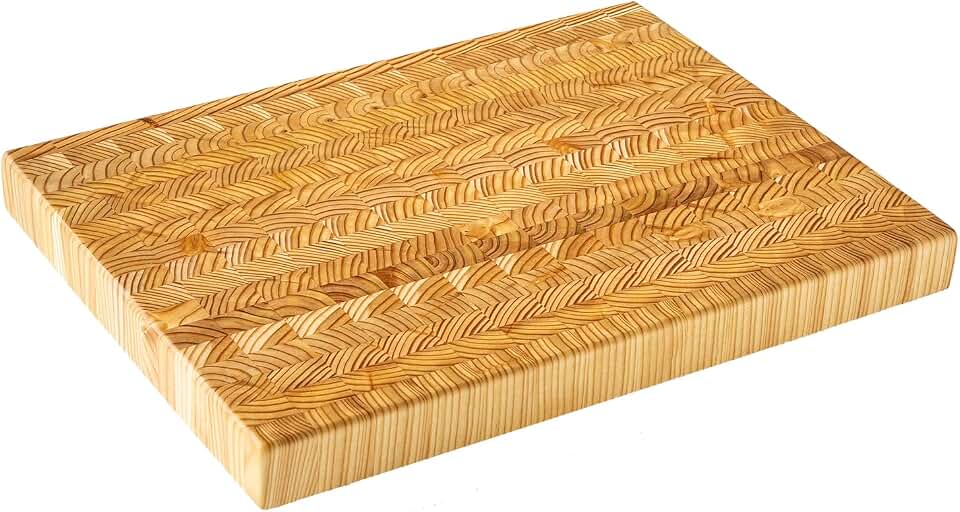
Larch Wood Medium End Grain Board
- Handcrafted larch wood construction
- End grain surface for everyday prep
- Medium 17-3/4 by 13-1/2 inch workspace
- Substantial 1-5/8 inch thickness
- Made for home cooks and chefs
Buy on Amazon
A 1-5/8-inch thickness adds useful mass and stability without occupying as much counter space as a large butcher block. Check sink width and drying space before purchase, since end-grain boards shouldn’t be left soaking in a basin.

Larch Wood Large End Grain Board
- Handcrafted larch wood construction
- End grain surface for serious prep
- Generous 21-5/8 by 13 inch workspace
- Thick 1-3/4 inch profile
- Built for home and professional kitchens
Buy on Amazon
The large preparation surface handles substantial batches, yet its size and 1-3/4-inch profile increase weight. Measure counter depth, cupboard clearance, and storage orientation before choosing it.
| Application | Suitability | Main condition |
|---|---|---|
| Ventilated cladding | Very good | Use heartwood-rich stock and a drained cavity |
| Decking | Good with care | Manage checking, drainage, algae, and splinters |
| Ground-contact posts | Limited | Use material rated for the applicable use class |
| Flooring | Good | Acclimate and apply a wear-resistant finish |
| Furniture and joinery | Good | Account for resin, knots, and movement |
| Structural timber | Product dependent | Use certified grade-specific design values |
| Cutting boards | Good when properly made | Require food-safe glue, finish, washing, and drying |
Larch Wood Advantages and Disadvantages
Larch combines useful strength, expressive grain, and moderate heartwood durability, but it can split, move, bleed resin, and weather unevenly. Its value depends more on grade and detailing than on the species name printed on an invoice.
Key Advantages
- Relatively dense and hard for a softwood.
- Warm orange-brown color with prominent growth rings.
- Heartwood has useful natural decay resistance.
- Suitable for interior and above-ground exterior applications.
- Can weather gray without a film coating.
- Accepts conventional machining with sharp tools.
- Available in several regional species and visual grades.
Design flexibility is a major benefit: clean vertical boards can produce a restrained façade, while knotty flatsawn stock creates a more rustic surface. Pigmented finishes retain color longer than clear oils because pigment blocks more UV radiation.
Main Limitations
- Sapwood has lower decay resistance than heartwood.
- Boards may check, cup, split, bow, or twist.
- Resin can interfere with adhesives and finishes.
- Knots may loosen or bleed in hot sunlight.
- Untreated faces can gray at different rates.
- Incorrect fasteners may corrode or leave black stains.
- Clear, stable, heartwood-rich grades can cost much more.
Beginner mistake: choosing wide, wet boards for a tightly fixed exterior surface. Use narrower conditioned stock, preserve specified expansion gaps, predrill near ends, and avoid overdriving screws into crushed pockets that retain water.
| Pros | Cons |
|---|---|
| Harder than many lightweight softwoods | Softer than many hardwood flooring species |
| Moderately durable heartwood | Less durable sapwood |
| Strong grain and warm color | Uneven weathering may look patchy |
| Works indoors and outside | Exterior success depends on drainage |
| Can be left unfinished | Surface checks and stains remain possible |
Larch Versus Alternative Woods
Larch is denser than cedar and many spruces, while oak is usually harder and heavier. Douglas fir competes in structural work, and correctly specified pressure-treated pine may be a safer choice for ground contact.
Larch Versus Cedar, Douglas Fir, and Pine
Larch versus cedar: larch is commonly harder and heavier, with stronger growth-ring contrast. Cedar wood is lighter to carry and often easier to machine, making installation speed and façade weight part of the decision.
Larch versus Douglas fir: both offer pronounced grain and useful strength. Douglas fir properties often support structural use, while larch is frequently selected for cladding appearance and heartwood durability; grade-specific values control any load-bearing comparison.
Larch versus pine: untreated larch heartwood usually resists decay better than common pine sapwood. Pine costs less in many regions, and pressure-treated stock rated for ground contact may outlast untreated larch in buried or persistently damp locations.
Larch Versus Spruce and Oak
Larch versus spruce: larch is commonly denser and more naturally durable outdoors. Spruce wood offers lower weight for interior framing and engineered structural products, but exposed untreated spruce usually needs stronger moisture protection.
Larch versus oak: oak is a hardwood and is usually harder, heavier, and more expensive. Oak’s tannins can also stain around reactive metals, while its movement, fixing resistance, and machining load prevent it from serving as a simple like-for-like replacement.
| Wood | Relative weight | Outdoor position | Key trade-off |
|---|---|---|---|
| Larch | Medium | Good above ground with sound detailing | Dense and attractive, but resinous and prone to checks |
| Western red cedar | Light | Widely used for cladding | Easy handling but softer surface |
| Douglas fir | Medium | Product and heartwood dependent | Strong structural supply; durability varies |
| Pine | Light to medium | Often treated for exterior exposure | Lower material cost; treatment class matters |
| Spruce | Light | Limited untreated exposure | Easy handling but lower natural durability |
| Oak | Heavy | Durable grades suit exterior work | Hard and long lasting but costly and demanding to machine |
Choosing, Installing, and Maintaining Larch
Choose larch by botanical species, grade, heartwood content, moisture, finished dimensions, certification, and intended exposure. Installation should let every exterior board shed water and dry, while maintenance should match the chosen appearance rather than a fixed calendar.
Species, Grade, Moisture, Dimensions, Certification, and Cost
Ask the supplier to identify botanical species, country of harvest, grading standard, kiln-dried or air-dried condition, and intended use. Inspect knot size, sapwood, resin pockets, splits, wane, grain direction, machining quality, and color variation across several packs.
Interior flooring and joinery need moisture content suited to the occupied building. Stack boards with spacers inside the installation environment and verify them with a calibrated meter; surface readings alone can miss a wet core in thick material.
Finished dimensions matter more than nominal sizes. For profiled cladding, distinguish overall width from cover width, confirm tongue engagement and drainage orientation, then order compatible corner trims, starter pieces, membranes, battens, and fasteners.
Request FSC or PEFC chain-of-custody evidence and match certificate claims to the seller and product. The Forest Stewardship Council explains certification scope, but certification doesn’t replace checks on legality, grade, moisture, or technical suitability.
Compare installed cost using the same unit: board foot for North American lumber, cubic meter for bulk timber, square meter for cladding, or linear meter for profiles. Include freight, waste, trims, coating, stainless fixings, labor, access equipment, and future recoating.
Machining, Installation, Finishing, Cleaning, and Maintenance
Sharp carbide cutters leave a cleaner surface around hard latewood and knots. Resin builds as amber smears on blades and sanding discs, creating heat and burn marks; stop to clean tooling rather than forcing a dull cutter through the board.
Predrill board ends and follow required edge distances. Use corrosion-resistant exterior screws, avoid crushing the face by overdriving, seal fresh cuts when the coating system calls for it, and protect exposed end grain above paving, roofs, and horizontal ledges.
Penetrating oil deepens the orange-brown color and slows moisture exchange, but clear oil gives limited UV protection. A pigmented oil retains color longer; test it across heartwood, sapwood, and knots because each area can absorb pigment differently.
Film coatings can provide a uniform finish but may crack or peel when water enters behind them. Factory application improves edge and end coverage, while dark colors can increase solar heating, resin bleed, and movement on exposed elevations.
Clean exterior boards with a soft brush, mild compatible cleaner, and controlled rinsing. Aggressive pressure washing strips soft earlywood faster than dense latewood, leaving a rough, ridged surface that feels furry once it dries.
Practical notes from use. Inspect lower board ends, window heads, shaded corners, and horizontal joints after prolonged rain; these areas reveal blocked drainage first. A narrow moisture meter probe often finds wet pockets behind apparently dry faces.
Watch for sticky knots, widening checks, loose fixings, dark metal stains, soft fibers, algae, and failed sealant interfaces. Correct the source of retained water before cleaning or recoating, since a fresh finish can trap moisture and hide continuing decay.
Kitchen boards need a different routine: hand-wash them without prolonged soaking, towel the faces, then dry upright with airflow on both sides. Reapply a food-contact-safe board finish when the surface looks pale and feels dry or slightly rough, and replace boards with deep cracks or opening glue joints.
FAQs
Is Larch Wood A Hardwood Or Softwood?
Larch is a softwood, even though it is denser and tougher than many common softwoods. It comes from a conifer tree, which is the defining characteristic of softwood. Its strength, resin content, and attractive grain make it suitable for decking, cladding, fencing, and outdoor projects.
Is Larch Wood Waterproof?
Larch wood is not waterproof, but its natural resin makes it highly resistant to moisture and decay. It can handle rain and damp conditions better than many untreated woods. For outdoor use, proper installation, ventilation, and a suitable finish can help reduce water absorption and surface weathering.
How Long Does Larch Wood Last Outside?
Larch wood can last 15 to 25 years outdoors when properly installed and maintained. Its lifespan depends on climate, ground contact, drainage, and exposure to sun and rain. Boards kept above the ground with good airflow usually last longer than timber that remains constantly damp.
Does Larch Wood Need To Be Treated?
Larch does not always need treatment because its natural resin provides good outdoor durability. However, treating it with a UV-protective oil or wood preservative can slow fading, reduce surface cracking, and improve appearance. Treatment is especially useful for exposed cladding, decking, and timber in wet locations.
Is Siberian Larch Better Than European Larch?
Siberian larch is often considered more durable than European larch because it is typically denser and contains more natural resin. European larch is still a strong, attractive, and reliable outdoor timber. The best choice depends on timber grade, sourcing, budget, and the conditions of your project.
Affiliate Disclosure: Some links in this post are affiliate links. If you make a purchase through these links, we may earn a small commission at no extra cost to you. We only recommend products we genuinely believe in.