

Pinus radiata, commonly called radiata pine or Monterey pine, is a fast-growing conifer native to three coastal areas in California and two Mexican islands. It is endangered in its natural range yet widely grown in plantations for structural timber, furniture, pulp, engineered panels, and radiata pine plywood.
This guide explains how to identify the tree, why wild populations remain at risk, how plantations are managed, and what buyers need to check before specifying Pinus radiata wood.
Table of Contents
Pinus Radiata at a Glance
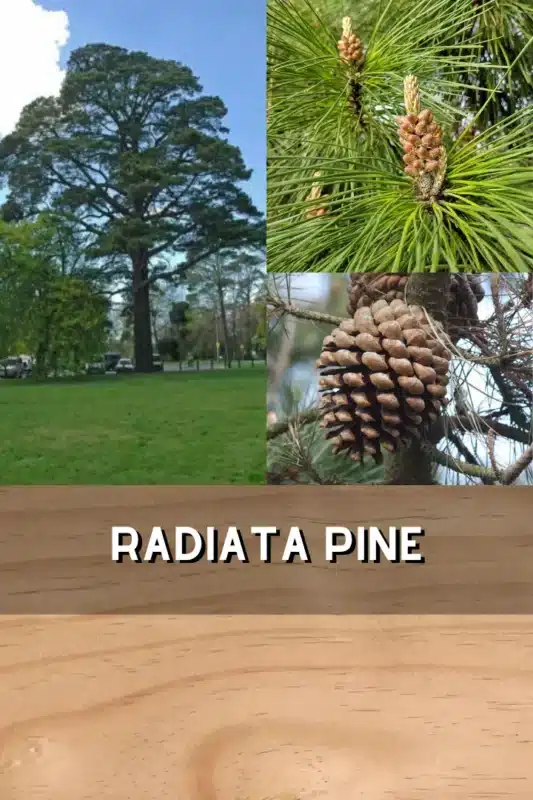
Radiata pine is an evergreen member of the pine family. Its commercial importance comes from fast plantation growth, a straight stem under managed conditions, easy machining, good preservative uptake, and suitability for veneer production.
Scientific Name and Taxonomy
The accepted scientific name is Pinus radiata D.Don. David Don formally described the species, while the older name Pinus insignis still appears in historical forestry records. Kew Plants of the World Online places it in the family Pinaceae and genus Pinus.
| Feature | Pinus radiata fact |
|---|---|
| Scientific name | Pinus radiata D.Don |
| Family | Pinaceae |
| Plant type | Evergreen conifer |
| Botanical wood class | Softwood |
| Common names | Radiata pine, Monterey pine, insignis pine |
| Native populations | Año Nuevo, Monterey, Cambria, Guadalupe Island, Cedros Island |
| Typical needles | Bundles of three, about 8–15 cm long |
| Typical cones | Persistent, woody, often asymmetrical, about 7–17 cm long |
| Wild conservation status | Endangered |
| Main commercial products | Sawn timber, plywood, LVL, MDF, pulp, paper, poles, packaging |
Radiata Pine or Monterey Pine
Both names match the same species. “Monterey pine” refers to its association with Monterey, California, while “radiata pine” is the standard forestry and timber name across New Zealand, Australia, Chile, South Africa, and several other plantation regions.
The phrase Pinus radiata Monterey pine can create the false impression that it names a hybrid or separate variety. It doesn’t; timber sold under either common name may still differ in grade, age, density, treatment, and plantation origin.
Varieties and provenances. Authorities have recognized P. radiata var. radiata from mainland California, var. binata from Guadalupe Island, and var. cedrosensis from Cedros Island. Taxonomic treatment varies, but these geographic sources remain useful in conservation and tree breeding.
A forestry provenance is the geographic seed source, not simply the country where seedlings were raised. Provenance affects drought response, foliage, cone traits, growth, stem form, disease resistance, and wood quality, so plantation performance can’t be predicted from the species name alone.
Key botanical facts. This conifer produces seeds in woody cones rather than flowers or fleshy fruit. It commonly reaches 15–30 metres in exposed native stands, while well-managed plantation trees often reach 30–50 metres and can grow taller on sheltered, fertile sites.
Like other pines, radiata pine is a botanical softwood. That term describes gymnosperm ancestry rather than a fixed strength level; certified structural grades can carry substantial loads, while low-density appearance boards may dent under a fingernail or chair leg. Our guide to soft wood explains this classification in greater depth.
How to Identify Pinus Radiata

Identify Pinus radiata by combining its usually three-needle fascicles, persistent asymmetrical cones, fissured mature bark, and geographic setting. No single feature is reliable across every age and provenance.
Tree Form and Crown
Young plantation trees usually show a conical crown and dominant central leader. Competition pushes branches upward and helps create a straight trunk; open-grown trees retain thicker low branches and develop broad, irregular crowns.
Coastal wind changes the silhouette. Exposed Monterey pine trees may lean, lose leaders, or carry foliage on one side, while sheltered plantation rows look tall and uniform. This difference explains why tree form alone is a weak identification test.
Needles and Fascicles
Needles normally grow in fascicles of three and measure about 8–15 centimetres. They feel flexible and slightly slick between the fingers, with a green to dark-green color rather than the rigid, sharply pointed feel seen in some other pine species.
Fascicle count needs several samples. Young growth, damaged shoots, and island provenances may depart from the typical pattern, so inspect healthy foliage from more than one branch before naming the tree.
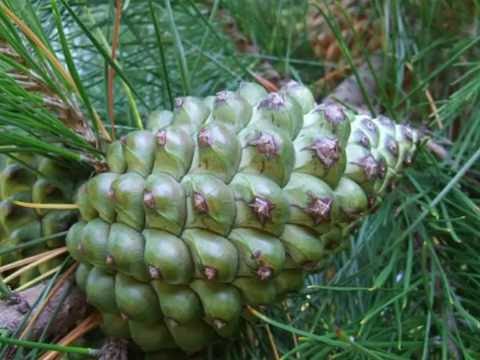
Cones and bark. Mature cones are commonly 7–17 centimetres long, woody, persistent, and visibly lopsided. Their outward-facing scales often become heavier and more raised. A dry cone feels dense and rough, and it may remain attached for years before opening after heat or drying.
Young bark starts relatively thin and smooth. Age brings deep vertical fissures, broad ridges, and a dark gray-brown surface. Resin around wounds has a sharp pine odor and sticky texture, but resin production also occurs in related pines.
Similar pine species. Bishop pine may also carry persistent cones and occur near the California coast. Knobcone pine usually has strongly serotinous, knobby cones, while ponderosa pine tends to carry longer needles and develops plated orange-brown bark as it matures.
| Species | Useful comparison | Identification caution |
|---|---|---|
| Pinus radiata | Usually three needles; asymmetrical persistent cones | Island forms may vary |
| Pinus muricata | Stout, often prickly persistent cones | Native ranges can overlap |
| Pinus attenuata | Strongly knobby cones attached tightly to stems | Fire can change cone behavior |
| Pinus ponderosa | Long needles, large tree, plated mature bark | Young bark is less distinctive |
| Pinus contorta | Shorter paired needles in many forms | Growth form varies widely |
For comparisons beyond these species, see shortleaf pine, loblolly pine, and Scotch pine. Comparing needle count, cone attachment, and bark is more dependable than matching one photograph.
Native Range, Habitat, and Conservation
Pinus radiata is native to only five principal population areas: Año Nuevo, Monterey, and Cambria in coastal California, plus Guadalupe Island and Cedros Island in Mexico. Plantation forests on other continents are introduced populations, not an extension of its natural range.
Five Native Populations
The three mainland populations occupy fragmented coastal habitats influenced by mild winters, seasonal rain, and summer fog. The two island populations are geographically isolated and hold distinct genetic material with value for conservation and future breeding.
Its fragmented distribution makes local loss hard to replace. A plantation established from selected commercial stock doesn’t recreate the evolutionary history, associated organisms, or full genetic variation of a wild population.
Global Plantation Regions
Large radiata pine plantations occur in New Zealand, Chile, Australia, Spain, South Africa, Argentina, and Uruguay. Smaller areas occur in Portugal and parts of eastern Africa and South America, with plantation location governed by rainfall, frost, soil, disease, and market access.
New Zealand forestry depends heavily on this species. Official statistics from the New Zealand Ministry for Primary Industries provide dated plantation and production data; percentages should always be read with the inventory year because harvested and replanted areas change.
Climate and soil. Radiata pine grows best in mild climates with useful soil-water storage, adequate rain, and limited severe frost. Annual rainfall near 600–750 millimetres may support growth on favorable sites, but the same total can fail on shallow soil where long dry summers exhaust stored moisture.
The roots favor deep, aerated soil. Prolonged waterlogging limits oxygen, while compaction restricts rooting and raises windthrow risk. Nitrogen, phosphorus, and boron can limit plantation growth; boron deficiency may deform leaders and leave forked stems.
Mycorrhizal fungi extend the effective root system and support nutrient uptake. Seedlings planted into soil without compatible fungi may remain pale and stunted despite irrigation, a problem that can be mistaken for poor seed or low fertilizer.
Environmental limits. Young trees are vulnerable to hard frost, salt burn, drought, waterlogging, and browsing. Strong wind can snap leaders or loosen shallow root plates; the damage becomes visible as a permanent sweep or compression wood on the lower side of a leaning trunk.
Wild versus plantation status. The IUCN Red List classifies the species as Endangered in the wild. This assessment concerns its restricted natural populations, not the total number of trees in commercial forests.
| Factor | Native populations | Commercial plantations |
|---|---|---|
| Geographic pattern | Five restricted population areas | Widely introduced across several continents |
| Primary value | Wild genetics, ecology, habitat | Wood and fiber production |
| Tree selection | Natural and locally adapted variation | Often selected breeding stock |
| Main threats | Development, disease, drought, fire, fragmentation | Fire, disease, wind, market and management risk |
| Conservation role | Irreplaceable in-situ populations | May conserve selected genes but not native ecosystems |
Threats and island restoration. Pitch canker, urban development, drought, altered fire patterns, and population isolation affect California stands. On Guadalupe Island, feral goats stripped vegetation and prevented regeneration until eradication and restoration work reduced browsing pressure.
New seedlings on an island are a positive sign, not proof of full recovery. Small populations can still lose genetic diversity or suffer heavily from one fire, storm, pathogen introduction, or prolonged drought.
Naturalization and invasiveness. Seed can escape plantation boundaries and colonize disturbed grassland, shrubland, or forest margins. Fire, grazing, bare soil, nearby seed sources, and limited plant competition increase establishment, while dense native vegetation may suppress seedlings.
Escaped trees can alter fuel loads and water use, shade low vegetation, and raise control costs. Regional evidence matters: a contained plantation in one climate shouldn’t be described the same way as spreading wilding conifers in another.
Plantation Forestry and Environmental Impacts
Plantation managers favor radiata pine because productive sites can produce merchantable logs within about 20–35 years. Yield and environmental performance depend on site selection, stocking, genetics, thinning, pruning, harvesting methods, and post-harvest land care.
Growth Rate and Yield
Productive stands can exceed a mean annual increment of 20 cubic metres per hectare per year. This figure isn’t a guaranteed harvest volume: it may describe total stem volume before deducting bark, breakage, defects, unmerchantable tops, access losses, and processing waste.
Rainfall distribution often matters more than the annual total. Deep volcanic soil can buffer a dry spell, while shallow compacted ground produces short internodes, sparse crowns, and resinous stress wounds after the same weather.
Rotation Length
Many New Zealand sawlog regimes use rotations near 25–30 years. Pulp-focused forests may be harvested earlier, while clearwood or large-diameter log regimes may run longer when added growth and wood value justify land, fire, wind, and finance costs.
Thinning and pruning. Initial stocking gives managers enough stems to select straight, healthy final-crop trees. Thinning shifts light, water, and nutrients to retained stems, increasing diameter but often enlarging branches if the canopy opens too early.
Progressive pruning can produce a knot-free outer sheath after the tree grows over branch stubs. Removing too much live crown slows diameter growth, while late pruning leaves a large knotty core and less clearwood before harvest.
- Pruned clearwood regimes target furniture, mouldings, and appearance timber.
- Unpruned sawlog regimes accept knots for framing and other structural products.
- Pulpwood regimes focus on fiber volume rather than clear boards.
- Thinning schedules must account for wind exposure after canopy opening.
- Harvest planning must protect waterways, steep slopes, and retained vegetation.
Genetics and wood quality. Breeding programs select growth, straightness, branch size, density, stiffness, and disease resistance. Selecting only for volume may increase the proportion of low-stiffness juvenile wood, so programs balance tree size against the properties required by mills and structural markets.
Pests and diseases. Pitch canker, caused by Fusarium circinatum, creates resinous lesions, shoot dieback, branch flagging, and crown decline. Dothistroma needle blight produces red-banded needles and premature foliage loss, while red needle cast associated with Phytophthora pluvialis can reduce repeated-season growth.
Cyclaneusma needle cast, Diplodia shoot blight, Armillaria root disease, Sirex woodwasp, and bark beetles also cause losses in some regions. Beginners often diagnose disease from brown foliage alone, yet drought, frost, waterlogging, and nutrient shortage can produce a similar crown.
Carbon storage. Oven-dry wood is often estimated at 50% carbon by mass. One tonne of dry wood at that fraction contains about 0.5 tonnes of carbon, equivalent to roughly 1.83 tonnes of carbon dioxide before roots, processing, transport, decay, fire, and substitution effects are counted.
Long-lived framing may store carbon for decades; paper and packaging usually have shorter lives. A credible calculation tracks product life and disposal, rather than treating gross tree uptake as permanent storage.
Plantation trade-offs. High yields can supply large timber volumes from a limited land area, but single-species stands may support fewer native organisms than mixed habitat. Harvesting can expose soil, add sediment to streams, alter catchment water use, and leave fuel if residues aren’t managed.
Certification and sourcing. Forest Stewardship Council and Programme for the Endorsement of Forest Certification labels show conformity with defined systems. Certification doesn’t mean every ecological impact disappears, so buyers should also check chain-of-custody claims, harvest region, recycled content, treatment chemistry, and transport distance.
Pinus Radiata Wood Properties
Pinus radiata wood is pale, moderately light, easy to machine, receptive to preservatives, and variable around knots and the juvenile core. Published species averages help compare materials, but certified grades must supply structural design values.
Color, Grain, and Texture
Sapwood is usually pale cream or yellowish, while heartwood can become pinkish to light reddish brown. Freshly planed radiata pine has a mild resin scent, a smooth warm surface, and visible earlywood-to-latewood bands that create its familiar grain and texture.
Grain is commonly straight, yet knots, compression wood, and spiral grain interrupt the pattern. Blunt cutters crush soft earlywood and leave a woolly surface; a sharp high-angle blade produces clean, bright shavings instead.
Density and Hardness
Basic density is often near 400 kg/m³ for New Zealand-grown material, while air-dry references commonly sit around 480–515 kg/m³. Density varies from pith to bark, along the stem, and between sites, ages, genetic stock, and silvicultural regimes.
The Wood Database radiata pine profile reports a Janka hardness near 710 pound-force, or 3,150 newtons. This helps explain why unfinished surfaces dent more readily than many hardwoods.
Strength and softwood classification. Reference clear-wood values place modulus of elasticity around 10 GPa, modulus of rupture around 79 MPa, and crushing strength near 42 MPa. Knots, slope of grain, moisture, density, and grading method can shift usable performance far below or above a species average.
Softwood doesn’t mean structurally weak. A graded radiata pine member may work well as construction wood, while an ungraded board with a large edge knot may fail at a fraction of the clear-wood value.
Shrinkage and drying. Representative shrinkage values are about 3.4% radial, 6.7% tangential, and 10.7% volumetric from green to oven-dry condition. Tangential movement being roughly twice radial movement helps explain why wide flat-sawn boards cup as one face dries faster.
Uneven kiln schedules can produce checks, bow, twist, or internal stress. A freshly opened pack may feel cool and slightly clammy between boards; machining it immediately can release stress, leaving parts curved by the following morning.
Juvenile wood variation. The central core contains wood formed during the tree’s early years. It often has lower stiffness, greater longitudinal shrinkage, and more spiral grain, which is why two boards carrying the same species name can behave differently after cutting.
Workability and finishing. Radiata pine saws, glues, nails, screws, sands, and rotary peels readily. Pilot holes reduce end splitting, sharp cutters prevent fuzzy grain, and a wash coat or conditioner limits blotchy stain absorption across alternating earlywood and latewood.
Resin around knots can bleed through pale paint, especially as sunlight warms a panel. Seal resinous areas with a compatible stain-blocking primer, let treated or wet timber reach the coating maker’s moisture limit, then coat all vulnerable faces and end grain.
Advantages and limitations. The advantages of radiata pine include fast renewable supply, low machining resistance, useful strength-to-weight performance, good gluing, broad panel use, and excellent preservative treatability. Its main limits are low untreated durability, surface denting, knot variation, resin bleed, and movement from juvenile wood.
| Property | Approximate reference | Practical meaning |
|---|---|---|
| Basic density | About 400 kg/m³ | Varies strongly within a tree |
| Air-dry density | About 480–515 kg/m³ | Depends on moisture and source |
| Janka hardness | About 3,150 N | Surfaces can dent in hard service |
| Modulus of elasticity | About 10 GPa | Use certified grade values for design |
| Radial shrinkage | About 3.4% | Less movement across quarter-sawn faces |
| Tangential shrinkage | About 6.7% | Flat-sawn boards have greater cupping risk |
| Natural durability | Low | Treatment or dry protected use is needed |
Common Uses of Pinus Radiata Wood
The common uses of radiata pine include framing, roof trusses, furniture, mouldings, plywood, laminated veneer lumber, MDF, particleboard, pallets, poles, pulp, and paper. The correct grade and treatment depend on load, appearance, moisture, insects, and expected service life.
Structural and Building Uses
Stress-graded timber is used for wall framing, studs, roof trusses, joists, and engineered components where local codes and span tables permit. Designers must use certified grade properties rather than generic species data from a timber wood profile.
Finger-jointing removes defects and joins shorter clear sections into long components. Adhesive type, joint certification, treatment, and service class still matter; an interior finger-jointed moulding isn’t interchangeable with an exterior structural product.
Furniture and Interior Joinery
Clear or well-selected boards suit shelves, cabinets, doors, mouldings, wall lining, drawer parts, and lightweight furniture. The pale color accepts paint readily, while knots provide a rustic appearance if resin and movement are controlled.
Beginners often choose soft boards for tabletops without testing the finish. Press a thumbnail into an offcut and drag a key lightly across the coating; if both leave marks, use a harder top layer, protective mat, or more wear-resistant species.
Engineered panels and pulp. Straight plantation logs peel efficiently into veneers for plywood and laminated veneer lumber. Lower-grade logs and processing residues feed MDF, particleboard, pulp, paper, packaging, and biomass streams, improving recovery from each harvested stem.
Exterior and landscaping uses. Treated timber serves in decking, fences, retaining structures, agricultural buildings, posts, and poles. Treatment must match the exposure: an above-ground product shouldn’t be buried simply because its surface looks similar to a ground-contact post.
Application-specific grading. Structural grade measures load-related characteristics; appearance grade focuses on visible defects and finish. Treatment class addresses biological exposure, while moisture content affects dimensions and coating. One label can’t replace the others.
- For framing, check stress grade, moisture condition, dimensions, and code acceptance.
- For furniture, check knot size, resin pockets, grain direction, and surface hardness.
- For decking, check hazard class, fastener compatibility, span, ventilation, and coating needs.
- For mouldings, check moisture, finger joints, primer compatibility, and straightness.
- For panels, check structural certification, bond class, face grade, thickness, and treatment.
Radiata Pine Plywood

Radiata pine plywood is made from rotary-peeled veneers arranged with alternating grain directions and bonded under pressure. Its strength, moisture performance, appearance, and price depend on veneer quality, layup, glue bond, panel standard, treatment, and thickness.
Veneer Construction
Most panels use an odd number of plies so both faces run in the same direction. Cross-lamination reduces splitting and spreads loads across two axes, but thin face veneers can still check or sand through during aggressive finishing.
Core gaps, overlapping veneers, poor scarf joints, or uneven press conditions can show through as ridges and hollows. Run a hand across a sheet under low side lighting; subtle core defects become easier to feel and see.
A/C and Other Face Grades
A/C radiata pine plywood has a high-quality A face paired with a lower appearance C back. A/A and A/B suit visible work, B/C balances finish and cost, while C/D is commonly selected for concealed or utility uses where permitted.
Face grade doesn’t state structural capacity or glue durability. A smooth A face can sit on a non-structural interior panel, while a rougher structural sheet may carry certified loads.
Structural plywood standards. Australasian specifications commonly refer to AS/NZS 2269 for structural plywood, AS/NZS 2270 for interior plywood, AS/NZS 2271 for exterior plywood, and AS/NZS 2272 for marine plywood. Project documents must identify the accepted edition, certification, and panel rating.
Is radiata plywood strong? Yes, certified structural radiata pine plywood can be strong for bracing, flooring, formwork, and other rated uses. A species name or thick sheet alone proves nothing; layup, veneer grade, stress rating, support spacing, grain direction, and fastening govern capacity.
Bond durability, not waterproofing. Exterior or phenolic bonding resists glue-line breakdown better than an interior adhesive. It doesn’t make untreated pine veneers decay-proof, and it doesn’t stop water entering cut edges, fastener holes, face checks, or damaged coatings.
Exterior-bonded plywood can survive wetting at the glue lines while the wood fibers swell, stain, soften, and decay.
Practical material distinction
Dimensions and thicknesses. Common sheets include 2,400 × 1,200 mm and 2,440 × 1,220 mm formats. Thicknesses often run from about 3 mm to 25 mm or more, but actual stock combinations vary by face grade, structural rating, treatment, mill, and region.
Applications and installation. Suitable products serve cabinetry, lining, flooring substrates, bracing, packaging, formwork, cladding substrates, and marine construction. Boats require plywood certified to the relevant marine standard; “radiata pine” or “exterior glue” isn’t a substitute.
Keep panel edges supported at the spacing shown in the manufacturer’s tables. Leave specified movement gaps, orient the strength axis correctly, seal exposed cuts, and avoid driving fastener heads through the face veneer.
Common plywood failures. Unsealed edges absorb water quickly and become rough, swollen, and dark. Interior glue can delaminate in wet service, unsupported joints can flex, and wet panels painted too early can blister or push checks through the coating.
- Edge swelling from exposed cuts or standing water.
- Delamination from the wrong bond class or faulty manufacture.
- Decay where untreated veneers stay damp.
- Face checking from moisture cycling and thin veneers.
- Fastener pull-through from overdriving or poor edge support.
- Surface telegraphing from core voids, plugs, or overlaps.
- Coating failure from resin, dust, moisture, or missed edge sealing.
Comparing plywood prices. A Bunnings radiata pine sheet, specialist structural panel, and imported furniture-grade sheet can’t be compared by sheet price alone. Match dimensions, actual thickness, face/back grade, structural certification, bond, treatment, sanding, tax, freight, and minimum order.
Calculate price per square metre by dividing sheet price by sheet area. For different thicknesses, divide the price by panel volume to find price per cubic metre, then compare only products suitable for the same application.
| Label or feature | What it tells you | What it does not tell you |
|---|---|---|
| A/C face grade | A-quality face and C-quality back | Structural capacity or bond class |
| Structural plywood | Compliance with a recognized structural standard | Natural decay resistance |
| Exterior bond | Glue-line resistance to moisture exposure | That veneers are waterproof |
| Marine plywood | Compliance with a named marine standard | Freedom from maintenance or detailing |
| Treated plywood | Preservative protection to a stated class | Suitability for every exposure |
| Nominal thickness | Product category | Guaranteed measured thickness |
Durability, Treatment, and Specification
Untreated plantation-grown radiata pine has low natural durability in persistent exterior moisture or ground contact. Safe specification combines the correct hazard class, compatible fasteners, verified structural grade, dry installation, drainage, ventilation, and maintained finishes.
Natural Durability
The large sapwood proportion is vulnerable to fungal decay, termites, and wood-boring insects in susceptible regions. Untreated boards perform well indoors when kept dry, but exposed end grain can wick water and soften long before a broad painted face appears damaged.
A common beginner mistake is calling weathered gray wood “rot.” Gray color can be superficial, while decay feels spongy, strings apart along fibers, or gives under a screwdriver. Probe hidden joints and end grain rather than judging color alone.
Preservative Treatment Systems
Radiata pine sapwood accepts preservatives well because its structure is comparatively permeable. Common systems include boron for protected interior use, copper azole, alkaline copper quaternary, light organic solvent preservatives, and chromated copper arsenate where local law permits defined applications.
Treatment names alone don’t define performance. The required penetration and retention must match the exposure, while heartwood, incising, dimensions, plant process, and quality control influence the treated zone.
Hazard classes. New Zealand specifications commonly use H1.1 and H1.2 for protected interior risks, H3.1 and H3.2 for different above-ground exterior exposures, H4 for ground contact, H5 for severe ground or freshwater exposure, and H6 for marine exposure.
| NZ hazard class | Broad exposure | Typical specification check |
|---|---|---|
| H1.1 | Protected interior, low moisture risk | Interior end use and insect risk |
| H1.2 | Protected interior with greater moisture or insect risk | Framing location and code requirement |
| H3.1 | Exterior above ground with coating and lower decay risk | Coating system and maintenance |
| H3.2 | Exterior above ground with greater wetting | Drainage, joints, exposed cuts |
| H4 | Ground contact | Soil exposure and structural role |
| H5 | Severe ground or freshwater exposure | Critical load and service conditions |
| H6 | Marine exposure | Marine borers and approved treatment |
These summaries don’t replace the current standard or local code. Similar class names in different countries may carry different preservative, retention, and permitted-use rules.
Fasteners and finishes. Copper-based preservatives can accelerate corrosion in unsuitable metals. Use the fastener type, coating thickness, and connector material named by the treatment supplier and building code; coastal salt exposure may call for a higher corrosion category.
Let wet treated timber dry to the coating maker’s limit before painting. Field cuts and drilled holes may need remedial preservative, particularly where work exposes untreated material inside the original treatment envelope.
Specifying solid timber. State species, dimensions, structural or appearance grade, moisture condition, treatment class, surface finish, finger-jointed status, and intended exposure. For load-bearing work, name the grading standard and certified design properties.
Specifying plywood. State the governing standard, panel rating, stress grade, face/back grade, bond class, preservative treatment, emissions class where required, nominal and measured thickness, sheet size, support spacing, and edge-sealing method.
Exterior moisture detailing. Slope horizontal surfaces, drain cavities, ventilate cladding backs, lift timber clear of soil, cap exposed end grain, and avoid ledges that hold wet leaves. Treated pine still decays where joints trap water beyond the treatment’s intended exposure.
Practical Notes From Real-World Use
Check moisture before fitting wide boards or panels. Timber that feels cool against the cheek or produces damp, heavy shavings may still be too wet; a calibrated meter gives a better decision than touch alone.
Stack plywood flat on level bearers and protect it from rain without sealing wet sheets inside plastic. Bent storage packs develop permanent bow, while trapped condensation can stain faces before installation begins.
Pre-drill near board ends, keep fasteners back from panel corners, and support plywood joints. For exterior work, seal cut edges during installation rather than waiting for the final coating day, since one rainstorm can raise the veneer fibers.
Inspect treated timber stamps before cutting the pack. Similar green or brown coloration can hide different hazard classes, and preservative color isn’t a reliable measure of penetration or legal end use.
The safest final choice treats species as one factor. Grade carries the load, treatment manages biological exposure, detailing controls moisture, compatible metal limits corrosion, and routine maintenance keeps coatings and drainage working.
FAQs
Is Radiata Pine The Same As Monterey Pine?
Radiata pine and Monterey pine are two common names for the same species, Pinus radiata. Monterey pine usually refers to its native California identity, while radiata pine is common in forestry and timber markets. The tree is widely grown in plantations because it grows quickly and produces workable wood.
Where Is Pinus Radiata Native?
Pinus radiata is native to coastal California and a few nearby Mexican islands. Its natural populations occur around Monterey and Cambria in California, plus Guadalupe and Cedros islands off Baja California. Outside this limited range, it is extensively planted in countries such as New Zealand, Chile, Australia, and Spain.
Why Is Pinus Radiata Endangered If It Is Widely Planted?
Pinus radiata is endangered because its small wild populations face habitat loss, disease, fire, and climate pressures. Plantation trees do not fully protect the species because they are often grown from limited genetic stock outside its natural habitat. Conserving native populations helps preserve the tree’s natural genetic diversity.
What Are The Advantages And Disadvantages Of Radiata Pine?
Radiata pine is affordable, fast-growing, lightweight, and easy to cut, paint, stain, and machine. It is widely used for framing, furniture, moulding, and sheet materials. However, untreated radiata pine has low natural resistance to moisture, insects, and decay, so outdoor projects need properly treated timber and suitable protective finishes.
Is Radiata Pine Plywood Strong And Waterproof?
Radiata pine plywood can be strong, but its water resistance depends on the plywood grade and adhesive used. Structural and exterior-rated sheets use durable glue and handle moisture better than interior plywood. No plywood is completely waterproof, so exposed edges and faces should be sealed when used outdoors or in damp areas.
Affiliate Disclosure: Some links in this post are affiliate links. If you make a purchase through these links, we may earn a small commission at no extra cost to you. We only recommend products we genuinely believe in.