
Red Fir: Identification, Range, Ecology, and Uses of California Red Fir

Red fir, also called California red fir, is the evergreen conifer Abies magnifica, a true fir native to snowy mountain forests in California and southwestern Oregon. Mature trees have reddish furrowed bark, blue-green needles, and upright cones that break apart while attached to the branches.
Table of Contents
What Is a Red Fir?
A red fir tree is a large member of the pine family, Pinaceae. The name usually means Abies magnifica in botanical sources, rather than Douglas-fir or another conifer with reddish wood or bark.
Scientific Classification
Red fir belongs to the genus Abies, whose members are known as true firs. Current California references, including Jepson eFlora, place the species in the following botanical classification.
| Rank | Classification |
|---|---|
| Kingdom | Plantae |
| Clade | Tracheophytes |
| Clade | Gymnosperms |
| Order | Pinales |
| Family | Pinaceae |
| Genus | Abies |
| Species | Abies magnifica |
The scientific epithet magnifica refers to the tree’s grand appearance. A mature specimen rising above a snowy Sierra Nevada forest has a straight, massive trunk and a high crown visible from a considerable distance.
Names and Meaning
Accepted common names include red fir, California red fir, and silvertip fir. Older or regional references sometimes use golden fir, while foresters may shorten the name to RF in stand records.
California red fir can mean the complete species or its typical southern variety, depending on the source. The longer name helps prevent confusion with lumber sellers who occasionally apply “red fir” to unrelated commercial wood.
Shasta red fir taxonomy remains less settled. Many authorities recognize Abies magnifica var. shastensis, a northern variety centered around Mount Shasta, the southern Cascades, and nearby southwestern Oregon.
Shasta red fir often has cone bracts that extend beyond the scales, while the typical variety usually hides them. Trees in contact zones don’t always follow that clean division because regional variation and genetic exchange blur the boundary.
Other named varieties include Critchfield’s red fir in some botanical treatments. Its rank and limits vary, so a variety name from an older field guide shouldn’t be treated as universally accepted without checking that guide’s taxonomic system.
Red Fir Tree Identification

Identify a red fir by combining its high-elevation setting, blue-green upswept needles, mature reddish bark, and upright cones. No single feature gives a safe identification across every age, season, or mixed-conifer site.
Form and Height
Mature red fir trees commonly reach 130–200 feet (40–60 meters). Exceptional specimens can exceed 230 feet (70 meters), while exposed trees near the upper forest limit may stay short, bent, or thin-crowned.
Young, open-grown trees have narrow conical crowns with branches arranged in regular tiers. Older crowns become rounded or uneven after decades of snow and wind break branch tips and upper leaders.
Large trunks may measure roughly 5–6.5 feet (1.5–2 meters) in diameter. Trunk size reflects soil depth, competition, moisture, and disturbance history, so it can’t provide a dependable age estimate by itself.
Bark and Resin Blisters
Young bark feels relatively smooth and cool, with a gray surface interrupted by raised resin blisters. Pressing or cutting those blisters can release sticky aromatic resin, but damaging bark for identification creates an unnecessary entry point for disease.
Older bark becomes thick, rough, and deeply furrowed, shifting from gray to cinnamon or reddish brown. Wet bark looks darker, while pale lichens, char, and direct sun can mask its natural red tone.
Needles and twigs: Needles usually measure 0.8–1.4 inches (2–3.5 centimeters). They feel firm rather than floppy, curve upward around the twig, and often look blue-green or silvered by pale stomatal bands.
Needle tips tend to be blunt or rounded. A crushed needle releases a clean, resinous scent that clings to the fingertips, yet odor is supporting evidence because other true firs smell similar.
Twigs are stout and often reddish brown. Removed needles leave smooth, round scars rather than the woody pegs found on spruce wood species, giving bare fir twigs a smoother texture.
Upright cones: Red fir cones stand on upper branches instead of hanging below them. Mature cones are commonly 5.5–8.3 inches (14–21 centimeters) long and may change from purple to brown as seeds ripen.
A mature cone breaks apart in the crown, releasing winged seeds and individual scales. Beginners often search the ground for whole cones, but the more useful clue is the upright central axis left on a branch.
Identification summary: Work from several independent traits instead of matching one photograph. Bark alone causes frequent errors because young red fir has little of the red, deeply furrowed surface associated with mature trees.
| Character | California red fir |
|---|---|
| Scientific name | Abies magnifica |
| Growth form | Large evergreen conifer |
| Typical height | 130–200 ft (40–60 m) |
| Young bark | Smooth, gray, with resin blisters |
| Mature bark | Reddish brown and deeply furrowed |
| Needles | Blue-green, firm, upswept, 0.8–1.4 in |
| Cones | Upright, commonly 5.5–8.3 in long |
| Cone behavior | Scales disintegrate on the tree |
| Core habitat | Snowy montane and subalpine forest |
Field Experience Insights: Start beneath the crown and scan the ground for loose cone scales, then look upward for persistent cone axes. Binoculars help because productive branches can sit more than 100 feet overhead, where cone posture is invisible to the unaided eye.
A second practical test is to inspect fallen fresh twigs after a storm rather than pulling foliage from a living tree. The combination of stiff upswept needles, smooth attachment scars, and stout reddish twigs gives a stronger field diagnosis than bark color.
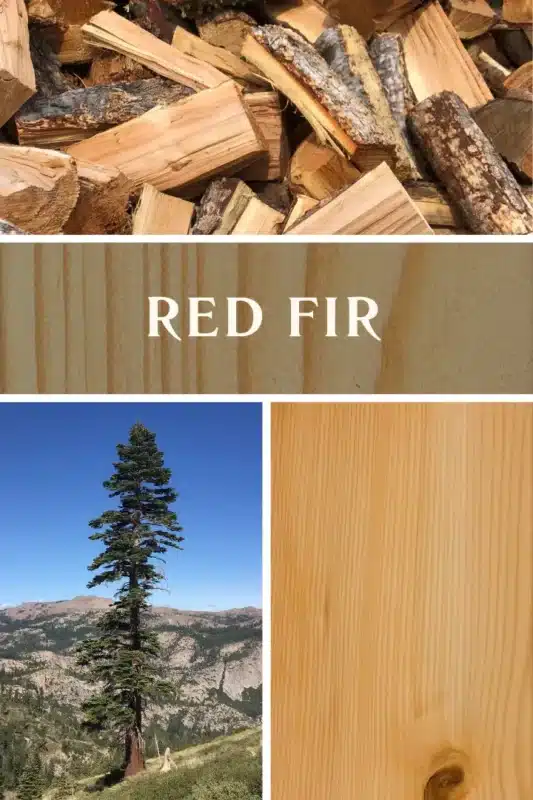
Red fir pictures: The picture below shows the tall, straight form and dense crown associated with the species. Photographs should still be checked against location, needles, bark, and cone structure before assigning a botanical name.
Native Range and Habitat
Red fir grows naturally in high mountain forests of California and southwestern Oregon. Its core habitat follows the Sierra Nevada, southern Cascade Range, Klamath Mountains, and Mount Shasta region.
Geographic Distribution
The typical California red fir is closely associated with the Sierra Nevada. Northern populations, including many trees identified as Shasta red fir, extend through the southern Cascades and into southwestern Oregon.
Red fir isn’t a lowland California tree. Records near cities, gardens, and arboretums may represent planted specimens, while wild stands occupy colder mountain belts described in the USDA Silvics Manual.
Elevation by Region
A practical species-wide elevation range is about 4,600–8,900 feet (1,400–2,700 meters). Red fir can occur lower in the north and higher in the southern Sierra Nevada, where latitude changes the temperature found at a given elevation.
Slope direction shifts the local limits. Cool north-facing slopes may support red fir below the elevation expected on dry south-facing ground, so elevation alone can’t separate it from white fir.
Climate and snowpack: Red fir is adapted to cold winters, deep seasonal snow, and cool growing seasons. Much of its moisture arrives in winter, then stored snow releases water gradually through spring and early summer.
Snow bends young branches and can leave older crowns ragged. Underfoot, late spring snow often feels dense and granular, while nearby exposed soil may already be dry; this contrast shows why snowmelt timing controls the short establishment window.
Soils and moisture: The species grows on mountain soils derived from granite, volcanic rock, glacial deposits, and other parent materials. Productive sites drain freely but retain enough moisture to carry roots through California’s dry summers.
Shallow rocky soils produce smaller, open stands. Deep soils with steady moisture support taller, denser trees, while saturated ground limits root oxygen and can increase windthrow risk.
Red fir forests may be nearly pure or mixed with white fir, lodgepole pine, Jeffrey pine, sugar pine, western white pine, noble fir, and mountain hemlock. The mix changes with elevation, latitude, fire history, and soil moisture.
- Look for cold, snowy montane or subalpine conditions.
- Check whether associated trees fit the local elevation belt.
- Expect lower occurrences on cool northern slopes.
- Expect stunted forms on exposed ridges and shallow soils.
- Separate planted records from naturally occurring populations.
Range map accuracy: Online maps can mix wild records, cultivated trees, and incorrect citizen-science observations. White fir and noble fir misidentifications are common, while databases may apply different names to Shasta red fir.
A reliable map should pair georeferenced records with photographs, elevation, collection notes, and taxonomic treatment. Outlying points deserve closer review when they sit far from recognized mountain populations.
Red Fir vs. Similar Conifers
Red fir differs from similar conifers through a combination of cone position, needle arrangement, bark, and location. Upright cones that disintegrate in place provide the best genus-level clue that the tree is a true fir.
Red Fir vs. White Fir
Red fir usually occupies colder, snowier sites than white fir, but their elevational ranges overlap. Red fir needles often look stiffer and more upswept, while white fir foliage tends to appear flatter and longer.
Mature red fir bark commonly develops a red or cinnamon cast. White fir bark stays grayer or ash-colored, though weather, shade, lichen, and fire scars can weaken that color distinction.
Red Fir vs. Douglas-Fir
Red fir is a true fir in the genus Abies; Douglas-fir belongs to Pseudotsuga. Douglas-fir has hanging intact cones with three-pointed bracts, while red fir has upright cones that disassemble in the crown.
The trees also differ commercially. Material described as Douglas-fir wood shouldn’t be assumed to come from red fir, regardless of reddish heartwood or a seller’s regional terminology.
| Feature | Red fir | White fir | Douglas-fir |
|---|---|---|---|
| Scientific name | Abies magnifica | Abies concolor | Pseudotsuga menziesii |
| True fir | Yes | Yes | No |
| Cone position | Upright | Upright | Hanging |
| Mature cone behavior | Breaks apart on tree | Breaks apart on tree | Falls mostly intact |
| Needle appearance | Stiff, blue-green, upswept | Flatter, often laterally spread | Softer, radiating around twig |
| Mature bark | Reddish and deeply furrowed | Gray or ash-colored | Thick, corky, deeply furrowed |
Red fir vs. noble fir: Noble fir, Abies procera, occurs mainly farther north and has cones with conspicuously projecting bracts. Shasta red fir can resemble noble fir, particularly where northern populations show exposed cone bracts.
Geography and cone structure work better together than either feature alone. A single distant photograph rarely shows enough detail to resolve northern fir identification.
California vs. Shasta red fir: Typical California red fir usually has cone bracts hidden behind the scales. Shasta red fir more often exposes its bracts and is concentrated around Mount Shasta and the southern Cascades.
That division functions as a useful field tendency, not an absolute rule. Intermediate cones and variable taxonomic treatments make some northern trees unsafe to name below the species level from photographs alone.
Reliable identification clues: Confirm an upswept needle pattern, smooth round needle scars, an upright cone or persistent axis, suitable mountain habitat, and mature reddish bark. Avoid relying on elevation, bark color, or one loose branch by itself.
Growth and Reproduction
Red fir reproduces from wind-dispersed seed, with pollen and seed cones growing on the same tree. Its growth rate ranges from very slow beneath a closed canopy to much faster after a well-lit gap opens.
Pollination and Seed Crops
Male pollen cones and female seed cones form on separate parts of the crown. Female cones cluster high in the tree, where greater wind exposure supports pollination and later seed dispersal.
Seed production changes from year to year. Heavy crops occur intermittently, which means one cone-free season doesn’t prove that a mature tree is sterile or incorrectly identified.
Cone Disintegration
Mature cones release winged seeds as their scales separate during autumn. The woody central axis remains upright, resembling a narrow spike after the cone scales fall.
This process explains why intact mature red fir cones are rarely found on the forest floor. Loose scales can feel papery at the edges and thicker near the base, but wind may carry them away from the parent tree.
Seedling establishment: Seeds overwinter before germinating under suitable moisture and temperature conditions. Seedlings need moist seedbeds, yet standing water, deep litter, fungal damage, browsing, heat, and early summer drying can kill new roots.
Earlier snowmelt creates a longer apparent growing season but may leave shallow roots without water before summer ends. A later melt shortens the season while preserving soil moisture for longer.
Shade and canopy gaps: Young red fir tolerates shade and can survive beneath mature trees for extended periods. Growth remains restrained until treefall, fire, disease, or snow breakage creates an opening in the canopy.
Sudden exposure carries a trade-off. More light supports photosynthesis, but higher leaf temperature and stronger wind can dry needles and soil, particularly where roots developed under a cool, sheltered forest canopy.
Growth rate and lifespan: No single annual growth figure applies across the species. Dense stands, short seasons, and poor soils slow growth, while moist sites with moderate light support wider rings and faster height gain.
Mature red fir can live for several centuries. Age estimates above 400–500 years need direct measurements or a named record because broken tops, hollow trunks, and missing inner rings can make old-tree dating difficult.
Red Fir Forest Ecology
Red fir forests shape high-elevation habitat by storing snow, moderating ground temperature, producing woody debris, and creating layered shelter. Fire, wind, insects, and snow damage maintain a shifting mix of living trees and gaps.

Fire Adaptations
Young red fir has thin bark and dies readily in fire. Older trees develop thicker bark that can insulate living cambium from some low-intensity surface burns, but mature trees aren’t fireproof.
Deep basal burns, injured roots, old wounds, and crown scorch can kill large trees. Dense dead lower branches also form ladder fuels that let flames climb from the ground into the crown.
Historical Fire Regimes
Red fir forests usually burned less often than lower-elevation pine and mixed-conifer stands. Fire patterns ranged from low-severity surface burns to mixed-severity events and occasional large tree-killing patches, as summarized by the Fire Effects Information System.
A single fixed fire-return interval misrepresents the species. Elevation, aspect, topography, fuel moisture, regional climate, and contact with lower forest types create substantial local variation.
Wildlife habitat: Live crowns provide weather cover, while cavities, broken tops, snags, and logs support birds, small mammals, insects, lichens, and fungi. Birds and rodents may eat seeds without depending exclusively on red fir.
Decaying logs hold moisture and soften into reddish-brown fibrous material that compresses under a boot. This coarse woody debris shelters organisms, stores nutrients, and creates protected germination sites.
Snow-fed watersheds: Red fir crowns intercept snowfall and alter where snow accumulates beneath and between trees. Canopy density, wind, sun exposure, and melt timing all affect runoff, so denser forest doesn’t automatically produce more summer water.
Roots stabilize mountain soils, while litter slows surface movement. Large disturbed patches can increase erosion, particularly where severe fire removes cover shortly before intense rain or fast spring snowmelt.
Forest structure: Mature stands contain multiple canopy levels, suppressed saplings, standing dead trees, broken crowns, and fallen trunks. Removing every snag or log simplifies habitat and nutrient cycling, though dangerous trees require treatment near roads, trails, and buildings.
Threats, Climate, and Conservation
Major threats to red fir include drought, heat, insects, decay, severe fire, snow breakage, and declining snowpack. These pressures interact, so visible mortality seldom has one isolated cause.
Insects and Diseases
Fir engraver beetles can attack weakened true firs, particularly after drought, root injury, or fire damage reduces their defenses. Beetle activity may finish a declining tree without being the original stress.
Root rots, stem decays, and dwarf mistletoes can reduce vigor or structural stability. Decay often enters through broken tops, dead branches, equipment wounds, or old fire scars and may remain hidden behind sound-looking bark.
Snow and Wind Damage
Heavy snow can split branches, bend young stems, and snap upper leaders. Fresh breaks expose pale wood and release a sharp resin scent, while older wounds darken and may admit decay fungi.
Windthrow risk rises where roots are diseased, soils are shallow or saturated, or neighboring trees have been removed. A tree stable for centuries inside a closed stand may fail after logging creates a new exposed edge.
Drought and heat: Reduced snowpack and early melt lengthen the summer dry period. Stressed trees may develop thin crowns, shorter shoots, reduced growth, and lower resin defenses against insects.
Beginners often blame brown foliage on beetles without checking roots, stem wounds, water stress, or recent fire. Examine the full site history and pattern of decline before selecting a single diagnosis.
Climate-driven range shifts: Warmer conditions may move suitable habitat higher, northward, or onto cooler aspects. Actual movement takes longer than climate models suggest because seeds must reach suitable soil, germinate, survive drought, and grow for decades.
High-elevation stands face a physical limit where little cooler ground remains above them. Large severe-fire patches add another barrier when seedlings are too far from surviving seed-bearing trees.
Conservation status: Red fir isn’t widely treated as globally endangered. Its broad status doesn’t show whether a local stand is losing mature trees, failing to regenerate, or becoming unsuitable as snow conditions change; conservation listings should be checked through the IUCN Red List.
Forest management: Useful goals include retaining large seed trees, maintaining varied ages and canopy structures, monitoring insects and disease, and keeping snags and logs where public safety permits.
Prescribed fire and mechanical thinning need site-specific plans. Applying a ponderosa pine treatment directly to a colder red fir forest can remove shade, expose roots, dry fuels, and damage the regeneration layer managers intended to protect.
Red Fir Wood and Lumber Uses

Red fir wood is light-colored, straight-grained, relatively lightweight, and easy to machine. It serves general construction and utility roles but has limited natural decay resistance in wet or ground-contact conditions.
Wood Characteristics
The wood usually has a pale cream to light tan color with little contrast between earlywood and latewood. Freshly cut boards carry a mild resin scent and feel light compared with dense hardwoods, fitting the broader soft wood category.
Published density, strength, and shrinkage figures vary with moisture content, growth rate, specimen selection, and testing method. Some references group red fir with other western true firs, so species-specific values require checking the test heading carefully.
Construction and Utility Uses
Red fir lumber has been used for framing, plywood, boxes, crates, pallets, pulp, and other utility products. Structural performance depends on the board’s grade stamp, dimensions, moisture condition, defects, and assigned engineering values.
- General construction lumber under applicable grading rules
- Interior framing and utility components
- Plywood and veneer products
- Shipping boxes, crates, and pallets
- Pulp, paper, and other fiber products
A straight board can machine cleanly, but soft fibers dent under concentrated pressure. Fasteners placed too close to an end may split dry stock, so predrilling near board ends offers a useful shop workaround.
Durability limitations: Untreated red fir performs poorly in prolonged ground contact or repeatedly wet exterior assemblies. Moisture cycling encourages checking and fungal decay, especially where end grain absorbs water behind trim or inside an unvented joint.
Keep boards dry, seal exposed end grain, provide drainage, and use treatment rated for the exposure. Surface paint can’t rescue wood that stays wet from the back, a common beginner construction mistake.
Lumber naming confusion: “Red fir” may describe botanical Abies magnifica, a mixed true-fir lumber group, or a colloquial Douglas-fir name. Confirm the species and grade rather than relying on color or a handwritten yard label.
Grades and pricing factors: A meaningful comparison needs the stated species, grade, dimensions, moisture content, treatment, volume, and sales region. Clear wide stock, structural framing, green timbers, and mixed utility boards represent different products and shouldn’t share one price assumption.
For structural work, use the grade stamp and code-recognized design values rather than the common name. Standardized information in the USDA Wood Handbook also shows why moisture condition and load direction change wood performance.
FAQs
Is Red Fir The Same As California Red Fir?
Yes. Red fir usually refers to California red fir (Abies magnifica), a native western North American true fir. The common name can vary by region, so use the scientific name when accuracy matters. It is named for its reddish bark, especially on mature trees.
How Can You Identify A Red Fir Tree?
You can identify a red fir by its silvery blue-green needles, narrow conical crown, and reddish-brown bark on older trunks. Its needles usually curve upward and occur on all sides of the twig. Large upright cones sit near the top of the tree and break apart when mature.
Where Do California Red Fir Trees Grow?
California red fir grows in cool, high-elevation mountain forests of California and southern Oregon. It is especially common in the Sierra Nevada and Cascade ranges, often between about 4,000 and 9,000 feet. The tree prefers deep, moist soils, snowy winters, and relatively short growing seasons.
Is Red Fir The Same As Douglas-Fir?
No. Red fir is usually California red fir (Abies magnifica), while Douglas-fir is Pseudotsuga menziesii. They are different conifers and are not even in the same genus. Douglas-fir has distinctive three-pointed cone bracts, whereas red fir produces upright cones typical of true firs.
What Is Red Fir Wood Used For?
Red fir wood is used mainly for general construction, interior lumber, plywood, and pulp products. It is relatively light, straight-grained, and easy to work, but it has limited natural decay resistance. For outdoor projects, protect it from moisture or choose a more durable wood species.
Affiliate Disclosure: Some links in this post are affiliate links. If you make a purchase through these links, we may earn a small commission at no extra cost to you. We only recommend products we genuinely believe in.