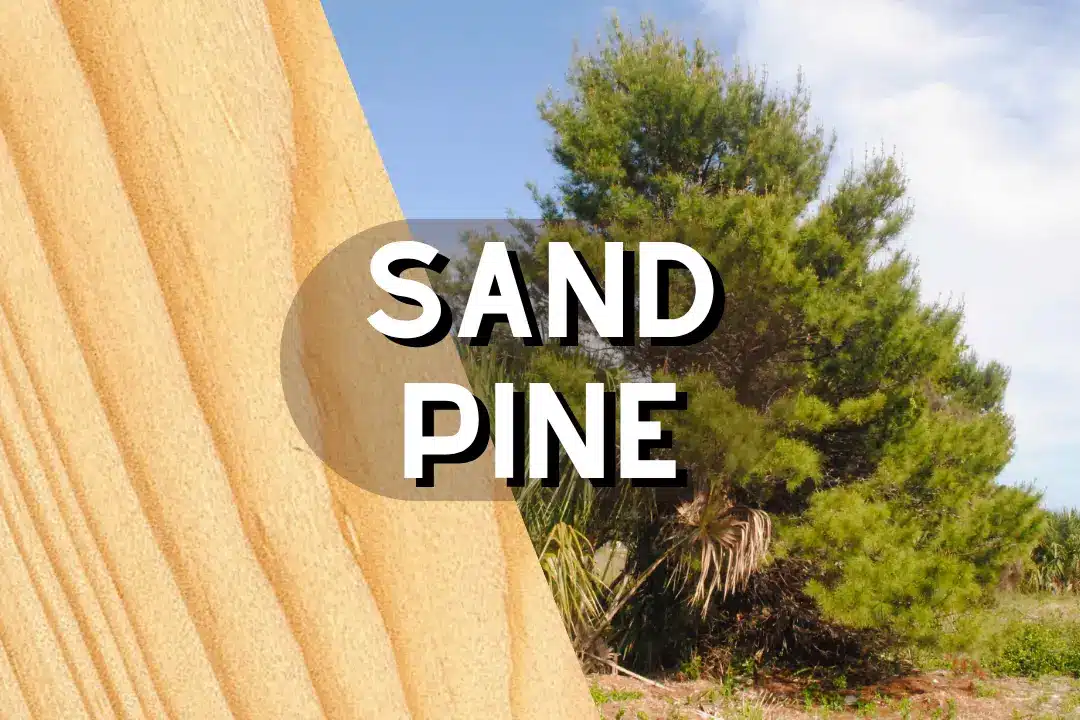

Sand pine (Pinus clausa) is a small to medium evergreen pine native mainly to Florida, with a limited range in southern Alabama. It grows on deep, dry sand, carries short needles in pairs, and includes populations whose cones release seed after exposure to fire.
This field guide explains how to identify sand pines, where they grow, why their fire response varies, how they perform in cultivation, and where sand pine wood fits in forestry and woodworking.
Table of Contents
Sand Pine at a Glance
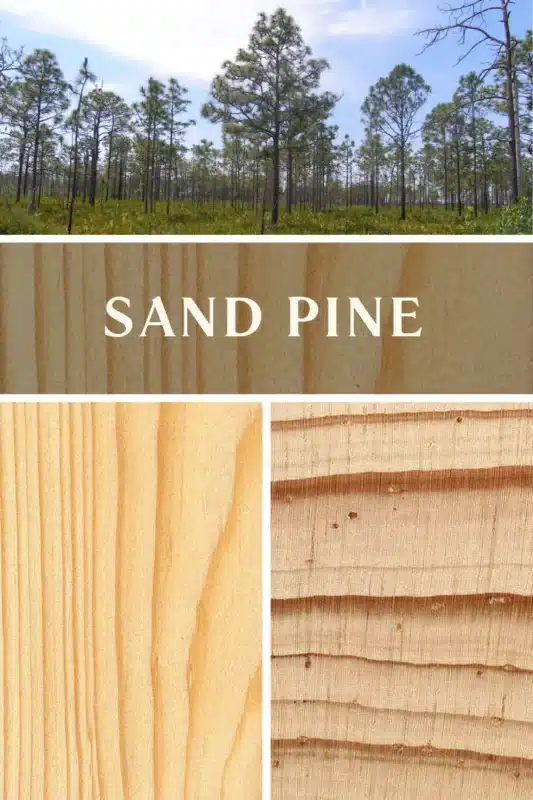
Sand pine is a native Florida pine adapted to xeric scrub, inland dunes, sandhills, and other sites with deep, nutrient-poor sand. Most trees reach about 20–60 feet, but exposed scrub specimens may remain short, crooked, and windswept.
Taxonomy and Native Status
The accepted scientific name is Pinus clausa, a member of the Pinaceae family and the genus Pinus. Kew Science recognizes the species as native to the southeastern United States.
Nearly all of its natural distribution lies in Florida. A western population reaches a small part of southern Alabama, making sand pine one of the more restricted southeastern pines.
Size, Spread, and Form
A typical sand pine grows 20–60 feet tall with a spread near 15–40 feet. Crowded forest trees may develop narrow crowns, while open-grown trees produce broad irregular crowns with low, persistent limbs.
Young trees often look compact and conical. Age, salt-laden wind, poor soil, competition, and storm damage gradually create leaning trunks, flattened tops, or forked leaders; that irregularity is normal in natural scrub, but it can become a hazard near buildings.
Quick Species Profile. These field marks provide a fast reference before examining the tree in detail:
- Scientific name: Pinus clausa
- Family: Pinaceae
- Plant type: Evergreen conifer
- Usual height: About 20–60 feet
- Needles: Two per fascicle, commonly 2–3.5 inches long
- Cones: Commonly 2–3.5 inches long and often persistent
- Primary range: Florida and a limited adjoining part of Alabama
- Typical habitat: Florida scrub and excessively drained sand
- Fire response: Mature trees often die; some populations regenerate from heat-opened cones
How to Identify Sand Pine

Identify sand pine by combining short paired needles, small persistent cones, thin plated bark, and an irregular crown with a dry scrub site. No single feature is reliable enough by itself because spruce pine also carries short needles in pairs.
Needles and Fascicles
Sand pine needles normally grow in bundles called fascicles, with two needles per bundle. Each needle is commonly 2–3.5 inches long, slender, flexible, slightly twisted, and yellow-green to dark green.
Run a gloved hand from the twig tip toward the older foliage and the needles feel fine and springy rather than long and coarse. This short foliage separates sand pine from slash pine, whose needles can hang in tufts several times longer.
Seed Cones and Serotiny
Seed cones are egg-shaped to broadly conical and commonly measure 2–3.5 inches long. They feel hard and resinous, and each scale may end in a small prickle that catches against bare fingers.
Many Ocala sand pine cones remain sealed and attached for years. Heat softens the resin between their scales, but cones from Choctawhatchee populations are more likely to open at maturity without intense fire.
Bark, Trunk, and Crown. Young sand pine bark is thin, gray, and fairly smooth. Older sand pine bark breaks into shallow fissures and small irregular plates rather than forming the thick, deeply furrowed armor seen on mature longleaf pine.
Natural trunks may be straight in dense young stands, yet open-grown specimens often lean, fork, or carry heavy branches close to the ground. The crown usually becomes open and asymmetrical as the tree ages.
Pollen Cones and Seeds. Small pollen cones form in clusters and release yellow pollen into the wind. The woody female cones contain winged seeds that can travel beyond the parent crown once their scales separate.
Reproductive Cycle. Female cones take more than one growing season to mature, as they do in many pines. Sand pine regenerates from seed and doesn’t normally resprout after severe crown fire, so the retained cone crop can determine whether a burned stand replaces itself.
The formal descriptions in Flora of North America support the paired needles, small cones, and southeastern distribution used in sand pine tree identification.
Native Range, Sandy Habitat, and Plant Communities
Sand pine grows naturally in Florida scrub and related habitats where deep quartz sand drains within minutes after rain. It tolerates drought and low fertility, but this specialization doesn’t make it suitable for every sandy coastal property.
Florida and Alabama Range
The main population occupies the Florida Peninsula, including broad tracts around Ocala National Forest. A separate western population occurs through parts of the Florida Panhandle and extends into southern Alabama.
These populations differ in cone behavior and local adaptation. Moving seedlings between distant regions can introduce stock with the wrong timing, growth pattern, or fire response for a restoration site.
Sandy Soil Conditions
Natural sand pine soil is often acidic, infertile, and excessively drained. Digging into it produces a loose, gritty feel; dry grains slip through the fingers and hold little of the cool dampness found in loam.
The roots gain access to oxygen because water moves away quickly. Sand pine can fail in fine sand over a shallow hardpan, compacted fill, or a low coastal pocket where the water table remains close to the surface.
Florida Scrub Habitat. Florida scrub is a dry, fire-shaped community with open sandy patches, shrubby oaks, scattered pines, and plants adapted to drought. Sand pines may form dense, nearly even-aged stands after a major seed-release event.
Companion Plant Species. Common associates include scrub live oak (Quercus geminata), myrtle oak (Quercus myrtifolia), Chapman oak (Quercus chapmanii), saw palmetto (Serenoa repens), and Florida rosemary (Ceratiola ericoides).
Plant combinations should reflect the site rather than a generic “native” label. Saw palmetto may fit some scrub communities, while Florida rosemary needs especially open, dry conditions and can disappear beneath a closed pine canopy.
Sand Pine Varieties and Fire Ecology

The two recognized sand pine varieties differ most clearly in cone opening. Ocala sand pine often retains sealed cones, while Choctawhatchee sand pine releases more seed without fire; neither pattern applies to every individual cone.
Ocala Sand Pine
Pinus clausa var. clausa, called Ocala sand pine, occurs mainly in peninsular Florida. Many of its mature cones remain closed by resin and accumulate in the crown for several years.
A hot scrub fire commonly kills the parent tree but heats the retained cones. Their scales then spread, releasing numerous seeds onto exposed sand with less litter and reduced plant competition.
Choctawhatchee Sand Pine
Pinus clausa var. immuginata, called Choctawhatchee sand pine, is associated with the western Florida Panhandle and adjoining Alabama. Its cones are more apt to open at maturity, making regeneration less tightly linked to severe fire.
This distinction matters when collecting seed or ordering nursery trees. Stock labeled only Pinus clausa may lack enough provenance information for a restoration project tied to a particular regional population.
Serotiny as a Spectrum. Serotiny means that a mature cone delays opening, often because resin seals its scales. Cone behavior varies by variety, stand, tree, and cone, so “all sand pine cones need fire” is inaccurate.
Hot summer air and direct sunlight can open some retained cones without flame. Fire can produce a much larger synchronized release, particularly where strongly serotinous Ocala sand pines hold multiple cone crops.
Stand-Replacing Fire. Sand pine has thin bark and foliage that can carry flames into the crown. Intense fire often kills mature trees rather than leaving them alive with minor scorch, unlike mature longleaf pine with its thicker bark.
Postfire Regeneration. Seeds landing on open mineral sand face less shade and competition. Dense seedlings can emerge after favorable rain, creating an even-aged thicket that later thins through competition, storms, insects, and drought.
The USDA Forest Service Fire Effects Information System describes sand pine as poorly resistant to fire at the tree level but capable of strong seed-based recovery in serotinous populations.
Fire Management Safety. Prescribed burning requires trained crews, legal authorization, weather monitoring, fuel assessment, smoke planning, and control lines. Homeowners shouldn’t use torches, grills, ovens, or open fires to imitate cone-heating conditions near trees or structures.
Sand Pine Compared With Similar Pines
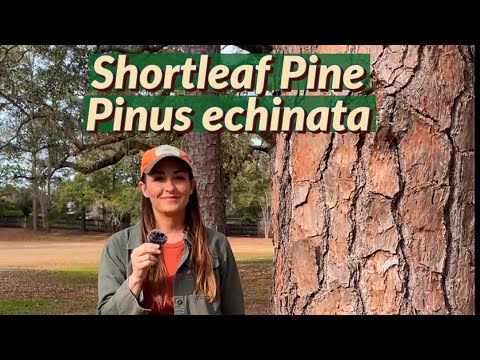
Sand pine differs from slash and longleaf pine through its much shorter needles, while habitat helps separate it from short-needled spruce pine. Check the whole trait combination rather than identifying a pine from needle length alone.
Sand Pine vs Slash Pine
Sand pine usually carries two needles per bundle, each about 2–3.5 inches long. Slash pine normally carries two or three needles measuring roughly 7–12 inches, creating a long drooping tuft at the twig end.
Habitat provides another clue. Sand pine favors dry scrub sand, while slash pine commonly occupies moist flatwoods, wet margins, and commercial plantations.
Sand Pine vs Longleaf Pine
Longleaf pine carries three needles per fascicle, commonly 8–18 inches long. Seedlings also pass through a distinctive grass stage, and older trees develop thick bark that provides greater fire resistance.
Sand pine lacks a grass stage, keeps much shorter foliage, and often dies in a severe fire. Longleaf pine cones are also far larger than the compact cones normally found on sand pine.
Sand Pine vs Spruce Pine. Spruce pine (Pinus glabra) creates the closest foliage confusion because it also has short, paired needles. Spruce pine usually grows in moist, shaded hardwood forests, while sand pine points to open, dry, infertile sand.
Pine Identification Table. Needle count, needle length, habitat, bark, and fire strategy provide the most useful field comparison.
| Species | Needles | Cones and bark | Typical habitat | Fire strategy |
|---|---|---|---|---|
| Sand pine (Pinus clausa) | 2 per bundle; about 2–3.5 inches | Small, often persistent cones; thin plated bark | Florida scrub and deep dry sand | Mature trees often die; some cones open after heating |
| Slash pine (Pinus elliottii) | 2 or 3; about 7–12 inches | Larger cones; plated bark | Moist flatwoods and plantations | Older trees have moderate fire tolerance |
| Longleaf pine (Pinus palustris) | 3; about 8–18 inches | Very large cones; thick bark with age | Sandhills and coastal plain uplands | Grass-stage seedlings and mature trees tolerate frequent surface fire |
| Spruce pine (Pinus glabra) | 2; about 1.5–4 inches | Small cones; relatively smooth young bark | Moist hardwood forests | Low adaptation to frequent fire |
For comparison with another commercially common southeastern species, the loblolly pine profile covers a taller pine associated with broader forestry use and longer needles.
Growing Sand Pine and Preventing Decline
Sand pine grows best in full sun on deep, acidic, fast-draining sand. Most cultivation failures come from wet compacted soil, excessive irrigation, damaged roots, or placement in confined urban spaces.
Climate and Sunlight
Use sand pine within a climate resembling its native Florida and Gulf Coastal Plain range. Full sun supports dense foliage and balanced growth; shade encourages sparse crowns, leaning stems, and lower branches reaching toward open light.
Cold tolerance can vary with provenance. A seedling collected from peninsular Florida may react differently from western Panhandle stock, so a nursery’s seed origin matters near the edge of the species’ climatic range.
Soil and Drainage
The best rooting zone is sandy, airy, and acidic to mildly acidic. After heavy rain, water should move through the profile rather than leaving a slick, saturated surface around the trunk.
Don’t amend a small clay planting hole with sand. The contrast between the loose hole and dense surrounding soil can create a water-holding basin; either improve a broad soil area or choose another tree.
Watering and Fertilization. Water a newly planted tree deeply, then let the soil drain and begin drying before watering again. Frequent shallow irrigation keeps roots near the surface and may leave them poorly anchored during wind.
Fertilizer rarely corrects a bad site. High nitrogen can produce soft extension growth and a top-heavy crown, so test the soil before applying nutrients and avoid feeding a tree simply because its native soil appears lean.
Placement and Transplanting. Allow for a 15–40-foot crown and the possibility of forked or irregular limbs. Keep the tree away from roofs, power lines, narrow parking islands, septic components, and areas where falling branches would create a serious risk.
Move nursery stock while it’s young and preserve the root ball. A damaged root mass feels loose and crumbles away from the fine roots; once that happens, the tree can wilt in dry sand before replacement roots form.
Practical Notes From Real-World Use. The most successful plantings are on naturally sandy sites where irrigation can taper after establishment. Trees placed beside lush, frequently watered turf often show pale foliage and branch dieback because the two planting schemes demand different moisture levels.
Container Growing. Containers suit seedlings, bonsai training, and temporary collections better than mature trees. Use a mineral-rich, airy substrate and a pot with several unobstructed holes; a decorative layer of sand at the bottom doesn’t fix a dense mix above it.

Coarse Sand Blend for Well-Drained Mixes
- Coarse texture improves soil aeration
- Helps reduce moisture around roots
- Suitable for sandy planting blends
- Useful as a top dressing for pots
- Versatile for cacti bonsai and terrariums
 Buy on Amazon
Coarse horticultural sand can increase mineral content in a container mix, but it must be blended through the substrate. Avoid very fine construction sand, salty beach sand, and recipes that pack into a dense airless mass after repeated watering.
Poor Drainage and Site Stress. Early symptoms include yellowing needles, sparse new growth, resin around dying branches, and a crown that looks thin against the light. Chronic saturation may lead to decayed roots and a trunk that rocks in wet soil.
The UF/IFAS sand pine profile lists full sun, high drought tolerance, and well-drained sandy soil among the species’ principal site requirements.
Storm and Wind Damage. Inspect mature trees after tropical storms or strong frontal winds. Fresh cracks expose pale, moist wood and often carry a sharp resin smell; hanging limbs, widening forks, and sudden lean call for assessment by a qualified arborist.
Insects and Diseases. Bark beetles may colonize drought-stressed or root-damaged trees, while sawflies and other larvae can consume needles. Root rots become more likely on wet sites, and shoot diseases can deform tender branch tips.
Brown foliage doesn’t prove insect attack. Check irrigation changes, flooding, trenching, root cuts, lightning scars, and soil compaction before using pesticides; correcting the stress source often provides more value than treating a secondary pest.
Sand Pine Wood Uses and Limitations
Sand pine wood has served mainly as pulpwood, paper fiber, and fuelwood rather than premium furniture or structural lumber. Small diameters, crooked trunks, large branches, and knots limit the amount of clear usable material.
Pulpwood and Fuelwood
Commercial sand pine planting has focused heavily on fiber production. Pulp mills can use smaller and less visually attractive stems that wouldn’t yield much high-grade sawtimber.
Sand pine firewood burns like other resinous pines: it lights readily and can produce a bright, lively flame. Season it before use, keep resinous wood out of open indoor fireplaces prone to sparks, and maintain the chimney because incomplete combustion can increase flammable deposits.
Wood Characteristics
Sand pine is a softwood in botanical terms because it comes from a conifer. That label doesn’t provide a dependable hardness, strength, or dent-resistance value for a particular board.
Scrub-grown logs often contain sweeping grain, knots, reaction wood, and abrupt changes around limbs. Freshly cut surfaces can feel slightly tacky where resin gathers, and the wood releases a sharp pine scent under a saw or plane.
Woodworking Considerations. Straight plantation material is usually easier to mill than a twisted open-grown trunk. Use sharp cutters, support grain near knots, clean resin from blades, and dry boards slowly enough to reduce checking, warping, and pitch movement.
A beginner’s common mistake is building from freshly sawn pine before checking moisture content. As the wood dries, joints can open and wide boards can cup, so acclimate the stock and confirm its moisture with a calibrated meter.
Structural Use Cautions. Don’t substitute an ungraded sand pine board for construction lumber based on appearance or the broad “southern pine” label. Load-bearing work requires recognized grades, stamps, span data, and engineering specifications that apply to the actual material.
Knots, slope of grain, drying checks, decay, and moisture condition can reduce strength more than the species name suggests. For shelving, trim, or rustic furniture, select each board by condition; for framing, use properly graded pine boards.
Lumber Availability and Pricing. Sand pine lumber is rarely distributed nationally under a species-specific label. Local price depends on log diameter, straightness, quantity, harvest access, milling, drying, surfacing, and whether the material is sold as logs, boards, pulp, or firewood.
Ask a seller how the species was identified and whether the boards are kiln-dried, air-dried, rough, surfaced, or graded. Wood sold simply as “pine” may come from slash, loblolly, longleaf, or another species with a much larger commercial supply.
Wildlife, Conservation, and Responsible Sourcing
Sand pine supplies seed, nesting structure, cover, and vertical habitat, but maximum tree density doesn’t always produce the best scrub habitat. Open sand and low vegetation remain necessary for several Florida scrub specialists.
Wildlife Habitat Value
Birds and small mammals eat pine seeds, while branches provide roosting and nesting sites. Fallen needles and woody debris add organic material to soils that begin with very little nutrient-holding capacity.
Florida scrub-jays, gopher tortoises, scrub lizards, and many invertebrates use the larger scrub community in different ways. Some benefit from pine cover, while others require sunny openings and patches of bare sand.
Canopy Density Impacts
Dense, long-unburned sand pines can shade out low shrubs and close open sandy gaps. That change may reduce foraging and movement space for species adapted to a patchy scrub structure.
Tree thinning or removal can form part of habitat restoration in one stand, while sand pine regeneration may be a goal in another. Managers base that choice on stand age, wildlife needs, fuel conditions, prior disturbance, and the desired mix of open and wooded stages.
Protection and Removal Rules. Sand pine isn’t broadly listed as a federally endangered tree, but its habitat may support protected plants or wildlife. Municipal ordinances, county rules, conservation easements, homeowners’ association terms, and public-land regulations may still control removal.
Check the property record and local rules before cutting. Never collect cones, seedlings, or wood from parks, conservation land, roadsides, or managed forests without written permission.
Restoration and Local Provenance. Match planting stock to the regional variety and project site. Ocala-origin seedlings aren’t an automatic substitute for Choctawhatchee stock because their cone behavior and regional adaptation can differ.
A sound restoration plan accounts for surrounding oaks, open sand, wildlife objectives, future canopy density, and professional fire management. Planting rows of pines without a long-term disturbance plan can produce a crowded stand that loses the structure the project intended to restore.
Seedling and Seed Sourcing. Buy from a native-plant nursery that records seed origin and botanical identity. Ask for the county or ecological region of collection, the variety when known, propagation date, root-container type, and any treatment used to open cones.
Inspect seedlings for circling roots, buried root collars, broken leaders, and sour-smelling saturated substrate. A healthy root plug should hold together without being a hard spiral of woody roots pressed against the pot wall.
Responsible sourcing protects local genetics and avoids damage to sensitive scrub habitat. The best sand pine is one whose provenance, site, and purpose align, whether the goal is ecological restoration, a specimen planting, fiber production, or small-scale woodworking.
FAQs
What Is A Sand Pine Tree?
A sand pine is a small to medium evergreen pine native to sandy coastal and inland areas of the southeastern United States. It is also called spruce pine in some regions and grows well in dry, nutrient-poor soils. Its narrow crown and heat tolerance make it useful for natural landscapes and restoration plantings.
How Can You Identify Sand Pine Bark And Needles?
Sand pine bark is thin, gray to reddish brown, and becomes scaly or plated as the tree ages. Its needles are usually short, stiff, dark green, and arranged in pairs, often with a slight twist. Look for small to medium cones and a generally irregular, open crown to help confirm identification.
Where Do Sand Pines Grow Naturally?
Sand pines grow naturally in sandy, well-drained areas of the southeastern United States, especially Florida. They are common in scrub, sandhills, dunes, and dry coastal plains. These trees tolerate poor soil, drought, heat, and salty air better than many other pine species.
Do All Sand Pine Cones Need Fire To Open?
No, not all sand pine cones need fire to open. Some cones open and release seeds naturally when they mature, while serotinous cones may remain sealed until exposed to fire heat. Fire can help certain populations regenerate, particularly in fire-adapted Florida scrub habitats.
What Is Sand Pine Wood Used For?
Sand pine wood is mainly used for pulpwood, paper products, and low-grade lumber. The wood is generally lightweight and not valued for fine woodworking because it often has knots and irregular grain. It may also be used for pallets, crates, fuelwood, and other utility products.
Affiliate Disclosure: Some links in this post are affiliate links. If you make a purchase through these links, we may earn a small commission at no extra cost to you. We only recommend products we genuinely believe in.