
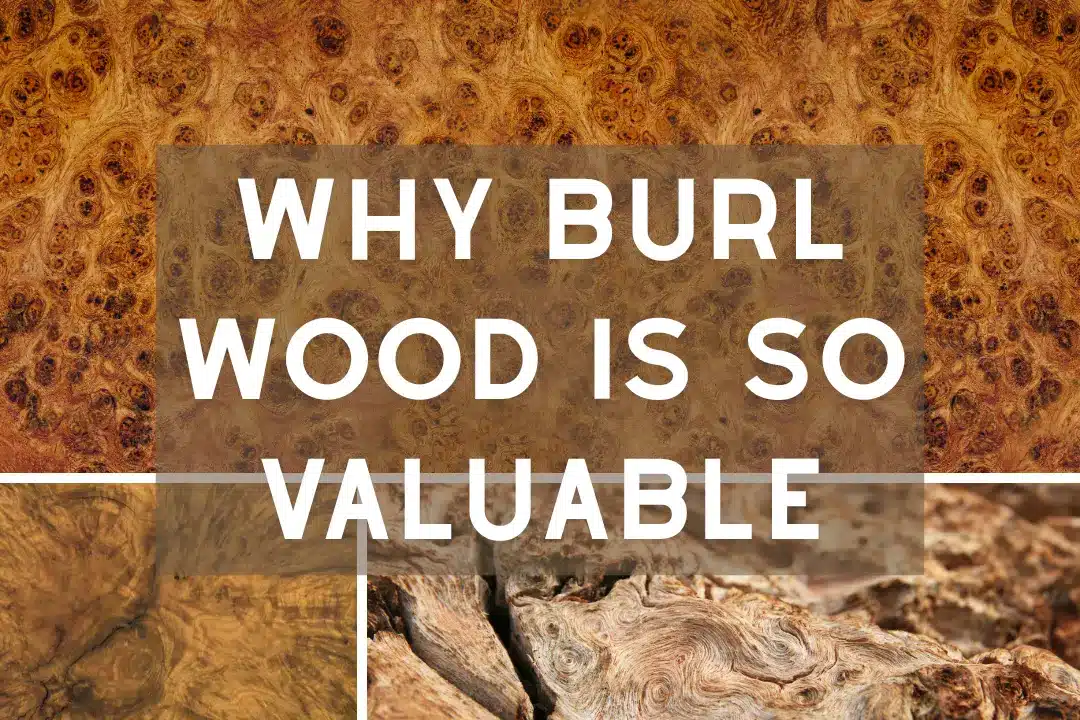
Burl Wood: How It Forms, What It Is Worth, and How to Use It

Burl wood comes from an abnormal woody swelling where fibers grow in irregular directions, creating eyes, swirls, curls, and interlocked grain. Its value depends on species, figure, usable size, dryness, defects, processing, and documented legal origin.
A burl isn’t a tree species, and a large swelling isn’t automatically valuable; bark pockets, cracks, decay, insects, and soil can leave surprisingly little usable timber.
Table of Contents
What Burl Wood Is and How It Forms

A tree burl is a woody growth on a trunk, branch, crown, or root system. Repeated changes in fiber direction produce the distinctive burl grain seen after cutting, but the exterior rarely reveals exactly what lies inside.
Burl, Burr, and Grain
Burl is the standard American spelling, while British timber dealers often use “burr.” Both describe the growth form or wood cut from it, rather than a botanical species. Normal grain follows a trunk or branch; burl fibers twist around buds, scars, and each other.
Cut surfaces may reveal dense eyes, lace-like pins, rolling curls, bark islands, or cloud-shaped color. For a broader comparison of fiber direction and figure, see this guide to wood grain patterns.
Formation and Possible Triggers
Burls develop when local growth becomes disorganized around cambium, xylem, dormant buds, or adventitious buds. The tree adds fresh layers around that tissue each season, slowly enlarging the woody swelling.
Possible triggers include injury, frost, fire, insects, infection, environmental stress, repeated bud growth, and genetic abnormalities. An exterior photograph rarely proves a single cause, and calling every burl “tree cancer” gives a false diagnosis.
Trunk, Branch, and Root Burls: Trunk and branch burls are easy to see but may contain deep bark seams. Root burls and lignotuber-like structures can hold sand, stones, or wire; their gritty surface rasps against gloves and can strip teeth from a clean bandsaw blade.
Burl Photos and Cut Figure: Useful burl photos show the whole growth, attachment point, end grain, and several freshly cut faces. A light mist of water or denatured alcohol temporarily deepens the color and makes figure easier to judge without leaving a permanent coating.
Burl Versus Similar Figure: Bird’s-eye has small eye-like marks but needn’t come from a visible burl. Crotch wood forms feather or flame patterns where stems divide. See bird’s-eye maple for a closer comparison.
Galls, Cankers, and Spalting: A gall is abnormal plant tissue produced after biological or physical stimulation, while a canker is an area of dead bark and cambium. Spalting describes fungal color or zone lines; a piece can be both burl and spalted wood.
Crown gall can be associated with bacteria historically named Agrobacterium tumefaciens, yet that doesn’t make every woody lump a crown gall. The University of Minnesota Extension explains how crown gall differs from other swelling and wound responses.
Common Burl Wood Species

Maple, redwood, walnut, oak, buckeye, madrone, manzanita, and desert ironwood can produce saleable burl. Parent-species properties provide a useful baseline, but distorted grain, decay, mineral deposits, and resin treatment can change the behavior of an individual burl blank.
Maple Burl
Bigleaf, sugar, red, and box elder maple burls can show tight eyes, quilted movement, pale curl, and dark bark lines. Bigleaf maple parent wood averages about 34 lb/ft³ dried and 850 lbf Janka hardness, making it easier to shape than dense desert ironwood.
Maple burl suits bowls, veneer, guitar accents, boxes, and stabilized knife scales. Soft or punky eyes can tear out under a dull gouge, so light cuts with freshly sharpened edges leave a cleaner surface. Compare the parent material in this maple wood guide.
Redwood Burl and Provenance
Coast redwood burl ranges from warm red-brown swirls to dense clusters of tiny eyes. Parent redwood is relatively soft at roughly 26 lb/ft³ dried and 450 lbf Janka, so dents and crushed edges are a greater concern than with walnut burl.
Buy redwood burl only with credible salvage records from fallen trees, storm damage, approved removals, or documented old inventory. The National Park Service documents poaching damage in protected redwood forests.
Walnut and Oak Burl: Black, Claro, and English walnut burls offer chocolate-brown color, dark veins, and rich eye figure. Oak adds prominent rays and open pores, but thick oak sections can check, honeycomb, or split around bark pockets during drying.
Black walnut parent wood averages about 38 lb/ft³ dried and 1,010 lbf Janka. Claro walnut may show stronger color variation; this profile of Claro walnut explains its reddish and purplish tones.
Buckeye Burl: Buckeye is light and often displays cream, gray, blue-gray, or black-streaked figure. Its soft zones and natural voids make it popular for a buckeye burl table, resin casting, pen blanks, and stabilized scales, but unsupported edges can crumble like dry cork.
Madrone and Manzanita Burl: Pacific madrone and manzanita produce dense, attractive turning stock that may move sharply while drying. Root pieces often conceal grit, so wash and dry the surface before machining; wet soil must be removed without driving stones deeper into checks.
Desert Ironwood Burl: Olneya tesota parent wood averages around 75 lb/ft³ and 3,260 lbf Janka. It feels heavy for its size, develops a glassy polish, and resists wear, yet oil, heat, and density make cutting, sanding, and gluing slower.
Burl Species Comparison Table: These figures describe representative parent wood, not every burl section. Density and hardness data should guide tool and project selection rather than serve as a promise about one natural blank.
| Common name | Typical appearance | Parent density | Parent Janka | Common uses | Main concern |
|---|---|---|---|---|---|
| Bigleaf maple | Pale eyes, curl, quilt | 34 lb/ft³ | 850 lbf | Bowls, veneer, guitars | Soft eyes and tear-out |
| Coast redwood | Red-brown, fine eyes | 26 lb/ft³ | 450 lbf | Slabs, sculpture, veneer | Provenance and dents |
| Black walnut | Brown swirls, dark veins | 38 lb/ft³ | 1,010 lbf | Furniture, bowls, panels | Bark pockets and checks |
| Buckeye | Cream, gray, black streaks | Variable and often light | Variable | Resin work, scales, pens | Voids and soft tissue |
| Desert ironwood | Dark brown, compact figure | 75 lb/ft³ | 3,260 lbf | Handles, jewelry, inlay | Heat and oily surfaces |
What Burls Are Used For
Burls are used for veneer, furniture, tables, desks, bowls, handles, musical-instrument accents, inlays, and resin projects. Project choice should follow usable dimensions, strength, dryness, and defect location rather than figure alone.
Burl Veneer and Furniture
Veneer makes a small amount of premium burl cover large cabinet doors, drawer fronts, wall panels, and decorative boxes. Book matching mirrors adjacent leaves, slip matching repeats their orientation, and four-way matching creates a radial kaleidoscopic pattern.
Thin veneer also reduces the movement and weight that would come with a thick burl panel. A stable substrate and balanced backer veneer help prevent cupping, while careless sanding can cut through an eye figure in seconds.
Burl Tables and Desks
A burl coffee table, buckeye burl table, or burl desk may use a solid slab, veneered panel, or resin-filled cap. Solid slabs need flat mounting methods that permit seasonal movement; rigidly screwing a wide slab to a steel base can create fresh splits.
Bowls and Woodturning: Burl bowls, hollow forms, pens, ornaments, and bottle stoppers display changing figure around every curve. Natural edges look striking, but loose bark and hidden seams can separate at speed. Start with properly prepared turning blanks.
Knife and Tool Handles: Dense or stabilized burl works well for knife scales, hidden-tang handles, chisels, and small grips. Leave room for saw kerf, pin holes, contouring, and crack removal; thin scales may become undersized after flattening both faces.
Burl Guitars and Inlays: A burl guitar commonly uses figured wood for a decorative top, headstock veneer, pickguard, cavity cover, or inlay. Dramatic figure doesn’t automatically make good structural tonewood, so the core, bracing, stiffness, and acoustic role need separate assessment.
Resin and Hybrid Projects: Casting resin can surround sound wood and bridge carefully prepared voids in bowls, tables, jewelry, scales, and pen blanks. Wet wood, trapped air, excessive pour depth, or uncontrolled exothermic heat can cause bubbles, cracks, cloudy resin, and weak bonds.
- Use veneer for broad decorative coverage with low material consumption.
- Choose thick, stable stock for bowls, handles, and carved objects.
- Reserve weak, voided buckeye or maple for stabilization or controlled resin casting.
- Keep heavily cracked pieces away from high-speed turning projects.
- Separate decorative guitar applications from structural acoustic parts.
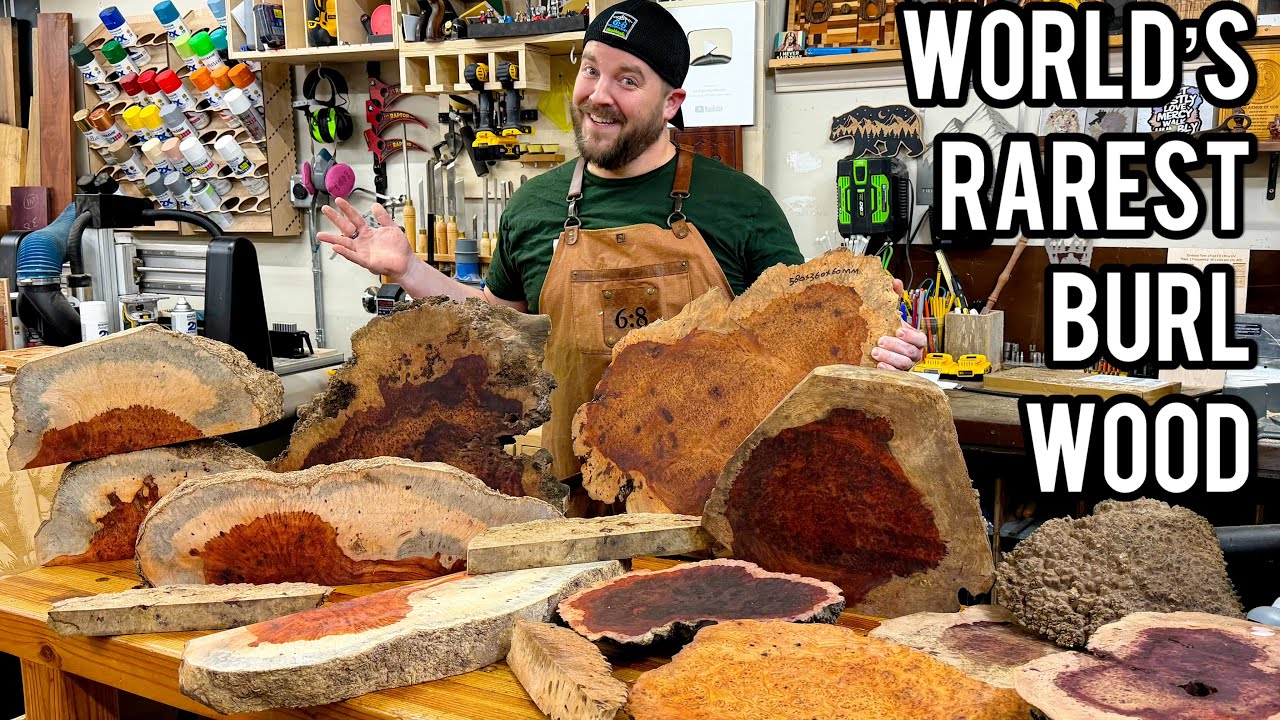
Why Burl Wood Is Valuable
Burl wood can command high prices because strong figure is uncommon, no two cuts match exactly, and processing produces heavy waste. Species, legal origin, dryness, dimensions, eye density, and defect-free yield matter more than the size of the exterior lump.
Visual Rarity and Demand
Furniture makers, turners, luthiers, knife makers, carvers, and interior shops compete for clean, highly figured material. Consecutive veneer leaves gain value because they can form mirrored or repeated patterns that can’t be recreated from unrelated burl cuts.
Usable Yield and Defects
A 200-pound raw burl doesn’t contain 200 pounds of project wood. Thick bark, irregular corners, rot, insect galleries, radial checks, soft tissue, and embedded soil may consume most of it; buyers should price the recoverable pieces, not the gross mass.
Processing and Drying Risks: Mills absorb costs for transport, pressure washing, metal detection, blade damage, slow drying, stabilization, and discarded stock. Sellers also carry the chance that an attractive cap opens to reveal a hollow center or deep bark inclusion.
Board-Foot and Yield Calculations: Multiply thickness, width, and length in inches, then divide by 144. A 2 × 12 × 24-inch rectangular blank contains 4 board feet before waste, but nominal rectangular measurements overstate irregular burl volume.
For a better comparison, calculate board feet and multiply by the estimated recovery rate. A nominal 4-board-foot piece with 60% usable material offers about 2.4 usable board feet; suspected internal decay calls for a lower estimate.
Illustrative Burl Price Ranges: For 2026 planning, small pen blanks often fall near $5–$30, knife-scale sets near $20–$100 or more, and small turning blanks near $30–$300 or more. Large figured slabs may sell for hundreds or several thousand dollars.
Those bands aren’t appraisals. Rare species, professional stabilization, matched cuts, exceptional size, clean figure, and legal documentation can raise the amount, while moisture, cracks, rot, and weak provenance can erase apparent market value.
Valuing a Found Burl: Identify the tree, record dimensions and location, confirm ownership, assess tree condition, and photograph exposed grain only after lawful removal. A burl attached to a living tree can have negative net value once arborist work, tree damage, and hauling are counted.
Ethical and Legal Burl Sourcing
Ethically sourced burl comes from authorized salvage, legitimate tree removal, managed forestry, or documented old stock. Finding a burl doesn’t grant ownership, and cutting one from a living tree creates a broad open wound.
Living-Tree Removal Risks
Removing a burl strips bark and active cambium, exposing the tree to moisture loss, decay organisms, and insects. The wound may weaken the trunk or shorten the tree’s life, so a visible swelling shouldn’t be treated as a detachable surplus growth.
Acceptable Salvage Sources
Suitable sources include naturally fallen trees, storm damage, orchard replacement, urban arborist removals, construction-clearing salvage with permission, legal forestry, and old inventory with traceable records. Save invoices, photographs, dates, addresses, and removal authorization for valuable material.
Ownership and Permits: Trees and attached burls belong to the landowner or managing agency. Cutting on private property without consent, public parks, road rights-of-way, protected forests, or conservation land may amount to theft, timber trespass, or resource damage.
Redwood Poaching Concerns: Illegally cut redwood burls can leave huge trunk wounds and damage protected ecosystems. Reject vague stories such as “forest found” or “old-growth source” when a seller can’t provide names, dates, salvage context, and transferable ownership records.
Lacey Act and CITES: The U.S. Lacey Act can apply to plant products taken or traded in violation of another law. CITES rules depend on the listed species and source; burl wood isn’t covered as one universal trade category. The U.S. Fish and Wildlife Service provides federal guidance.
Provenance and Chain of Custody: Keep the scientific name where known, origin, seller identity, invoice, harvest or salvage permission, transport documents, and import records. A continuous paper trail protects buyers and can increase resale confidence for rare slabs or matched veneer.
How to Buy and Inspect Burl Wood
Before buying burl wood, verify species, provenance, exact dimensions, moisture condition, stabilization, defects, and whether the photographs show the delivered piece. Compare cost against usable project volume after kerf, flattening, crack removal, and final shaping.
Species and Origin
Ask for the common and scientific name plus country or region of origin. Labels such as “exotic burl,” “ironwood,” or “redwood type” are incomplete because trade names can cover woods with very different density, legal status, odor, oil content, and working behavior.
Moisture and Stabilization
Confirm whether the wood is green, air-dried, kiln-dried, oven-dried for resin treatment, or stabilized. Indoor furniture lumber commonly settles near 6–9% moisture content, depending on local equilibrium conditions, but dense, oily, figured, or resin-filled stock may confuse a moisture meter.
Cracks, Voids, and Insects: Inspect every face and end for radial checks, bark pockets, punky tissue, mold, pinholes, fresh frass, stones, and metal. A clear tapping sound can help locate some voids, but it can’t rule out hidden decay.
Figure Quality and Orientation: Look for eye density, contrast, depth, continuity, and matching potential. Side grain, face grain, and end grain can look unrelated, so request several angles plus a lightly misted image if the seller permits it.
Usable Project Dimensions: Add allowances for blade kerf, flattening, cracks, turning tenons, pin locations, and sanding. A 1.5-inch handle blank may lose enough material during squaring to miss a 1.25-inch finished target, especially when both faces rock.
Buyer Inspection Checklist: Use this list before comparing listings. Natural-piece sellers sometimes photograph a representative blank rather than the exact item, which makes crack location and grain orientation impossible to verify.
- Confirm common and scientific species names.
- Request documented origin and legal ownership.
- Verify exact length, width, and minimum thickness.
- Ask how moisture was measured and at what temperature.
- Confirm whether stabilization penetrates the full blank.
- Request photographs of all faces, ends, cracks, and voids.
- Check for insects, soft decay, soil, stones, and metal.
- Calculate usable material after kerf and defect deductions.
- Check shipping weight, packaging, and return terms.
Desert Ironwood Burl Blank: Compact ironwood stock suits knife handles, jewelry, small carvings, and turned pieces. Check the listing’s exact measurements and whether the pictured blank is the delivered item; density makes a seemingly small block feel unexpectedly heavy in the hand.

Desert Ironwood Burl Blank
- Rare Grade A++ desert ironwood
- Dramatic burl ball grain pattern
- Dense exotic hardwood stock
- Sized for carving and wood turning
- Ideal for custom handles and small crafts
 Buy on Amazon
Ironwood Burl Turning Blank: Treat a compact blank as project stock, not a substitute for dimension planning. Confirm crack depth, grain direction, dryness, and mounting room before turning; a short blank can lose useful length when damaged ends are removed.

Ironwood Burl Turning Blank
- Grade A desert ironwood blank
- Distinctive burl ball figure
- Dense hardwood for detailed work
- Great for knife handles and turning
- Compact size for DIY projects
Buy on Amazon
Drying and Stabilizing Burl Wood
Burl wood dries unpredictably because interlocked fibers shrink in competing directions. Slow airflow, sealed end grain, clean stacking, weight records, and corrected moisture readings reduce failures, but no fixed calendar can promise crack-free drying.
Primary Drying Risks
Common failures include end checks, surface checks, internal honeycombing, warp, bark separation, mold, and collapse around soft tissue. The familiar “one year per inch” saying is too crude for burl because species, thickness, climate, airflow, and grain orientation vary.
Cleaning and Metal Detection
Remove soil with water, brushes, and blunt picks, then let the surface dry before sawing. Scan reclaimed trunk material for nails, fencing, screws, bullets, and wire; one hidden object can throw sparks, chip carbide, or ruin a costly bandsaw blade.
Slab Drying and ANCHORSEAL: Seal fresh end grain soon after cutting with ANCHORSEAL or another commercial wax-emulsion sealer. Stack slabs off the ground with dry, evenly spaced stickers, a weighted top, rain protection, shade, and restrained airflow.
Rough-Turning Bowl Blanks: Green burl can be rough-turned before slow drying. Leaving a wall near 10% of bowl diameter is a useful starting point—a 10-inch bowl stays close to 1 inch thick—but distorted grain may require extra material.
Moisture and Weight Monitoring: Weigh small blanks on the same scale at regular intervals and record the date. When weight stops dropping, water loss has slowed; stable weight doesn’t replace a corrected moisture reading or acclimation in the final room.
Vacuum Stabilization Benefits: Vacuum stabilization draws heat-curing resin into dry, porous wood. It can improve dimensional stability, machinability, surface polish, and weak soft areas, which makes it useful for pen blanks, knife scales, jewelry, and compact handles.
Stabilization Limits and Questions: Stabilization doesn’t repair every rotten blank, fill large open voids, or make wet wood ready for use. Ask which resin was used, whether the blank was weighed before and after treatment, how it was cured, and whether voids were separately cast.
Working Burl Wood Safely

Safe burl woodworking starts with stable support, sharp tools, conservative speeds, dust extraction, and repeated crack inspection. Grain reversals cause tear-out, while bark seams and hidden voids can let a rotating blank separate with little visible warning.
Cutting and Milling
Use a cradle, sled, or screwed sacrificial base to stop round burls from rocking. Never freehand an unstable lump against a table-saw fence. Sharp carbide or high-quality steel, shallow cuts, and reduced feed pressure limit catches and grain tear-out.
Secure Woodturning Practices
Balance the blank, use a strong mounting area, rotate it by hand to check clearance, and begin at low speed. Wear safety glasses plus a face shield, stand outside the initial line of fire, and stop often to inspect newly exposed bark inclusions.
Sanding Dense Burl Species: Desert ironwood can burnish instead of cutting when abrasive is dull or pressure creates heat. Fresh paper makes a crisp scratching sound and cool dust, while excessive pressure produces a hot resinous smell and glossy patches that resist finish.
Gluing Oily Burl Wood: Create fresh mating surfaces, avoid polishing them smooth, remove loose dust, and follow the adhesive maker’s preparation rules. Test epoxy or another chosen adhesive on offcuts; gap-filling chemistry can’t compensate for oily contamination or moving cracks.
Filling Voids and Finishing: Remove loose bark before filling stable voids with a compatible epoxy or decorative material. Test oils, shellac, lacquer, polyurethane, or cyanoacrylate on scrap because eyes and soft tissue can absorb finish unevenly and form dark halos.
Dust and Mold Protection: Burl dust carries the hazards of its parent species and may irritate skin, eyes, and lungs. Use effective extraction, eye protection, and a fitted particulate respirator; a properly fitted P100 filter offers more filtration than a basic nuisance-dust mask.
Clean moldy green wood outdoors or under controlled extraction. Dry brushing and compressed air can launch spores into the breathing zone, so damp cleaning and contained disposal create less airborne contamination.
Unstable Blank Hazards: Probe loose bark, mark cracks, and reject blanks with major structural separation. Thin cyanoacrylate can secure minor sound checks in suitable work, but adhesive shouldn’t disguise deep cracks or hold together material that belongs off the lathe.
Practical Notes From Real-World Use
In practical work, the best-looking face often isn’t the safest or most economical cutting orientation. Chalk proposed bowls, scales, or veneer leaves on every face first, then position saw cuts around defects rather than chasing the strongest surface figure.
A freshly opened burl can smell earthy and feel cool or damp several inches from its exterior. If the blade leaves wet fibers or the cut face darkens within minutes, pause processing, seal vulnerable end grain, and reassess the drying plan.
Beginners often pay for total dimensions, skip the moisture question, and assume resin can repair anything. A better method is to sketch the finished parts, add machining allowances, subtract every suspect zone, and buy only when the remaining volume supports the project.
The most valuable burl isn’t always the largest one; it is the legally sourced piece that yields stable, attractive parts with predictable waste.
Practical burl selection principle
FAQs
What Is Special About Burl Wood?
Burl wood is special because its unusual grain creates dramatic swirls, eyes, and patterns that ordinary wood does not have. Each burl produces a one-of-a-kind appearance prized for furniture, veneers, bowls, and decorative pieces. It is also harder to source and work with than straight-grained lumber.
What Causes A Burl To Form On A Tree?
A burl forms when a tree experiences stress, injury, infection, or abnormal bud growth that disrupts its normal grain pattern. The tree responds by producing dense, twisted wood around the affected area. Burls can develop over many years and may continue growing while the tree remains alive.
Why Is Burl Wood So Expensive?
Burl wood is expensive because it is rare, difficult to harvest, and highly valued for its distinctive appearance. A usable burl may take decades to develop, and much of the material can be lost during cutting or drying. Skilled milling and careful finishing also add to its cost.
Does Removing A Burl Kill The Tree?
Removing a burl can seriously injure or kill a tree because the burl is connected to living wood and protective bark. Cutting it away creates a large wound that can allow decay, insects, and disease to enter. Consult a qualified arborist before doing any work near a tree burl.
How Can You Tell Whether A Tree Burl Is Valuable?
A tree burl may be valuable if it is large, sound, accessible, and made from a desirable species such as walnut, maple, redwood, or oak. Value also depends on internal grain quality, cracks, rot, and local demand. An experienced arborist, sawmill, or woodturner can provide a realistic assessment.
Affiliate Disclosure: Some links in this post are affiliate links. If you make a purchase through these links, we may earn a small commission at no extra cost to you. We only recommend products we genuinely believe in.


