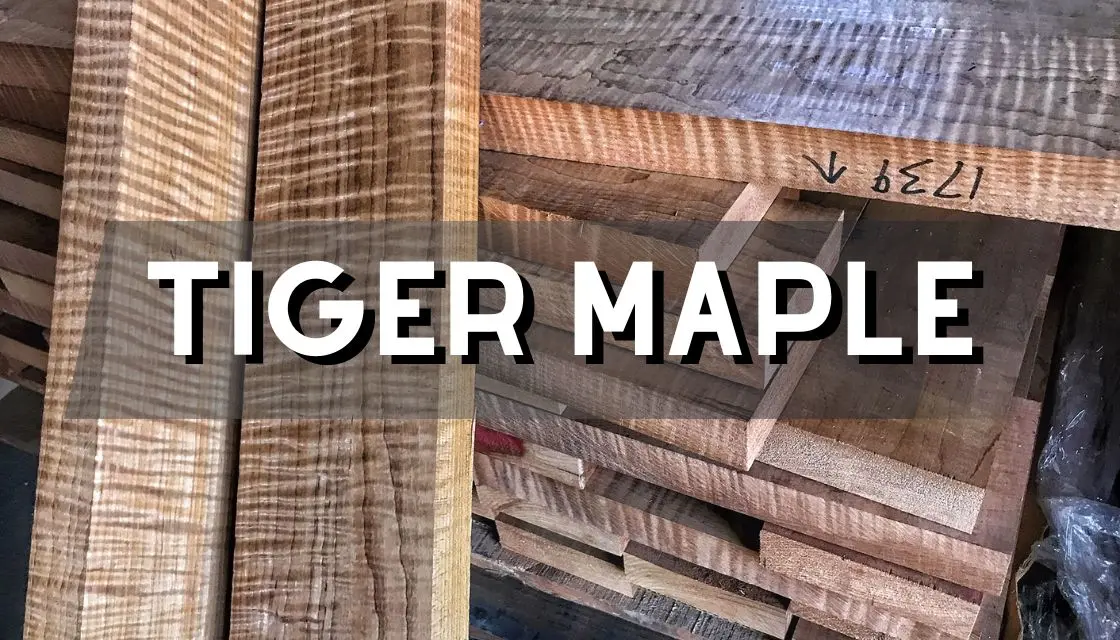


Types of maple trees range from towering sugar maples to compact Japanese maples, yet all belong to the genus Acer and produce paired winged seeds called samaras. This guide compares 19 common species, explains reliable identification traits, and shows how to select a maple for climate, space, fall color, syrup, and long-term care.
Table of Contents
What Is a Maple Tree?

A maple is a tree or shrub in the genus Acer, recognized by opposite branching and paired winged fruits. Many species have palm-shaped leaves, but leaf form varies enough that branches, buds, bark, and seeds often provide better identification evidence.
The Acer Genus
Acer belongs to the soapberry family, Sapindaceae. Older books may use Aceraceae, while modern references such as Kew Science place maples within Sapindaceae. This change affects classification, not the tree’s field traits or care.
Defining Maple Traits
Most maples are deciduous and carry leaves, twigs, and buds in opposite pairs. Their joined seeds have two papery wings that spin through the air with a faint dry rattling sound; gardeners call them helicopters, keys, or whirlybirds.
- Opposite leaves, buds, and branches
- Paired winged samaras
- Simple, often palmately lobed leaves in most species
- Compound leaves on boxelder
- Three main lobes on trident maple
- Deciduous growth in nearly all temperate species
Species Count and Distribution
Botanists recognize about 130 maple species, though totals differ when authorities combine or separate subspecies and synonyms. Asia holds the greatest diversity; native maples also grow across North America, Europe, and northern Africa, with a small number of evergreen or semi-evergreen Asian species.
Species, Hybrids, and Cultivars
A species has a botanical name such as Acer rubrum. A hybrid combines taxa—the multiplication sign in Acer × freemanii marks Freeman maple’s red-maple and silver-maple parentage. A cultivar is selected for traits such as color, form, or reduced seed production.
‘Bloodgood’ is a Japanese maple cultivar, ‘October Glory’ belongs to red maple, and ‘Crimson King’ is a purple-leaved Norway maple. Red summer foliage doesn’t make any of these trees red maple species.
Trade Names and Propagation
Nursery labels often display a trade name more prominently than the cultivar name. Autumn Blaze, for example, identifies the Freeman maple cultivar ‘Jeffersred.’ Read the complete botanical label before comparing plants.
Seeds create genetically variable offspring, so seedlings collected from a named red or Japanese maple may differ in color, vigor, and mature form. Growers preserve cultivar traits through grafting, budding, cuttings, or tissue culture. Buy clonally propagated stock when an exact feature matters.
Maple Tree Types at a Glance
The most familiar maple tree types differ greatly in mature height, cold tolerance, growth rate, and structural strength. A maple suited to a 60-foot lawn can become an expensive problem in a six-foot planting strip.
Species Comparison Table
| Common name | Scientific name | Class | Height | USDA zones | Fall color | Growth | Defining trait | Main limitation |
|---|---|---|---|---|---|---|---|---|
| Sugar maple | Acer saccharum | Species | 60–75 ft. | 3–8 | Yellow, orange, red | Moderate | Syrup-rich sap | Salt and heat sensitivity |
| Red maple | Acer rubrum | Species | 40–60 ft. | 3–9 | Yellow to red | Moderate-fast | Red buds and twigs | Chlorosis in alkaline soil |
| Silver maple | Acer saccharinum | Species | 50–80 ft. | 3–9 | Yellow | Fast | Silvery leaf undersides | Brittle limbs and surface roots |
| Freeman maple | Acer × freemanii | Hybrid | 45–70 ft. | 3–8 | Orange-red | Fast | Red-silver hybrid | Needs structural training |
| Black maple | Acer nigrum | Species | 60–75 ft. | 3–8 | Yellow-orange | Moderate | Drooping leaf edges | Taxonomic disagreement |
| Norway maple | Acer platanoides | Species | 40–50 ft. | 3–7 | Yellow | Moderate | Milky petiole sap | Regionally invasive |
| Japanese maple | Acer palmatum | Species | 10–25 ft. | 5–8 | Yellow to crimson | Slow-moderate | Fine, variable foliage | Heat and wind scorch |
| Paperbark maple | Acer griseum | Species | 20–30 ft. | 4–8 | Orange-red | Slow | Copper peeling bark | Higher purchase cost |
| Trident maple | Acer buergerianum | Species | 20–35 ft. | 5–9 | Yellow to red | Moderate | Three-lobed leaves | May need early training |
| Korean maple | Acer pseudosieboldianum | Species | 15–25 ft. | 4–8 | Orange, red, purple | Slow-moderate | Cold-hardy fine foliage | Dislikes hot, dry exposure |
| Bigleaf maple | Acer macrophyllum | Species | 50–100 ft. | 5–9 | Yellow | Moderate-fast | Very large leaves | Oversized for small lots |
| Vine maple | Acer circinatum | Species | 15–25 ft. | 5–9 | Yellow to red | Moderate | Multi-stemmed habit | Scorches in exposed heat |
| Boxelder | Acer negundo | Species | 30–50 ft. | 2–9 | Yellow | Fast | Compound leaves | Weak wood and short life |
| Amur maple | Acer ginnala | Species | 15–20 ft. | 3–8 | Red | Moderate | Compact, cold-hardy form | Regionally invasive |
| Field maple | Acer campestre | Species | 25–35 ft. | 5–8 | Yellow | Moderate | Pruning tolerance | Regional escape potential |
| Shantung maple | Acer truncatum | Species | 20–30 ft. | 4–8 | Yellow to red | Moderate | Glossy five-lobed leaves | Variable regional availability |
| Striped maple | Acer pensylvanicum | Species | 15–30 ft. | 3–7 | Yellow | Slow | Striped green bark | Needs a cool woodland site |
| Mountain maple | Acer spicatum | Species | 10–25 ft. | 2–7 | Yellow-red | Slow | Northern understory habit | Limited heat tolerance |
| Florida maple | Acer floridanum | Species | 20–60 ft. | 6–9 | Yellow-orange | Moderate | Warm-region sugar-maple relative | Availability can be limited |
Size and Hardiness Caveats
These dimensions and zones are estimates, not promises. The USDA Plant Hardiness Zone Map measures average annual extreme minimum temperature; it doesn’t describe summer heat, wind, drainage, humidity, or road salt.
After three years, two trees of the same species may differ markedly because of root condition, irrigation, seed source, and soil. Cultivars also vary in spread and growth, so check the exact plant rather than relying on a species-level average.
Common Types of Maple Trees
The most common maples include large native shade trees, small Asian ornamentals, woodland understory species, and hybrids selected for urban planting. Each profile below gives the tree’s practical advantages and the limitation most likely to cause long-term failure.
Sugar Maple (Acer saccharum)
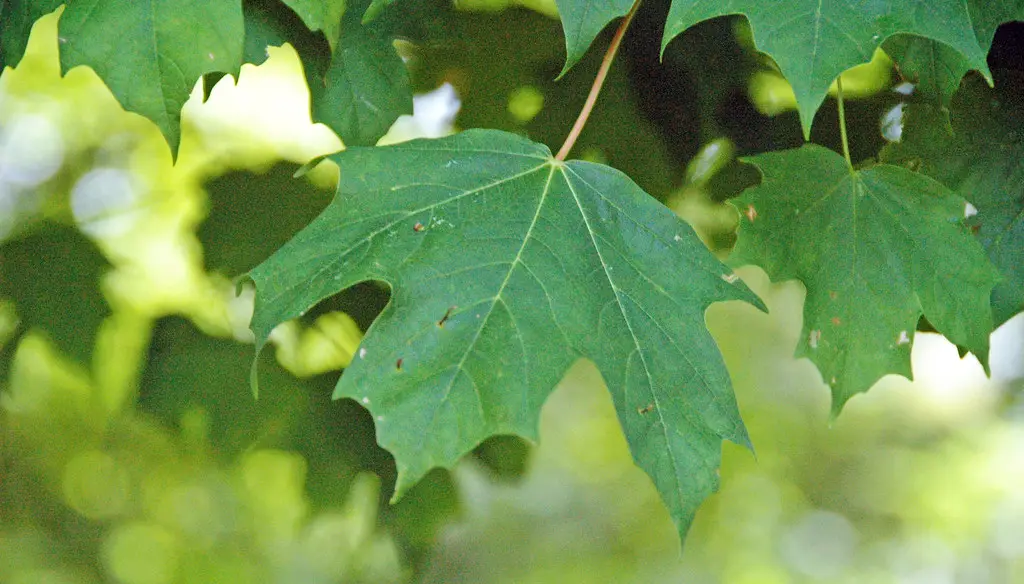
Sugar maple is a 60- to 75-foot eastern and central North American tree known for syrup and layered yellow, orange, and red fall color. Its dense, pale maple wood also makes it an important timber species.
Leaves usually have five lobes and smooth, rounded U-shaped sinuses. Broken petioles release clear sap, while the narrow brown terminal buds feel sharp and dry beneath a fingertip. Deep, moist, well-drained soil supports its best growth.
Avoid sugar maple beside heavily salted roads, compacted parking areas, or hot pavement. Its broad crown and roots need generous soil volume, and repeated drought can thin the canopy from the top down.
Red Maple (Acer rubrum)
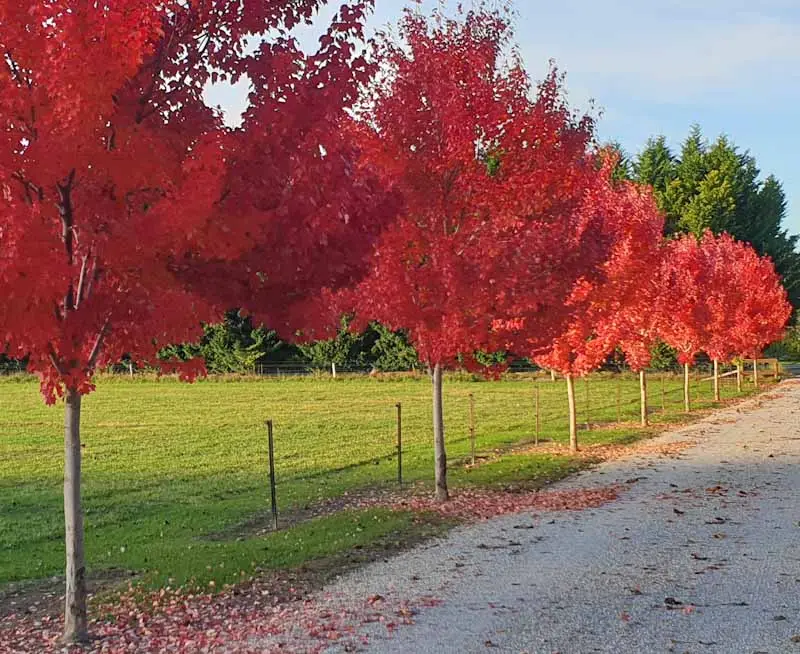
Red maple typically reaches 40–60 feet and grows across a broad part of eastern North America. Its name refers to red buds, flowers, petioles, samaras, or autumn leaves; the summer canopy is usually green. Selected cultivars offer more consistent color than seedlings.
Look for three to five serrated lobes, shallow V-shaped sinuses, and reddish winter buds. High-pH soil can block iron or manganese uptake, leaving yellow leaves with green veins. Adding fertilizer without a soil test rarely fixes this alkaline-soil chlorosis.
Silver Maple (Acer saccharinum)
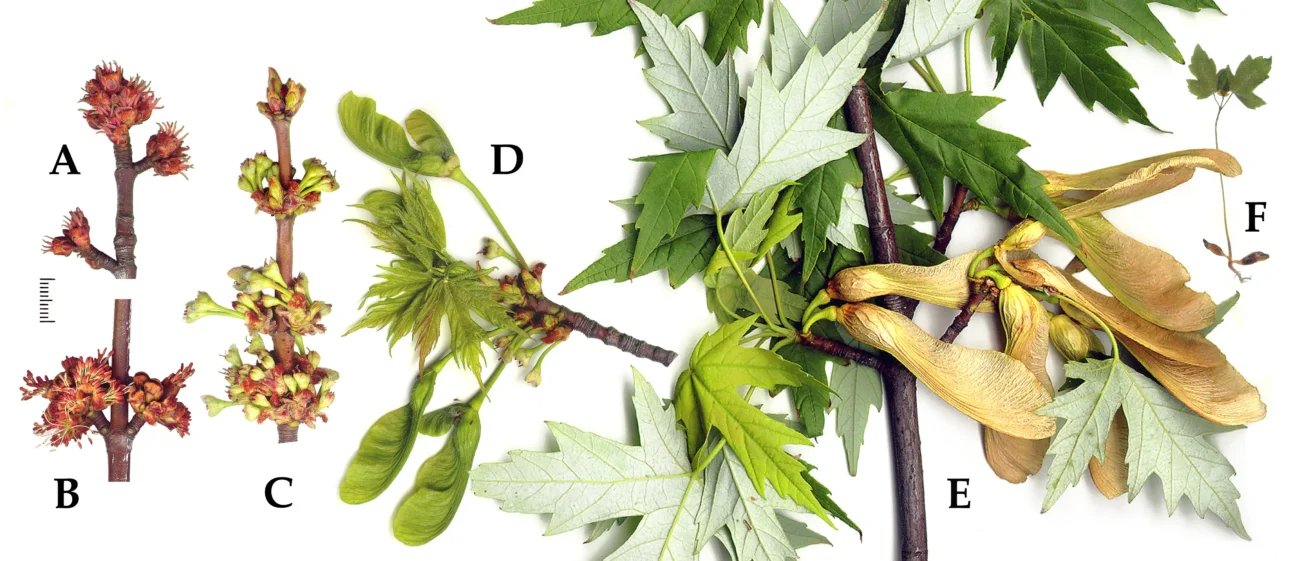
Silver maple is a fast-growing, 50- to 80-foot floodplain tree. Its deeply cut leaves flash pale silver when wind turns their soft undersides upward. For bark, timber, and identification details, see silver leaf maple.
Quick shade comes with serious structural trade-offs: brittle limbs, crowded attachments, aggressive surface roots, and storm breakage. Keep this species away from roofs, septic fields, narrow verges, and paving. Early structural pruning helps, but it can’t change weak wood into strong wood.
Freeman Maple (Acer × freemanii)
Freeman maple is a red-maple and silver-maple hybrid commonly reaching 45–70 feet. It combines silver maple’s vigor with red maple’s stronger fall color. Autumn Blaze is the trade name linked with ‘Jeffersred,’ not a separate maple species.
Fast shoots can form codominant trunks with bark trapped between them. Correct those attachments while branches are small; removing a six-inch limb later leaves a large wound. Cultivars differ in seed production, crown form, and autumn color.
Black Maple (Acer nigrum)
Black maple is a 60- to 75-foot North American syrup tree closely related to sugar maple. Its leaves often have three dominant lobes, drooping margins, and a softly textured underside. Some botanists place it within Acer saccharum, which explains conflicting species counts.
Black maple favors deep, fertile soil and needs room for a broad crown. Its wood, tapping value, and relationship to hard maple are covered further in the black maple guide.
Norway Maple (Acer platanoides)
Norway maple is a 40- to 50-foot European and western Asian tree once planted widely for dense shade and urban tolerance. A snapped leaf stalk releases milky white latex, and its samara wings spread almost horizontally.
The tree escapes cultivation and suppresses understory growth in parts of North America. Check state, provincial, and municipal rules before planting. ‘Crimson King’ is a Norway maple cultivar, not red maple; the Norwegian maple profile covers its wood characteristics.
Japanese Maple (Acer palmatum)
Japanese maple includes upright trees, cascading laceleaf forms, and compact cultivars from roughly shrub size to 25 feet. Foliage may be green, gold, red, purple, or variegated. Cultivars such as Acer palmatum ‘Katsura’ open with orange-edged yellow leaves before turning green.
Fine leaves feel thin and papery, so hot afternoon sun, reflective walls, and dry wind can crisp their edges. Give the roots draining soil and stable moisture. Late frost may blacken tender new tips, but established branches often push a second flush.
Seedlings don’t reproduce a named parent reliably. Choose a grafted, correctly labeled plant if mature size, laceleaf form, or persistent dark foliage matters.
Paperbark Maple (Acer griseum)
Paperbark maple is a slow-growing, 20- to 30-foot Chinese species valued for cinnamon-copper bark that curls away in translucent strips. Low winter light makes the peeling bark glow, giving this tree four-season value after its orange-red leaves drop.
Slow growth and difficult propagation often raise its nursery cost. Place it where the trunk remains visible rather than burying it behind shrubs. Heavy wet soil can damage roots before canopy symptoms become obvious.
Trident Maple (Acer buergerianum)
Trident maple usually grows 20–35 feet and has compact, three-lobed leaves. It tolerates pruning and some urban stress better than many Japanese maples, which makes it useful where a full-sized shade tree would be excessive.
Young trees may carry several competing leaders, so establish sound scaffold spacing early. Yellow, orange, and red fall color varies with cultivar and weather. Check local escape reports before planting this non-native species.
Korean Maple (Acer pseudosieboldianum)
Korean maple brings the delicate form and multicolored autumn foliage of Japanese maple into colder sites, commonly zones 4–8. It usually stays 15–25 feet tall, making it a strong candidate for a small garden tree.
Protection from drying wind and intense afternoon heat still matters. In a hot exposed bed, leaves can feel brittle by midsummer and develop tan edges even when the species survives winter without injury.
Bigleaf Maple (Acer macrophyllum)
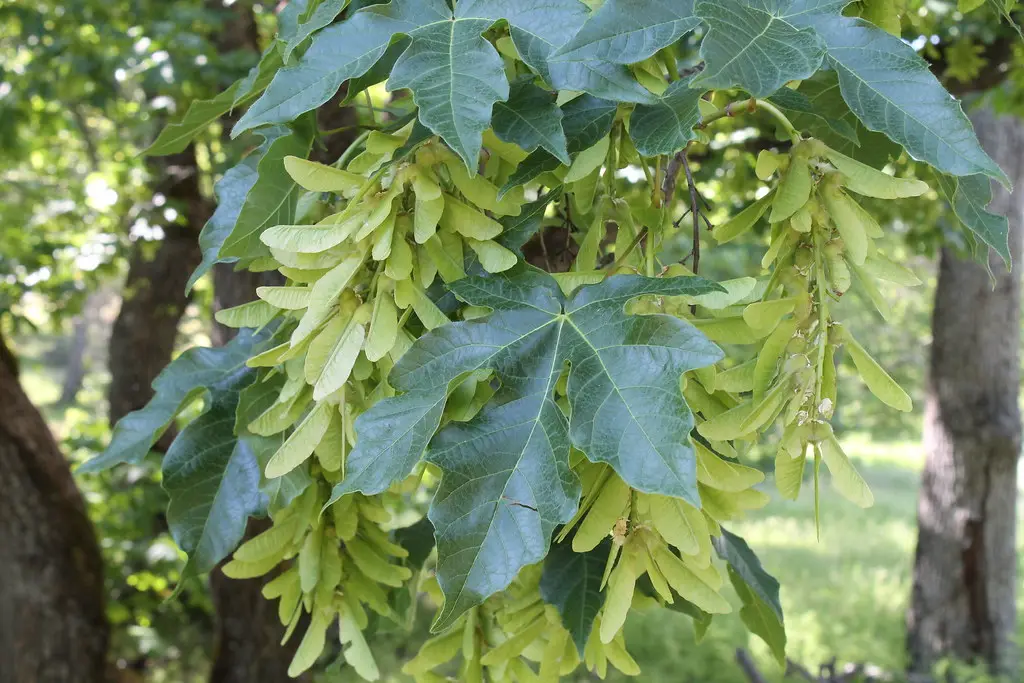
Bigleaf maple is a Pacific coast native that commonly reaches 50–100 feet. Leaves can exceed 12 inches across, forming a broad canopy that supports mosses, lichens, insects, and wildlife in humid native forests.
This is a tree for acreage, parks, or large regional plantings—not a compact residential yard. Its coarse leaf litter becomes heavy and slick after rain. Sap is tappable, though its sugar concentration and commercial role differ from sugar maple.
Vine Maple (Acer circinatum)
Vine maple is a 15- to 25-foot western North American understory maple with rounded, seven- to nine-lobed leaves. It often grows as several arching stems and develops yellow, orange, or red autumn color.
Filtered light, organic soil, and steady moisture recreate its woodland conditions. Full sun can produce a denser crown in cool coastal climates, while inland heat and dry wind cause fast leaf scorch.
Boxelder (Acer negundo)
Boxelder is a true maple with compound leaves carrying three to seven leaflets. Opposite twigs and paired samaras reveal its identity when the foliage resembles ash or poison ivy more than a familiar maple leaf.
This adaptable 30- to 50-foot native grows fast in disturbed or moist ground, but weak wood and a short life reduce its value near buildings. Female trees support boxelder bugs, which are usually a building nuisance rather than a serious tree pest. Learn about its lumber in the box elder wood article.
Amur Maple (Acer ginnala)
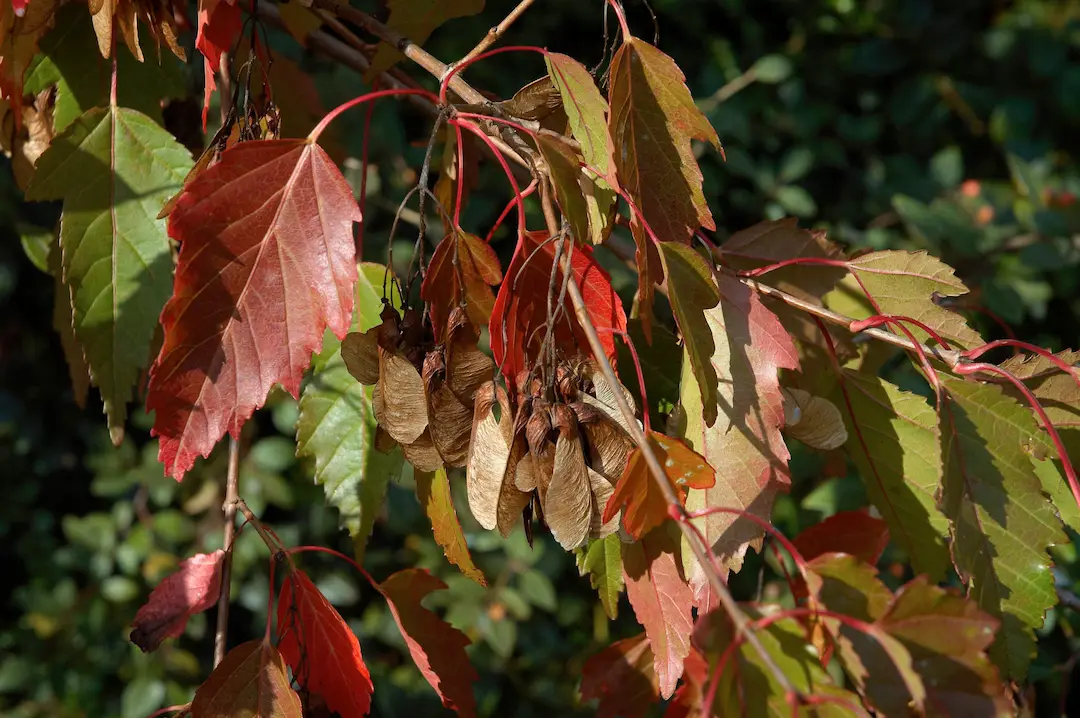
Amur maple usually stays 15–20 feet tall and offers cold hardiness, fragrant spring flowers, and red autumn leaves. Some authorities classify it as Acer tataricum subsp. ginnala.
Its abundant seeds allow it to colonize natural areas in several northern regions. Don’t assume small size makes it environmentally safe; consult local regulated-plant lists and choose a native small tree where invasion risk is documented.
Field Maple (Acer campestre)
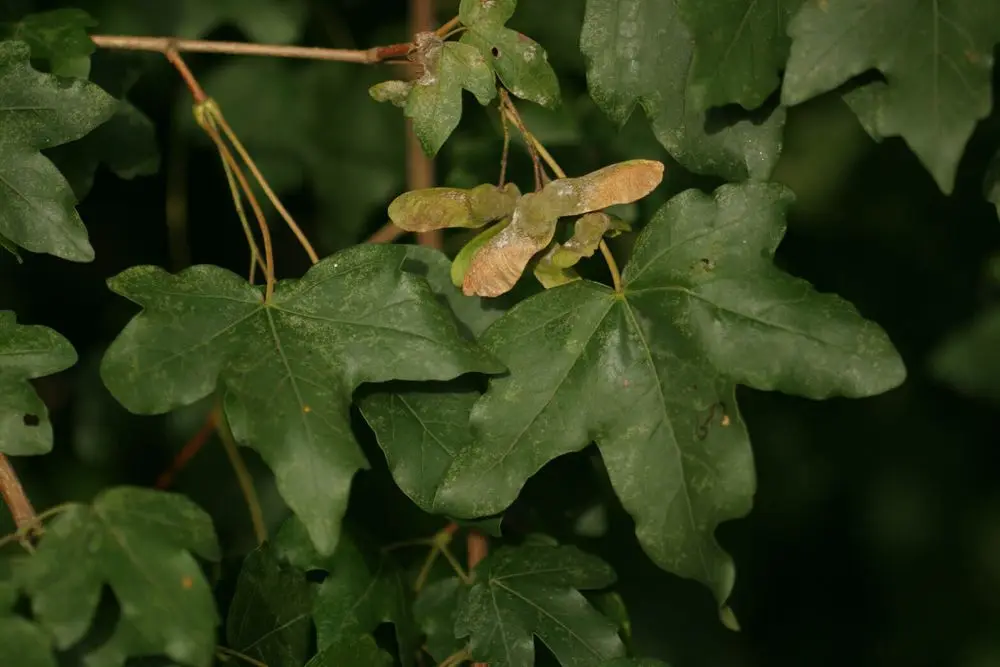
Acer campestre, or field maple, grows about 25–35 feet and accepts regular pruning better than many maples. Its smaller leaves and dense crown explain its traditional use in hedges, screens, and formal plantings.
Field maple tolerates some urban stress, but regional escape potential should be checked before purchase. Its crown still needs more room than a hedge-maintained nursery specimen suggests.
Shantung Maple (Acer truncatum)
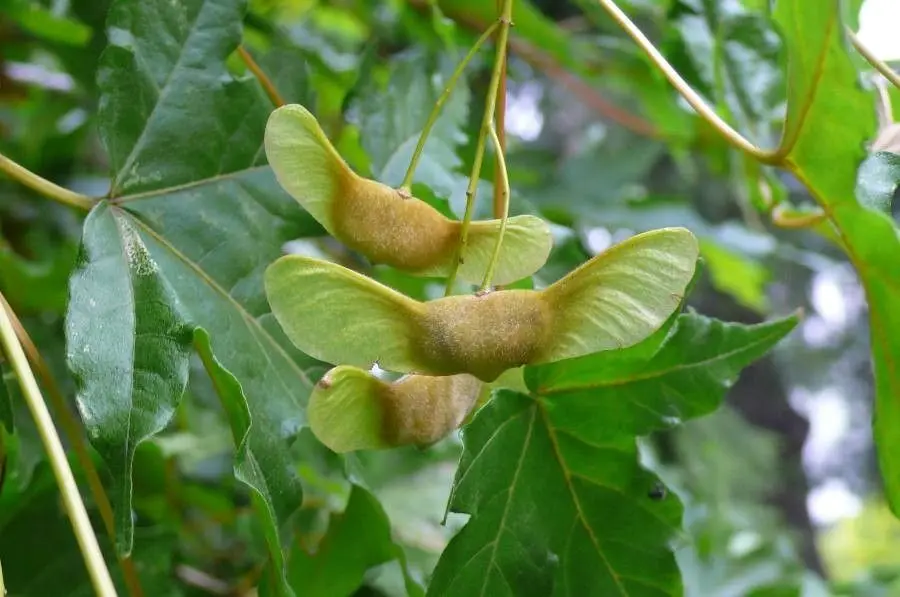
Shantung maple is a 20- to 30-foot Asian species with glossy five-lobed leaves and yellow-to-red fall color. It can work as a medium residential or street tree where local trials confirm acceptable heat, drought, and soil performance.
Don’t confuse Shantung maple with Miyabe maple, Acer miyabei, another medium-sized Asian maple used in urban planting. Nursery availability and cultivar performance vary by region, so local planting records provide better guidance than hardiness numbers alone.
Striped Maple (Acer pensylvanicum)
Striped maple is a 15- to 30-foot eastern North American understory tree identified by green bark marked with pale vertical lines. Its large three-lobed leaves turn yellow in fall. Read the dedicated striped maple profile for further wood and range details.
Cool, moist woodland soil suits it better than exposed turf. Heat, dry air, and compacted roots can thin the crown, making this species a poor substitute for an urban street tree.
Mountain Maple (Acer spicatum)
Mountain maple is a northern North American shrub or small understory tree, usually 10–25 feet tall. Upright clusters of flowers and fruit help separate it from other native maples. It suits naturalized edges where cool root conditions persist.
Its loose form can look untidy in a formal bed, but that branching provides cover and browse in native habitat. Warm, dry regions fall outside its practical range.
Florida Maple (Acer floridanum)
Florida maple is a southeastern North American relative of sugar maple adapted to warmer conditions. Mature height varies from about 20 to 60 feet according to site, and the rounded crown can produce yellow or orange autumn foliage.
This species offers a regional option where northern sugar maple suffers from prolonged heat. Local provenance matters: stock grown from a distant seed source may respond differently to drought, heat, and winter temperature swings.
How to Identify Maple Species
Identify a maple by combining opposite branching, leaf structure, buds, samaras, petiole sap, bark, and mature form. Fall color alone isn’t reliable because many unrelated species and cultivars turn red.
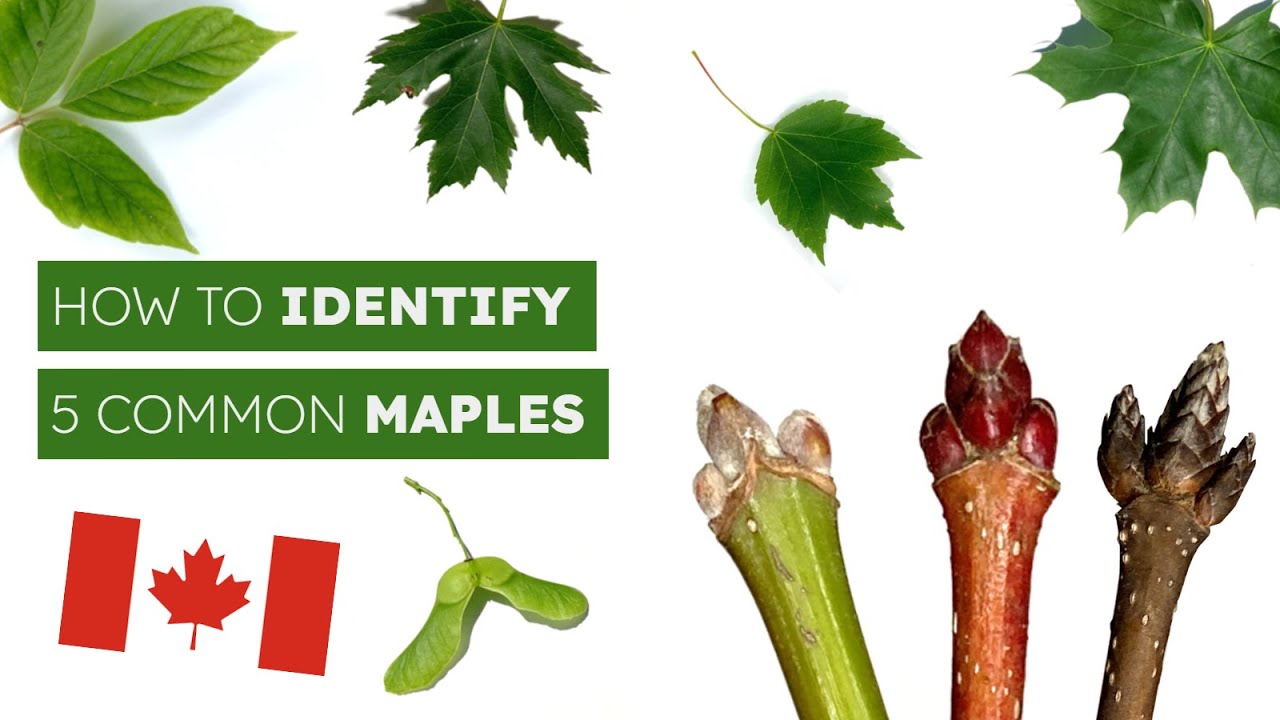
Opposite Branching
Maple leaves, buds, and side branches normally appear directly opposite one another. This quickly separates maples from most alternate-branched trees, but ashes, dogwoods, buckeyes, and horse chestnuts also have opposite growth.
Check several twigs because breakage can hide one side of a pair. On young shoots, run a finger along the twig and feel for the paired bud bumps.
Leaves and Sinuses
Count lobes, study the gaps between them, inspect margins, and turn the leaf over. Sugar maple has rounded U-shaped sinuses; red maple has serrated edges and shallower V-shaped gaps; silver maple has deep cuts and a pale underside.
Trident maple normally has three lobes, while boxelder has several leaflets on one central stalk. Deeply dissected Japanese maple foliage remains simple because each blade forms one continuous leaf.
Buds and Twigs
Winter buds reveal species after leaves fall. Red maple carries small reddish buds and twigs; sugar maple has narrow pointed brown buds; Norway maple buds appear broader and blunter.
Break a fresh leaf stalk only when permission allows. Norway maple produces sticky, opaque white latex, while sugar maple sap remains clear. Cold weather or old leaves may reduce the visible flow, so use this as one clue rather than a verdict.
Samaras and Bark
Compare samara wing angle, size, color, and ripening season. Red and silver maples commonly release fruit in spring or early summer; sugar and Norway maple seeds mature later. Norway maple wings form a wide, nearly straight line.
Bark becomes more useful with age. Paperbark maple peels in copper curls, striped maple stays green with pale stripes, mature sugar maple forms gray-brown plates, and silver maple develops loose shaggy strips.
Sugar, Red, and Norway Maples

| Feature | Sugar maple | Red maple | Norway maple |
|---|---|---|---|
| Sinuses | Rounded, U-shaped | Shallow, V-shaped | Broad and shallow |
| Leaf edge | Mostly smooth | Serrated | Few coarse teeth |
| Petiole sap | Clear | Clear | Milky white |
| Buds | Pointed brown | Small red | Broad, blunt |
| Samaras | Horseshoe angle | Moderately spreading | Nearly horizontal |
Common Identification Mistakes
Beginners often call every red-leaved tree a red maple or reject boxelder because its compound foliage looks wrong. Another mistake is identifying a young tree by bark, which may remain smooth and generic for years.
Use at least three independent features, then compare habitat and mature form. A leaf photo without scale, twig arrangement, or underside detail can support several wrong answers.
Choosing Maple Trees for Your Yard
Choose a maple by matching mature spread, root volume, soil, summer heat, winter cold, moisture, and local regulations. The best shade trees are those that fit their sites after 30 years, not those that grow tallest during the first three years.
Large Shade Maples
Sugar maple works in deep, cool soil away from salt; red maple fits a wider moisture range; Freeman maple provides faster canopy development with higher pruning needs. Bigleaf maple belongs on very large properties within or near its native western range.
Measure overhead wires and rooting width before purchase. A healthy 70-foot crown can spread well beyond the small circle shown on a nursery tag, while roots occupy soil outside the branch line.
Small Garden Maples

Japanese, Korean, paperbark, and trident maples are practical small-tree choices. An Amelanchier may also suit a compact native planting, but it isn’t a maple. For the best tree for a small garden, compare mature width before height.
A 25-foot tree can overwhelm a courtyard or scrape siding when planted three feet from a wall. Compact Japanese maple cultivars offer tighter proportions, yet cultivar labels must be checked because species averages hide major size differences.
Maples for Fall Color
Sugar maple offers blended gold, orange, and red; selected red and Freeman maples can deliver scarlet tones; Japanese and Korean maples span yellow through deep crimson. Amur maple colors well where local rules permit it.
Color changes with genetics, day length, moisture, temperature, nutrition, and early frost. Don’t promise identical red foliage each year. A warm wet autumn may produce muted color on a tree that was brilliant the previous season.
Native and Wildlife Maples
North American native maples include sugar, red, silver, black, bigleaf, vine, boxelder, striped, mountain, and Florida maple. Native status must match the planting region; bigleaf maple is native in the West but not in an eastern woodland.
Native maples support insects, birds, fungi, and food webs, but ecological value doesn’t erase physical constraints. A silver maple remains a risky choice beside a roof, and a bigleaf maple still outgrows a narrow lot.
Cold and Warm Climates
Sugar, red, Freeman, Korean, and boxelder maples tolerate cold winters when their provenance suits the region. Stock derived from southern populations may respond differently from locally adapted material, even under the same species name.
Warm-region options include Florida maple, trident maple, regionally selected red maples, and heat-tolerant Japanese maple cultivars in protected positions. USDA zones measure winter lows, so combine them with local heat records and extension recommendations.
Wet and Urban Sites
Red and silver maples handle periodic wetness better than sugar or Japanese maple, but no maple thrives indefinitely in oxygen-starved compacted clay. Standing water around a root ball can smell sour and produce soft, dark roots.
Urban selection must account for road salt, high pH, reflected heat, restricted soil, pollution, and drought. Trident, field, Freeman, and selected red maples may perform acceptably where local trials support them. Norway maple’s toughness doesn’t cancel invasive restrictions.
Maples Near Buildings
Maple roots don’t deliberately attack foundations, but they proliferate in moist, oxygenated soil and can exploit existing cracks. Surface roots may lift paving where soil is thin or compacted.
Keep large silver, red, Freeman, sugar, and bigleaf maples out of narrow beds beside buildings. Use projected crown spread, utility clearance, and available rooting volume rather than the nursery tree’s present size.
Invasive and Regulated Maples
Norway and Amur maples are invasive or regulated in several North American jurisdictions. Field and trident maples also warrant regional checks. A species can remain acceptable in one state while appearing on a prohibited list across the border.
Search state agriculture, natural-resources, and municipal planting lists before ordering. This check also prevents a beginner’s common mistake: paying shipping charges for a plant the seller can’t legally deliver.
Which Maple Trees Produce Syrup?
Sugar and black maples are the leading syrup trees, but red, silver, bigleaf, Norway, and boxelder maples also produce usable sap. The main differences are sugar concentration, flavor, flow timing, and yield.
Sugar and Black Maples
Sugar maple dominates commercial production because its sap often carries more sugar than sap from many other species. Black maple is closely related and equally useful where healthy mature trees occur.
Other Tappable Maples
Red, silver, bigleaf, Norway, and boxelder maples can be tapped. Lower sugar content means more sap, fuel, and boiling time. Early-budding species may also develop off-flavors sooner as spring growth begins.
Sap-to-Syrup Ratio
The familiar estimate is 40 gallons of sap for one gallon of syrup, but that assumes sap near 2% sugar. The North American Maple Syrup Council Research Fund provides production resources explaining how sap chemistry affects processing.
The Rule of 86 estimates gallons of sap by dividing 86 by sap sugar percentage. Sap at 2% requires about 43 gallons per finished gallon; 3% sap requires about 29 gallons. Finished syrup contains roughly 66–67% soluble solids.
Tapping Conditions
Sap runs best during repeated freezing nights and above-freezing days. Use trunk diameter and local producer guidance, not age alone, to decide whether a tree can support a tap.
Never tap a newly planted, severely stressed, or undersized tree. Drill with clean equipment, avoid old wounds, and don’t plug the hole with foreign material after the season; healthy wood closes around it naturally.
Maple Growth, Care, and Common Problems
Maple failures most often start with poor species selection, buried root flares, restricted roots, drought, or weak branch unions. Pests and diseases matter, but correcting basic site and planting faults prevents more trouble than routine spraying.
Growth Rates and Size
Fast-growing maples may add more than 24 inches in a favorable year; slow trees may add under 12 inches. Silver, Freeman, red, and boxelder often grow quickly, while paperbark and many Japanese maple cultivars develop slowly.
A fast tree isn’t automatically superior. Long shoots may carry wide spacing, weak attachments, and higher pruning costs. Root establishment, rainfall, genetics, and soil can make published annual growth figures unrealistic for a particular yard.
Root and Pavement Conflicts
Surface roots become common where irrigation is shallow, topsoil is thin, or deeper soil lacks oxygen. Silver, Norway, red, and Freeman maples can lift pavement when confined to small planting strips.
Cutting major roots to repair paving can destabilize the tree or trigger decline. A professional workaround is to redesign the hard surface with a wider opening, flexible material, or raised route rather than repeatedly shaving roots.
Structural and Storm Risks
Silver maple and boxelder have weak wood, while red and Freeman maples commonly develop codominant stems. Tight V-shaped unions may trap bark, preventing strong wood from connecting across the fork.
Train young trees with a dominant leader and well-spaced scaffold limbs where the species’ form allows it. Never top a maple: topping creates large decay columns and a cluster of weakly attached shoots around each cut.
Soil Stress and Scorch
Red and Freeman maples may become chlorotic in alkaline soil. Sugar maple declines with salt, compaction, and repeated drought, while Japanese maple loses fine roots in waterlogged ground.
Brown leaf margins can reflect heat, wind, drought, salt, damaged roots, or excess fertilizer. Diagnose the root zone before treating foliage. Extra fertilizer can raise salt levels and make scorch worse.
Correct Planting and Watering
Dig a broad hole no deeper than the root ball and expose the first major root before setting the tree. The root flare should sit at or slightly above finished grade. Remove synthetic wrapping and correct severe circling roots.
Backfill mainly with native soil and water slowly across the root ball and surrounding ground. Check moisture by touch: suitably damp soil feels cool and forms a weak clump, while saturated soil smears like putty.
Mulching and Pruning
Spread two to three inches of organic mulch across as much root area as practical, keeping it several inches from the trunk. Mulch piled against bark holds moisture, hides girdling roots, and invites decay.
Remove dead, broken, rubbing, or poorly attached branches. Maple sap may run from late-winter cuts; this looks alarming but is usually less harmful than the structural defect being corrected. Limit large live cuts and avoid flush cutting.
Pests and Diseases
Verticillium wilt can cause sudden wilting, branch dieback, and stained vascular tissue; no simple curative spray exists. Tar spot creates black leaf patches that are usually cosmetic, while anthracnose causes blotching and distortion during cool, wet springs.
The Asian longhorned beetle, Anoplophora glabripennis, can kill maples. Report suspicious beetles or round exit holes and follow firewood rules described by USDA APHIS. Don’t move suspect wood.
Spotted lanternflies, aphids, and scales feed on sap, but treatment should follow confirmed identification. Boxelder bugs gather around female boxelders and enter buildings; they seldom cause major injury to healthy mature trees.
Professional Tree Care: Practical Notes From Real-World Use
The most useful inspection starts at ground level. If the trunk enters soil like a telephone pole with no visible flare, excavation often reveals deep planting, stem-girdling roots, or both. Treating yellow leaves without exposing that problem wastes time.
Young structural defects are cheaper to correct than mature failures. Removing a thumb-thick competing leader leaves a small wound; waiting until both trunks are heavy can require cables, repeated inspections, or removal.
Hire an ISA Certified Arborist for large cuts, decay assessment, root damage, or branches over structures. Ask whether proposed work follows ANSI A300 pruning standards, and reject quotes that recommend topping as routine maintenance.
Buying Maple Trees and References
Buy a maple by botanical identity, root quality, provenance, and mature fit—not by height or autumn photographs alone. A smaller tree with sound roots often establishes faster than a tall, root-bound specimen.
Nursery Price Factors
Price changes with species, cultivar, grafting, propagation difficulty, container volume, trunk caliper, shipping weight, local supply, installation, and warranty. A two-foot mail-order plant can’t be compared fairly with a professionally installed caliper tree.
Paperbark and specialty Japanese maples often cost more because they grow slowly or require skilled propagation. Common Freeman and red maple cultivars are produced in larger numbers, reducing unit cost at comparable sizes.
Tree Inspection Checklist
Inspect the plant before accepting it. Leaves can recover from shipping stress, but a poor graft, buried flare, or severe root defect follows the tree into the ground.
- Confirm the full botanical and cultivar name.
- Find a visible trunk flare and first structural root.
- Check for circling, matted, or girdling roots.
- Reject major trunk wounds and included bark.
- Inspect graft unions for cracks, swelling, or failure.
- Verify measured container volume rather than relying on photos.
- Ask where the tree was grown and for how long.
- Read warranty exclusions for drought, winter injury, and planting errors.
Shipping and Local Rules
Confirm the seller ships live plants to your state, the species is legal locally, and delivery timing suits planting weather. Bare-root, container-grown, and balled-and-burlapped trees need different handling, and a plant left in a hot delivery box can suffer within hours.
Open packages at once, photograph damage, and check root moisture. Don’t treat seeds advertised for a particular purple or red color as equivalent to a named cultivar; seedlings can vary widely.
Autumn Blaze Freeman Maple
Autumn Blaze is a fast-growing Freeman maple suited to larger sites with sufficient root and crown space. Plan formative pruning while branches remain small, and check local soil pH because alkaline conditions can still trigger chlorosis.

Autumn Blaze Maple Tree
- Hybrid maple with vivid autumn color
- Fast-growing choice for larger landscapes
- Tolerates dry conditions once established
- Supplied in a one-gallon nursery pot
- A popular shade tree for home yards
 Buy on Amazon
American Sugar Maple
A live sugar maple fits cool regions with deep, draining soil and ample mature space. Confirm local provenance, summer heat tolerance, shipping season, and root condition before ordering; cold hardiness alone doesn’t predict urban success.

American Sugar Maple Live Tree
- Native maple known for syrup production
- Classic golden to orange fall foliage
- Live tree arrives two to three feet tall
- Makes an excellent long-lived shade tree
- A traditional choice for cooler climates
Buy on Amazon
Japanese Maple Reference
Japanese maple cultivars differ so much in leaf shape, exposure tolerance, color, and mature form that a specialist reference is useful. Compare named selections rather than choosing from a generic “Japanese maple” label.

Japanese Maples Complete Guide
- Detailed reference for Japanese maple varieties
- Helps compare leaf shapes and seasonal color
- Covers selection for different garden spaces
- Includes practical cultivation guidance
- Useful for new and experienced gardeners
Buy on Amazon
Bloodgood Japanese Maple
‘Bloodgood’ is a clonally propagated Japanese maple cultivar with dark red-to-purple foliage. Color may green slightly in shade or bleach in intense heat, while mature size depends on climate, rootstock, and pruning.

Bloodgood Japanese Maple
- Classic Japanese maple with deep red foliage
- Two-year live plant for garden planting
- Elegant branching creates a focal-point tree
- Ideal for patios borders and small landscapes
- Colorful foliage adds multi-season appeal
Buy on Amazon
FAQs
What Are The Main Types Of Maple Trees?
Maple trees are commonly grouped into native species, ornamental Japanese maples, and sugar-producing maples. Popular types include sugar maple, red maple, silver maple, Norway maple, boxelder, and Japanese maple. Each type differs in leaf shape, mature size, fall color, and tolerance for heat or shade.
How Can I Identify Which Maple Tree I Have?
You can identify a maple tree by examining its leaves, bark, seeds, and overall growth habit. Most maples have opposite leaf and branch arrangement plus paired winged seeds called samaras. Compare leaf lobes, sinuses, and underside color with a local tree guide, especially during summer or fall.
Which Maple Trees Stay Small Enough For A Garden?
Several maple trees remain compact enough for home gardens, especially Japanese maples and selected dwarf cultivars. Coral bark maple, laceleaf Japanese maple, and Amur maple often fit smaller spaces when planted correctly. Check the cultivar’s mature height and width, because pruning cannot permanently keep a naturally large maple small.
Which Maple Trees Can Be Tapped For Syrup?
Several maple species can be tapped for syrup, but sugar maple produces the sweetest sap and the best yield. Red maple, black maple, and silver maple can also be tapped when healthy and mature. Sap is collected in late winter or early spring, then boiled down to make syrup.
What Maple Tree Has The Brightest Red Fall Color?
Red maple often delivers the brightest reliable red fall color, particularly in sunny locations with suitable soil moisture. Cultivars such as ‘October Glory’ and ‘Red Sunset’ are widely chosen for vivid displays. Japanese maples can also turn intensely red, although their color varies more with cultivar, climate, and light.
Affiliate Disclosure: Some links in this post are affiliate links. If you make a purchase through these links, we may earn a small commission at no extra cost to you. We only recommend products we genuinely believe in.