
Hardwood trees are angiosperms—flowering plants that produce seeds enclosed within fruits, nuts, pods, or similar structures. The name describes botanical origin rather than timber hardness: balsa, butternut, and catalpa are hardwoods with relatively soft wood.
Table of Contents
What Are Hardwood Trees?

Angiosperms and Enclosed Seeds
A hardwood tree belongs to the angiosperms, whose flowers develop ovaries that enclose their seeds. An acorn, walnut husk, cherry, maple samara, catalpa pod, and apple all meet this enclosed-seed test, despite looking very different.
Most familiar temperate hardwoods have broad leaves and shed them in autumn. Many tropical hardwoods remain evergreen, so leaf retention doesn’t define the group. Hardwoods include trees such as oak, maple, walnut, cherry, birch, beech, ash, hickory, elm, poplar, butternut, catalpa, and chestnut oak. Our guide to types of hardwood compares more timber-producing species.
The living wood contains vessel elements that transport water. Those vessels appear as pores on end grain, often large enough to see in oak and ash after making a clean crosscut. Gymnosperm wood relies mainly on tracheids and lacks these true vessels, apart from rare botanical exceptions.
Hardwood Is Not Hardness
Hard timber resists indentation, while hardwood identifies a plant group. Balsa is a hardwood at roughly 70 pounds-force on the Janka scale; yew is botanically a softwood yet can be harder and denser than several hardwood species.
Catalpa at about 550 lbf and butternut at about 490 lbf feel soft under a carving gouge. The edge enters with little pressure and leaves a slightly fuzzy surface if it isn’t freshly honed. Sugar maple, near 1,450 lbf, pushes back sharply and transfers more vibration into the handle.
Fruit trees are hardwoods if they’re angiosperm trees. Apple, pear, peach, plum, citrus, and cherry qualify. Palms are flowering monocots and are often placed broadly with hardwoods in trade statistics, but their fibrous, vascular-bundle structure differs from conventional hardwood lumber.
Common classification myths come from appearance. Broad leaves are a useful clue, not the botanical rule; palms and some tree-like monocots complicate the lumber definition. Growth speed also proves nothing: cottonwood and willow can grow fast, while both remain true botanical hardwoods.
Hardwood Trees Versus Softwood Trees

Hardwood versus softwood is chiefly an angiosperm-versus-gymnosperm comparison. Seeds, reproductive structures, and wood anatomy provide firmer evidence than leaf width, seasonal color, growth speed, or timber weight.
Botanical Comparison Table
| Characteristic | Hardwood trees | Softwood trees |
|---|---|---|
| Plant group | Angiosperms | Gymnosperms |
| Seeds | Enclosed in fruit, nut, pod, or ovary-derived structure | Usually exposed on cone scales |
| Typical leaves | Broad and flat | Needles or scales |
| Wood anatomy | Vessels, fibers, and other cells | Mostly tracheids |
| Common pore pattern | Ring-porous or diffuse-porous | No true vessel pores in common commercial species |
| Temperate habit | Often deciduous | Often evergreen |
| Examples | Oak, maple, ash, beech, walnut | Pine, spruce, fir, cedar |
| Key exceptions | Evergreen tropical hardwoods | Deciduous larch and bald cypress |
Pine trees aren’t hardwoods; pines are cone-bearing gymnosperms. Ash is hardwood, as are beech and American elm. Separate guides cover ash wood, beech wood, and elm wood.
Wood Anatomy, Pore Types, and Seasonal Exceptions
Ring-porous hardwoods form conspicuous large vessels early in the growing season and smaller pores later. Oak, ash, elm, hickory, and chestnut show this contrast. It produces bold growth-ring patterns and can make stain collect heavily in open pores.
Diffuse-porous woods such as maple, birch, basswood, and poplar distribute similarly sized vessels across each growth ring. Their end grain looks finer, while planed faces feel smoother before filling. Walnut and cherry often receive semi-ring-porous or transitional labels, depending on the reference system.
Visible pores help identify cut lumber, but finishes, dirt, and a rough saw surface can hide them. A razor-clean end-grain slice viewed through a hand lens reveals far more than the long-grain face. Compare related wood anatomy in our overview of wood types.
Seasonal behavior misleads beginners. Evergreen live oaks and many tropical broadleaf species are hardwoods; larch, dawn redwood, and bald cypress are deciduous softwoods. Botanical reproduction settles the classification when appearance gives mixed signals.
How to Identify Hardwood Trees

Identify a hardwood by combining leaf arrangement, twigs, bark, and reproductive structures. One leaf or bark photograph rarely proves a species because age, shade, drought, injury, and natural hybridization can change its appearance.
Leaves, Branching, Bark, Buds, and Twigs
Start by deciding whether leaves are simple or compound, then record opposite or alternate arrangement. Maples, ashes, dogwoods, and buckeyes commonly show opposite branching. Oaks, walnuts, hickories, butternuts, birches, elms, and cherries use alternate branching.
- Maples usually have opposite leaves, paired buds, and paired branches.
- Oaks have alternate leaves and clustered buds at twig tips.
- Ashes have opposite, pinnately compound leaves and single-winged seeds.
- Walnuts, hickories, and butternuts have alternate compound leaves.
- Catalpas carry very large, heart-shaped leaves in opposite or whorled arrangements.
- Yellow-poplar has a distinctive four-lobed leaf with a squared-off tip.
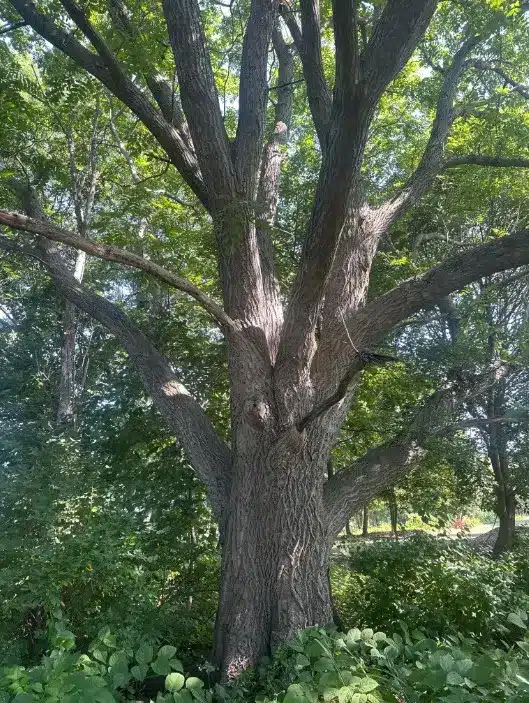
Bark becomes more useful after leaf fall. Mature American beech stays smooth and pale gray; chestnut oak develops thick vertical ridges; shagbark hickory lifts into long curling plates; black cherry forms dark flakes that resemble charred potato chips. Young bark may look nothing like mature bark.
Winter twigs supply clues that casual identification misses. Butternut has chambered pith, a hairy fringe above its leaf scar, and a pale terminal bud. Black walnut also has chambered pith, so confirm nut shape and twig details rather than relying on a split twig alone.
Flowers, Fruits, Nuts, and the Three-Feature Identification Rule
Fruits often settle a difficult identification. Oaks produce acorns, walnuts and butternuts carry husked nuts, maples release paired samaras, cherries bear fleshy drupes, and catalpas hang long capsules that resemble beans.
Use a three-feature rule: confirm leaf or bud arrangement, bark or twig structure, and a flower, fruit, nut, or seed. Check the scientific name against an authoritative record such as the USDA PLANTS Database, since local common names can point to several unrelated trees.
Field experience insight: collect observations from more than one branch and from reachable growth exposed to normal light. Shade leaves may be larger and less deeply lobed, while stump sprouts can look oversized. Photograph the whole crown, bark, twig, and leaf underside before taking a sample.
A fresh yellow birch twig releases a distinct wintergreen smell when lightly scratched. Walnut husks leave a tacky green-brown stain on bare fingers, and catalpa leaves can feel soft and slightly fuzzy underneath. These sensory clues support identification but shouldn’t replace structural evidence.
Common and Best Hardwood Trees
The best hardwood trees depend on the job. Oaks and maples make broad shade canopies, hickory and Osage orange produce hard timber, walnut supplies valuable lumber and nuts, while catalpa tolerates many urban conditions but drops bulky leaves and pods.
Hardwood Species Comparison Table
| Common name | Scientific name | Field clue | Approximate Janka hardness |
|---|---|---|---|
| White oak | Quercus alba | Rounded lobes; acorns mature in one season | 1,360 lbf |
| Northern red oak | Quercus rubra | Bristle-tipped lobes | 1,290 lbf |
| Sugar maple | Acer saccharum | Opposite five-lobed leaves | 1,450 lbf |
| Black walnut | Juglans nigra | Compound leaves; round husked nuts | 1,010 lbf |
| Butternut | Juglans cinerea | Oblong sticky-husked nuts | 490 lbf |
| Black cherry | Prunus serotina | Dark drupes; scaly mature bark | 950 lbf |
| American beech | Fagus grandifolia | Smooth gray bark; long pointed buds | 1,300 lbf |
| White ash | Fraxinus americana | Opposite compound leaves | 1,320 lbf |
| Yellow-poplar | Liriodendron tulipifera | Four-lobed squared leaf | 540 lbf |
| Northern catalpa | Catalpa speciosa | Heart-shaped leaves; long pods | About 550 lbf |
| Chestnut oak | Quercus montana | Rounded teeth; deeply ridged bark | About 1,100–1,200 lbf |
| Osage orange, or bodock tree | Maclura pomifera | Thorns; large green compound fruit | About 2,620 lbf |
Janka figures describe clear, seasoned samples and vary with moisture, growing site, and test procedure. They don’t measure tree safety, rot resistance, drying behavior, or ecological value. Compare red oak versus white oak before selecting oak lumber for wet or dry service.
Oak, Maple, Walnut, Hard Timber, and Best Purpose
A tree that produces hard timber may include Osage orange, hickory, black locust, hard maple, or selected oaks. Osage orange—also called the bodock tree—has exceptionally hard, decay-resistant wood, but twisted grain, thorns, and limited board size reduce its appeal for conventional furniture.
Hickory suits impact loads in handles and sporting goods, while sugar maple suits wear surfaces and fine joinery. White oak combines hardness with tyloses that can restrict liquid movement through heartwood vessels. Read more about hickory wood and maple wood.
For shade, bur oak, swamp white oak, red maple, sugar maple, American elm cultivars selected for disease tolerance, and tulip tree can form large crowns where regional conditions fit. The best oak tree for a dry ridge may be chestnut oak; a periodically wet site may favor swamp white oak or pin oak.
Average mature size varies more by species and site than the hardwood label suggests. Small tree-form serviceberries may stay near 15–25 feet, but cherrybark oak and tulip tree can pass 100 feet. Crown spread, roots, overhead wires, buildings, and sight lines must guide placement.
Fast growth carries trade-offs. Tulip tree, cottonwood, silver maple, and catalpa can produce shade sooner, yet some develop large limbs, weak unions, aggressive roots, or abundant litter. Slow-growing white oak may take longer to fill space but can become a long-lived canopy tree.
These field references and basic tree-care products can help with identification and planting preparation.
Hardwood Tree Species Profiles
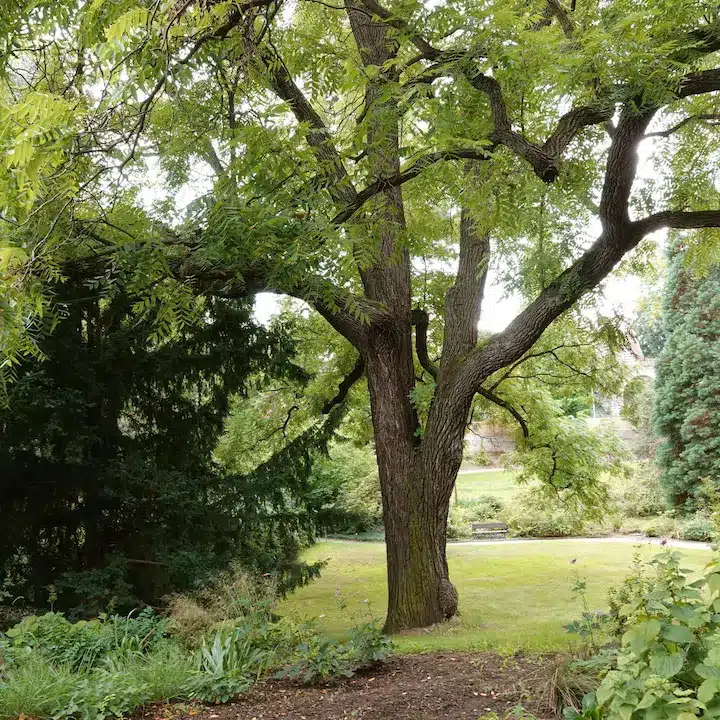
Butternut, catalpa, chestnut oak, and cherrybark oak show why species-level identification matters. All are hardwoods, yet they differ sharply in site preference, mature size, disease exposure, timber hardness, and conservation concerns.
Butternut Tree: Juglans cinerea, Butternuts, and Conservation
The butternut tree, Juglans cinerea, is a North American walnut relative also called white walnut. It commonly reaches about 40–60 feet, bears alternate pinnately compound leaves with 11–17 leaflets, and produces elongated nuts inside sticky, hairy green husks.
Butternuts are edible, oily, and rich-flavored, with a shell that’s difficult to crack cleanly. Squirrels often reach a crop before people do, leaving ragged husks below the canopy. Trees grow best in sun and moist, fertile, well-drained soil; stagnant water and dense shade weaken establishment.
Butternut wood is light tan to warm brown, stable, easy to machine, and softer than black walnut. At roughly 490 lbf Janka, it carves with low resistance and works well for paneling, boxes, furniture, interior trim, and relief carving. Compare its darker relative in our black walnut guide.
Butternut canker, linked to Ophiognomonia clavigignenti-juglandacearum, creates sunken cankers, bark cracks, dark staining, crown dieback, and eventual death. Older references may call the fungus Sirococcus clavigignenti-juglandacearum. Healthy mature trees can carry valuable disease-tolerance traits and shouldn’t be removed without informed assessment.
Hybrid identity matters in restoration. Butternut crosses with Japanese walnut, Juglans ailantifolia, producing hybrids often called buartnuts. Visual checks can be inconclusive, so conservation seed collection may require detailed morphology or genetic testing.
Northern and Southern Catalpa, Chestnut Oak, and Cherry Oak
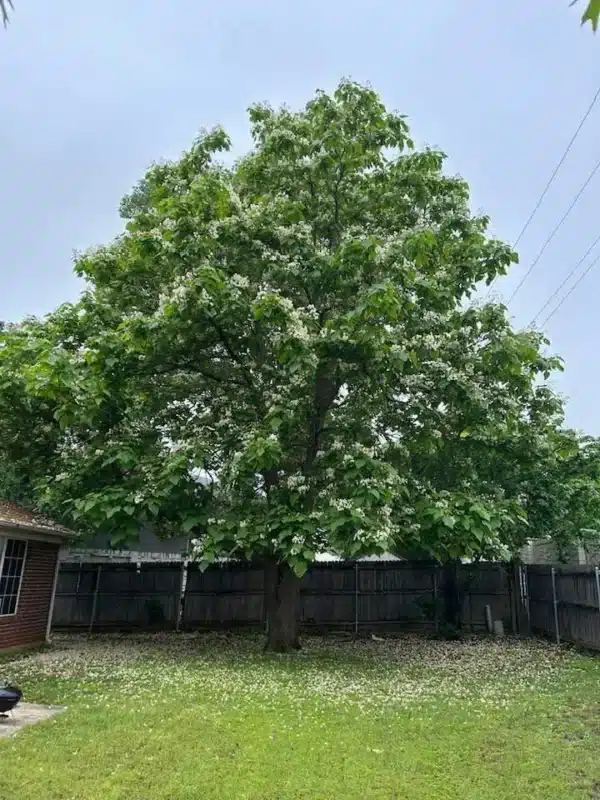
Northern catalpa, Catalpa speciosa, and southern catalpa, Catalpa bignonioides, carry huge heart-shaped leaves, white flowers marked with yellow and purple, and long narrow seed capsules. Northern catalpa is often taller. Both form irregular crowns and need early structural pruning to reduce poor branch unions.
Catalpa wood is a light, relatively soft hardwood near 550 lbf Janka. Its heartwood offers useful decay resistance, which explains its historic use for fence posts despite modest hardness. It also machines easily for carving, turning, rails, millwork, and occasional furniture.
Catalpa’s practical drawback appears after flowering: wilted blossoms, huge leathery leaves, pods, and small twigs collect below the crown. The dry pods rattle in wind, and fallen wet leaves form slick mats. Give the tree room away from gutters, patios, utility lines, and narrow parking strips.
Chestnut oak, Quercus montana, is a white-oak-group species of dry ridges and rocky uplands. Older literature often uses Quercus prinus. It isn’t American chestnut, Castanea dentata; the name refers to its coarsely toothed, chestnut-like leaves.
Mature chestnut oak often reaches 60–80 feet and develops thick, deeply furrowed bark. Its large acorns feed deer, turkeys, squirrels, and other wildlife. Lumber enters the white oak market for flooring, beams, furniture, and related uses rather than always being sold under a separate species label.
Cherry oak is ambiguous. In tree discussions it often means cherrybark oak, Quercus pagoda, a large southeastern red-oak-group tree of fertile bottomlands. In retail listings, the phrase can describe oak stained to resemble cherry or an invented trade name.
Cherrybark oak may reach 80–120 feet on favorable sites. Bristle-tipped lobes place it in the red oak group, while mature scaly bark suggests black cherry. Its lumber serves flooring, furniture, veneer, and interior woodwork; actual cherry wood comes from Prunus, not Quercus.
Hardwood Properties and Uses
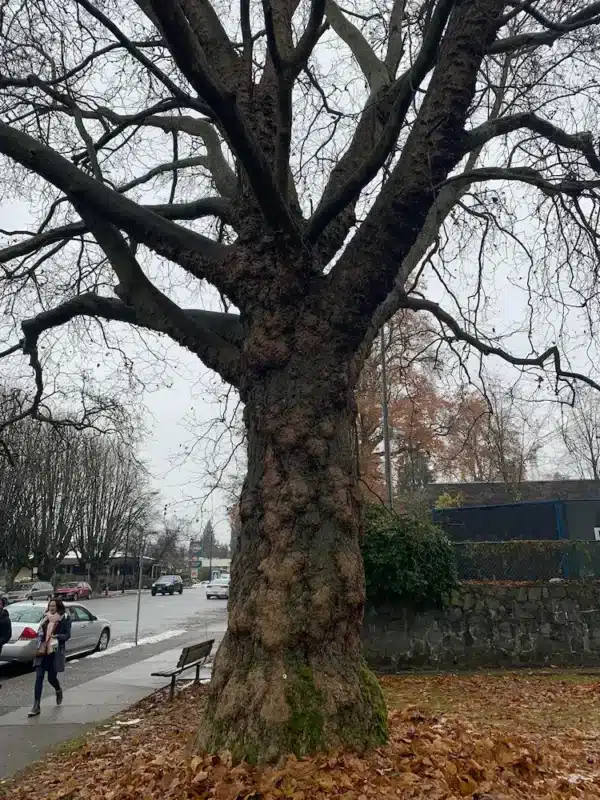
A hardwood species must be judged by hardness, density, stability, pore structure, decay resistance, drying behavior, and grain. No single number predicts performance in flooring, outdoor posts, carving, handles, furniture, or structural parts.
Janka Hardness, Density, Stability, and Rot Resistance
The Janka test records the force needed to embed a steel ball halfway into wood. It estimates resistance to denting and wear, making it useful for flooring comparisons. The USDA Wood Handbook explains how moisture, grain direction, density, and test conditions affect wood-property results.
Hardness isn’t strength. It also doesn’t measure rot resistance, bending stiffness, fastener holding, dimensional movement, or drying risk. Catalpa and black locust can resist decay better than harder species in exposed conditions, while hard maple lacks comparable natural heartwood durability.
Density affects lifting weight, shipping, tool effort, screw holding, and several strength properties. Specific-gravity comparisons need matching moisture and volume bases. A green-volume value can’t be compared fairly with one calculated from oven-dry dimensions.
Grain, Pores, Workability, Uses, Heartwood, and Sapwood
Open-pored oak and ash show strong grain and may need pore filler for a glass-smooth finish. Maple and birch have finer textures but can blotch under stain. Quarter-sawn oak reveals bright medullary-ray fleck that changes as a board moves under the light.
Walnut and cherry machine cleanly when grain runs predictably, but reversing grain can tear under a planer. Butternut and catalpa cut easily yet may fuzz around pores. A sharp, high-angle cutter and a light final pass reduce torn fibers better than aggressive sanding.
| Use | Suitable hardwoods | Main reason |
|---|---|---|
| Flooring | Oak, maple, hickory | Wear resistance and broad supply |
| Furniture and cabinets | Walnut, cherry, maple, oak, birch | Appearance, machining, and finish quality |
| Tool handles | Hickory, ash, hard maple | Shock resistance and strength |
| Carving | Butternut, basswood, catalpa | Low cutting resistance |
| Decay-prone use | White oak, black locust, catalpa | Durable heartwood |
| Veneer and panels | Cherry, walnut, maple, oak | Color and grain figure |
Heartwood and sapwood can behave differently. Heartwood contains extractives that may add color and decay resistance; pale sapwood remains physiologically active before harvest and often lacks the same protection. White oak heartwood can suit wet exposure, but its sapwood shouldn’t receive the same durability rating.
A compact moisture meter can help compare boards before indoor woodworking or installation.
Ecology, Diseases, and Conservation
Hardwood forests supply food, cavities, shade, soil cover, stored carbon, and deadwood habitat. Protecting established trees often preserves more accumulated habitat and carbon than replacing them with young seedlings.
Wildlife, Soil, Water, Carbon, and Forest Diversity
Acorns, hickory nuts, walnuts, butternuts, cherries, samaras, flowers, and tender foliage feed mammals, birds, caterpillars, and pollinators. Mature trunks provide cavities for bats and nesting birds. A standing dead tree can remain valuable habitat where its fall zone presents no risk to people or structures.
Roots bind soil and create channels for water infiltration, while fallen leaves add organic matter and cycle nutrients. Thick leaf litter also moderates temperature and moisture at the soil surface. Removing every leaf from a woodland edge strips away habitat used by fungi, insects, and small animals.
Mixed-species planting limits the chance that one pest removes the entire canopy. A street planted only with ash can lose nearly all shade to emerald ash borer; a mix of oaks, maples, hickories, elms, and other locally suitable trees spreads that risk.
Ash Borers, Oak Wilt, Beetles, and Firewood Quarantines
Emerald ash borer, Agrilus planipennis, kills North American ash by feeding beneath the bark. D-shaped exit holes, serpentine galleries, bark splitting, crown thinning, and heavy woodpecker activity are common signs. Dead ash can become brittle and dangerous much faster than beginners expect.
Oak wilt, caused by Bretziella fagacearum, can spread through root grafts and sap-feeding beetles visiting fresh wounds. Red-oak-group trees often decline faster than white-oak-group trees. Pruning windows and response methods vary by region, so follow local extension or forestry guidance.
Asian longhorned beetle, Anoplophora glabripennis, attacks maples and other hardwood genera. Suspected beetles or round exit holes should be photographed and reported, not moved. The USDA APHIS pest guidance provides reporting and quarantine information.
Buy firewood locally and burn it near its source. Untreated logs can carry emerald ash borer, spongy moth, spotted lanternfly, beetles, and pathogens across county, state, provincial, or quarantine boundaries. Kiln-dried retail wood still needs labeling that meets local rules.
Beginners often stack unknown firewood beside healthy trees, then leave bark and debris through summer. Keep purchased wood separated from valuable hosts, inspect it during handling, and don’t transport leftovers home after camping.
Choosing and Planting Hardwood Trees
Choose a hardwood tree by matching its mature size and biology to the site, not by hardiness zone alone. Drainage, soil pH, summer heat, rainfall, salt, available rooting space, utility clearance, and regional diseases determine long-term success.
Site, Mature Size, Seeds, and Nursery Stock
Measure the distance to buildings, pavement, wires, drains, and neighboring property before buying. A 100-foot cherrybark oak or wide catalpa doesn’t belong under utility lines. Place large shade trees where their mature crowns can develop without repeated topping.
- Seed: low initial cost and broad genetic variation, but slower establishment and possible cold-stratification needs.
- Bare-root seedling: economical and easy to ship, but roots dry quickly and planting must occur during dormancy.
- Container tree: longer planting window, with a higher risk of circling and girdling roots.
- Balled-and-burlapped tree: immediate size, paired with greater transplant stress, handling effort, and watering demand.
Inspect roots before purchase. A thick root circling the pot wall can become a stem-girdling root years later. Slide the root ball out when nursery policy permits; reject severely bound stock or correct young circling roots before planting.
Local provenance can improve adaptation to regional day length, winter timing, rainfall, and pests. For butternut, verify the scientific name, hybrid status, seed source, and disease screening. For ash, ask about emerald ash borer planning before planting susceptible stock.
Planting, Watering, Mulching, and Responsible Sourcing
Find the root flare before digging; nursery soil may cover it by several inches. Dig a broad hole no deeper than the root system, set the flare at or slightly above final grade, and backfill mainly with the removed native soil.
- Remove the container and expose the upper structural roots.
- Cut or straighten circling roots while they’re still small enough to correct.
- Set the trunk upright with the root flare visible above settled soil.
- Backfill in stages and water to settle large air pockets.
- Spread 2–4 inches of mulch over the root zone.
- Keep mulch several inches away from the trunk.
- Stake only on exposed sites or where the root ball can’t remain stable.
- Remove staking materials after the tree becomes established.
Water slowly across the original root ball and nearby soil, then check moisture below the mulch before watering again. Constantly saturated soil can suffocate roots; shallow daily sprinkling encourages a limited root zone. The goal is deep, periodic moisture adjusted for soil and weather.
Mulch volcanoes hide the flare, hold damp material against bark, and invite girdling roots. Pull old mulch back each year before adding more. A wide, shallow ring works better than a tall cone packed against the trunk.
Responsible timber sourcing starts with legal harvest records, species identity, forest regeneration, and chain-of-custody claims. FSC-certified material can support traceability, while local salvage lumber can keep usable urban trees out of waste streams. Certification doesn’t make every species suitable for every exposure or project.
The common beginner mistake is buying the largest tree available. Smaller stock often establishes faster because it loses less root volume during transplanting, needs less staking, and is easier to water evenly. Healthy roots, correct species, and sound structure matter more than immediate height.
FAQs
What Trees Are Considered Hardwood Trees?
Hardwood trees are usually broad-leaved flowering trees that produce seeds inside fruits or nuts. Common examples include oak, maple, ash, beech, birch, cherry, walnut, and mahogany. Most lose their leaves in autumn, although some tropical hardwoods stay evergreen. The term describes the tree group, not always the wood’s actual hardness.
What Is The Difference Between Hardwood And Softwood Trees?
Hardwood comes from flowering broad-leaved trees, while softwood comes from cone-bearing gymnosperms such as pine, spruce, and fir. Hardwood typically has more complex grain and pores, whereas softwood often grows faster and has a simpler structure. Neither label guarantees strength, as some softwoods are denser than certain hardwoods.
Are Pine Trees Hardwood?
No, pine trees are softwood trees because they are conifers that produce seeds in cones. Pine wood can still be useful, durable, and relatively strong for many projects. Its classification refers to its botanical type rather than how hard it feels, and some pine species are harder than others.
Are All Fruit Trees Hardwood?
No, not every plant that bears fruit is a hardwood tree. Familiar orchard trees such as apple, pear, cherry, plum, and peach are hardwoods because they are flowering broad-leaved trees. However, fruit can also grow on softwood-related plants, palms, shrubs, vines, and herbaceous plants, which are not hardwood trees.
Which Hardwood Tree Produces The Hardest Timber?
Australian buloke (Allocasuarina luehmannii) is widely regarded as one of the hardest timbers in the world. Its wood has an exceptionally high Janka hardness rating, although results vary with moisture content and testing method. Lignum vitae, quebracho, and several eucalypts are also extremely hard hardwoods used for demanding applications.
Affiliate Disclosure: Some links in this post are affiliate links. If you make a purchase through these links, we may earn a small commission at no extra cost to you. We only recommend products we genuinely believe in.